1943 A year like any other
Strasbourg, March 17, 1943 (*) — 2:30 p.m.
Strasbourg no longer officially existed. And yet everything was still happening there. A self-satisfied bourgeois mansion stood on the Allée de la Robertsau, three stories high, no outward Nazi insignia.
Gallenstein had just stepped inside. He did not like the wooden floorboards. He was heavyset, wedged into his suit and thick overcoat, giving him a faintly bovine air at first glance. The Reich spared no expense on polish; the floors gleamed with ideological discipline. There were none of the usual Nazi courtesies.
The SS man in civilian clothes, nearly six and a half feet tall, gaunt as a tick, was named Franz Egger. Emaciated face. High cheekbones with something Eastern about them. Hardly anything German at all. And yet, perfect for bringing Alsace to heel. Gallenstein, the collaborationist cop, felt old memories stirring.
Egger smiled.
“Melchior! He even has a name, the lucky bastard. Slipped right through your fingers. Too bad for you! How many victims exactly? All carved up with a butcher’s knife, entrails laid open, sometimes the vagina slashed wide, as if copying his great model, Jack the Ripper. A butcher always searching for the finest cuts.”
Gallenstein remembered. Always along the Rhin Tortu.
The killer had vanished during the 1939 evacuation, carried off in the luggage of the police itself.
A sudden terror seized him, like a child locked inside a wardrobe. Double-locked. No sound from outside could reach him.
In his mind, he drifted toward a garden planted by the Devil, sinking slowly into undergrowth where enormous, foul-smelling flowers watched him.
Egger’s mood also shifted, as though in imitation.
He had seen the Eastern Front. Smoke. Carrion. Scaffoldings erected for others, perhaps for himself one day.
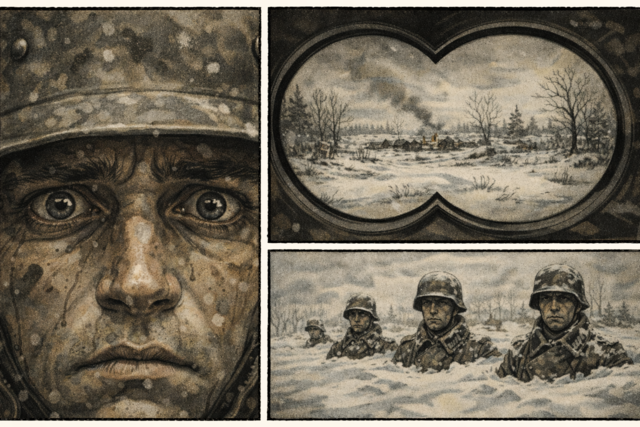


Original images designed within a narrative and fictional framework.
Then his tone hardened.
“Four days ago. March 13. The Kurgarten park. A prostitute. Zizi Schneider. Melchior’s signature. The park by the Ziegelwasser, that thin stream feeding the Rhin Tortu. I don’t need to spell it out for you.”
The meeting gathered force.
“Hermelin Wotan, that name must mean something to you. An exceptional SS Sturmbannführer. A hero of the Reich who carried the swastika to the far reaches of Asia.”
Untouchable. Brother-in-law to the Gauleiter. Stainless-steel German.
“Wotan was sleeping with the girl. The last time, something went wrong. Maybe she wanted more money. Maybe pervitin. Maybe anger. In any case, she ends up in the Kurgarten. I won’t describe the condition.”
“And Wotan?”
“Waiting. Somewhere safe in Strasbourg. The timing couldn’t be worse for Gauleiter Wagner.”
Outside, heavily loaded Wehrmacht trucks thundered past three floors below, shaking the building like a warning.
Egger stood by the window.
“Some say Wagner has pursued policies of his own. Against Berlin. Who knows. Discrediting a Reich hero is unacceptable. A prostitute in a park does not concern the Reich. Wotan says they quarreled. He slapped her. She cried. He gave her money. Nothing more.”
Silence seeped back into the room.
“And what do you think?” Gallenstein asked.
“The Gauleiter believes there is only one possible truth: the Sturmbannführer is innocent. Which leaves us Melchior. Convenient, isn’t it?”
“You think Melchior killed her?”
“I know he did.”
“And if he’s dead? Or fled to South America?”
“Then we find a Melchior. There are enough in our prisons. We want the perfect one.”
Egger turned back to him.
“There was no one but you for this job. Everyone calls you a traitor. They’d like to see you hanged. That makes you ideal. You’re finished — just like I am.”
The name finally surfaced.
Hélène Ascher-Laub. Gallenstein understood the meeting was over.
Hitler’s portrait loomed in the grand hall. Swastikas everywhere. Guards ignored him.
Outside, a dry cold gripped him from the inside out.
________________________________________________________________
*In 1943, the year in which what follows takes place, the Nazis had been present for four years in this city called Strasbourg. But since then, it has been learned that this city did not exist. Gallenstein, a French cop—rather tall, fat, flushed with rosacea, and slightly rotten-looking, as if he had once contracted syphilis (the tiny Doctor Marx had eventually put an end to that damn syphilis, with the tenderness of a nurse in love with her patient), had crossed over to Collaboration without hesitation. When the story begins, he is well fed and tightly packed into his elegantly tailored suit. Some twenty years earlier, he had enjoyed his moment of glory, during the case of“Melchior the Killer.” Never caught by Gallenstein. A mass murderer who never had the slightest complaint to make against the police. The author’s father, named Ruben Stutz, a gardener employed by an industrialist living on the Allée de la Robertsau, claims to have spoken once or twice with someone who might have been Gallenstein. A man who sometimes waited in the street before going upstairs when he was a few minutes early. It was on such occasions that the author’s father may have crossed paths with him. While waiting to be able to “go upstairs,” Gallenstein smoked a cigarette, but he coughed so violently that one might have thought he never smoked at all except during those brief waiting moments before “going up to see his SS friends.”
not the first time the courtyard of the Blue Cloud Building looks like it lost a fistfight with civilization from up there second floor, Gallenstein’s perch the royal balcony of broken dreams you can see it all. Been that way for over ten years.
eggs smashed flat yolks bleeding out like they just hired a publicist apples crushed to applesauce without the courtesy of a spoon. Chunks of meat real prima donna steaks sprawled naked across the cobblestones no longer hiding in yesterday’s newspaper, their indecency on full display. gallenstein knows the décor leftovers from last night. Delivery was, as usual, enthusiastic black-market enthusiasm, the kind that comes with muscle and no receipt.
he imagines the scene nazis swinging rifle butts the way a conductor swings a baton whack! The poor devils don’t stay vertical long. Gravity’s very persuasive these days.
he doesn’t know where to start his investigation maybe the visit to egger never happened maybe egger never happened maybe nobody happened.
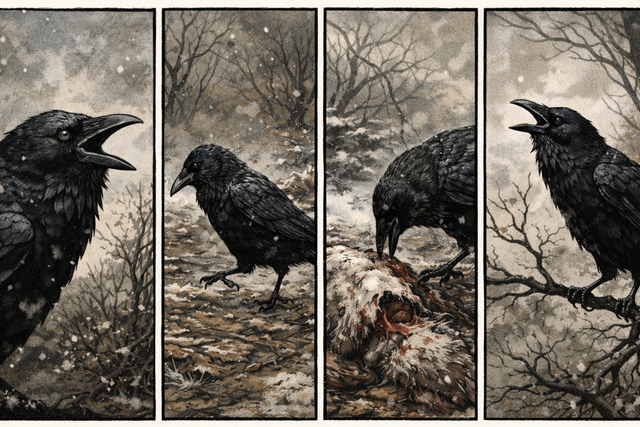
enter stage left three rooks.
big shots aristocrats of the gutter black uniforms shiny as SS parade boots stepping in little awkward hops like they’re afraid of dirtying their dignity.
KRR.
a few spectators at the windows not just collaborator cops some actual nazis too taking a five-minute vacation from brutality to let their minds wander as if the rooks have finally had it.
they start heckling.
KKRRÂÂKKKKRRRÂÂ KKRRRÂÂPPP
all they want is to get out of here.
and between you and me who says they haven’t seen the whole racket who says they haven’t been watching our little operations from the rooftops all along maybe they’ve got notes maybe they’ve got better notes than we do.
1995
No captagon. I’ll have to proceed without it and forget, for a moment, that I am not in Zurich. My heart is about to explode. Everything is fine. I am sweating like a horse. Climbing the hill—a movement I know well and that usually produces a certain enlargement of the soul, or something like that—may simply be the combined effect of vodka and amphetamines. The city lights flicker below. In the distance a large mass of water: a lake, unless it is already the Rhine.
I have the impression that at the top someone will hand me the photograph that was included in the file given to me by the men from Zurich. Or perhaps it is the one Hirsch—the notary, who seems to have been alive for centuries—will later place before me during our first meeting in Strasbourg, his old face emerging abruptly inside my delirium, the mouth tightened into something that might be called a smile. I listen carefully to what is being said:
“Mister Kettler, we have nothing more precise, but we are certain that the woman in the photograph is indeed Madame Ascher-Laub, president and majority shareholder of the Ascher & Laub Bank since 1932.”
I have not closed my eyes in what feels like centuries. The advantage, if there is one, is again mine. Give me the remaining files, however compromised they may be, and I will examine them methodically, in full view if necessary.
A striking woman. In the photograph she appears fragile, almost delicate, though this may be the result of restraint rather than fact. She does not allow her gaze to drift for even a second from the mechanical eye of the camera. She appears determined not to let the image extract anything from her.
I am going to vomit. This generally happens when I attempt to increase the tempo.
We will never know one another. I have always ensured that such inconveniences do not arise. You may insist, though I see no benefit in the exercise; I have nothing in particular to teach you. Let us proceed in order. By the time you first hear my name, I am fifty-four. A private investigator. I work independently, mostly for banks and insurance companies, preferably Swiss. For nine years I was largely bypassed by those who might have retained my services. It is possible that period is ending.
I have lived in Zurich for more than two decades. I was born in Strasbourg. And it is precisely to Strasbourg that my clients wish to send me. The assignment concerns a banker. More accurately, the task is to establish that she is deceased. They require a definitive document. A notarized act. It seems to me that asking an Alsatian to cut through the knot of an Alsatian story is a poor idea, although no one has asked for my opinion.
My name is Kettler. Peter Kettler. If I appear older than I am, this can be attributed to captagon and to WhiskyVodka, which has replaced whatever education I once possessed. I compensate by dressing with care. Anthracite suit. Half-moon glasses that suggest a certain intellectual seriousness. A face that might resemble Trotsky’s, had he been sustained too long by medication.
My immediate objective is to connect the recurring cycle—one might call it a carousel—that brings me into contact with improbable individuals, and the remainder of my existence. When I signed the contract, it was evident that I would soon have to step onto another carousel, entirely unfamiliar. I hoped only that it would not prove excessively infernal. Subsequent events would revise that expectation.
I see a man who dominates the frame. Hirsch stated that he possessed information. I believe I remember that. The narrative has already begun to shift its own outlines. Time does not align with itself. My heart rate is approximately one hundred and fifty. I am, apparently, at the beginning of something that resembles a new life.
To avoid attention, the meeting took place in an annex on the outskirts. A landscape of grease and fast food, a residual zone of the kind almost erased from present-day Zurich. In a future that may not be distant, when I can no longer tolerate pursuing Hélène Ascher, I may choose to pursue something else. The thought occurs intermittently.
“You understand what is expected of you, Mister Kettler. We place considerable expectation on the success of your work. This banker, who disappeared in 1968, remains a matter of the highest importance,” concludes the representative, who likely provided a false name. “It is, if you like, a file under tension.”
I do not require further detail. They will compensate me. They will consider the matter settled once they possess a document suitable for archiving. Order will be restored, at least on paper.
Hirsch’s voice continues internally: “That man is Gallenstein, the most prominent police officer in Strasbourg before the war. He never resolved his most significant case. Melchior—the killer of thirty individuals—has largely been forgotten. No one can say what became of Gallenstein. Perhaps he died in the 1950s. Perhaps suicide. He disappeared, like Melchior.”
I examine the photographs repeatedly. The woman may be Hélène Ascher. Reserved, measured—unless the restraint itself is strategic. It is possible she is indifferent to the questions others wish to impose upon her. It is not clear by what right we involve ourselves at all.
Locations overlap. Adjusting to this overlap proves difficult. Such confusions are usually confined to pulp novels or to minor American films now rarely screened.
“You know the rumor,” continues the voice speaking without external confirmation, as if it intends one day to restore every silhouette it invokes. “They say Gallenstein and she grew up together. Survivors, both of them.”
I remain uncertain whether this information was provided by the men from Zurich or constructed afterward. The stimulants interfere with continuity. They interfere with most things. Nonetheless, I remain functional. In an hour, perhaps two, I will sit on a curb. The sort no longer designed, curbs once intended to permit the steady flow of ordinary life.
I descend too quickly to observe Hélène Ascher clearly in her office. The stimulants distort distance. She signs documents. Her dark blue suit, reminiscent of formal mourning, establishes a barrier. She does not look up.
What are you searching for? Is the question even coherent? It may take years to accept that there is nothing to recover. The voice that accompanies me offers this conclusion without emphasis.
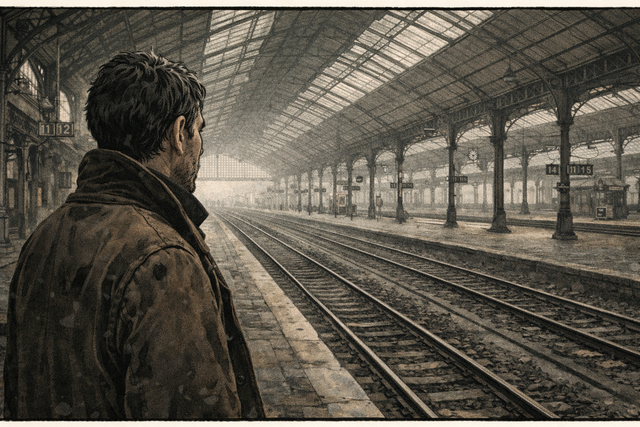
I imagine myself crossing the deserted hall of Strasbourg’s train station, an immense structure left in partial neglect. The air contains a metallic odor. It feels dense, though perhaps that is subjective. A man, visibly agitated, positions himself in front of me.
“Where did you come from? Are you trying to trigger something?”
I prefer that he remain at a distance.
“I haven’t seen you here before. If I decide to sell you something worthless, I won’t hesitate.”
At last I vomit. The physical reaction stabilizes me. The episode, for the moment, concludes.
DOCUMENT TO BE ADDED TO THE FILE: Undated Letter
When I saw you recently, you asked me to speak about my brother. You wanted to know whether I still remembered those very old stories. Yet I never concealed from you that, between my brother Jacob and myself, that past was rarely discussed. During the years of the Occupation I believe I saw him only two or three times. Perhaps he intended to spare me, since I allow myself to remind you that we are Jews, bound at a distance by the daily fear that prevailed during the years of Nazi power in Alsace. That was sufficient. I was aware that he benefited from a certain protection from the Nazi authorities, what at the time was referred to as a Schutzstellung.* You know how precarious that entire arrangement was. If you were Jewish in those days, you remained Jewish regardless of circumstance. I did not know then, and do not know now, which Jewish grandparents were counted against us.
You ask whether he had contacts with the policeman named Gallenstein, a figure remembered for unfortunate reasons. I must be frank: my memory fails with some regularity. When I think of that period, what returns first is not clarity but the fact that I lied often, that we all lied, that concealment became habitual. We lied for fifty years afterward. It became a second nature. How, then, should one speak now? You are ninety, Master Hirsch; I am eighty-two. Our turn will come soon enough. You expect certain things from me. Not everything. Why should one say everything? Jacob died in 1967. He smoked too much. Everyone smoked too much.
Yes, he told me things. Perhaps he had decided to confess at last. Apart from myself, and probably Gallenstein, he spoke of this matter to no one else, and I am convinced he never wrote a line about it. Not a word. I will attempt to recount what he told me; afterward you must make what use of it you can. You are a notary. I have nothing to teach you.
In 1943—if I understand correctly, that is the year that interests you—Jacob was living on Rue de Bouxwiller, called Buchsweiler-Strasse at the time, behind the violated synagogue. It was a vast apartment on the third floor. I have forgotten the exact address. Perhaps I never knew it. He treated everyone, the poor and, on occasion, officers of very high rank. SS. Wehrmacht. Primarily the uniform, one might say. For delicate procedures. Jacob was known, if such words are permissible, as a specialist in syphilis. Two Jewish grandparents were sufficient to place one on a list of future hangings, whenever they chose to consult it. Not sufficient for immediate deportation in the case of men like Jacob who had secured certain protections.
Forgive me if the chronology appears confused. It is difficult to impose order now. You will have understood by this point that I did not care much for my brother. That is why I hesitate to speak of him. Even today I fear that in doing so I may lose restraint. I harbor grievances whose exact wording escapes me. But that is not what you wish to hear.
I must speak of Dr. Schweickart. A Wehrmacht officer. Knowing Jacob, he must have recounted to the Wehrmacht, and to anyone disposed to listen, the details of the treatments he provided to SS officers. The infirmities of those men were not unknown to their colleagues. Schweickart served in forensic medicine. The military authorities—among others—spent their days cataloguing bodies: bombing victims, anonymous civilians, soldiers returned from the various fronts and treated in Strasbourg. The Germans recorded everything. Even minor acts required annotation. Reports accumulated in files.
One day, in the spring of 1943, perhaps March or April, Schweickart approached Jacob with what he described as an unusual case. Plainclothes agents—possibly from a service linked indirectly to the SS, not merely Gestapo functionaries—had delivered a body. Early March 1943. A young woman. Approximately twenty-five or twenty-six. Identified in the accompanying documentation as a prostitute. Found in a park.
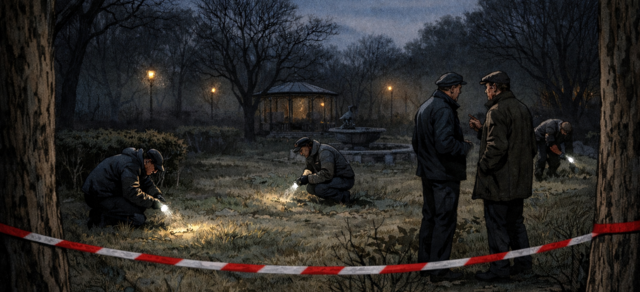
The Kurgarten. You know the strip of grass near Neudorf. Yes, that park. According to Schweickart: strangulation. He examined the body. Wrote his report. Strangulation. What I recount now is only what Jacob retained. He may have embellished nothing. He rarely dramatized such matters.
What followed was less clear. The body disappeared from the morgue. Misplaced. Removed. For less than forty-eight hours. No authorization. Simply absent. One could imagine such a disappearance in the Neue Reichskanzlei*** in Berlin. In a small military morgue it was less comprehensible. The body later reappeared in its drawer.
Schweickart observed additional injuries that had not been present before. Incisions over the neck, superimposed upon the original marks of strangulation. Tissue removed. Clean cuts. Limited swelling. No significant surrounding bruising. Stagnant blood, though minimal. I repeat these descriptions only because Jacob insisted upon precision, and I have retained what I could. Forensic anomalies, he called them.
There were also injuries to the shoulders and breasts. Portions of flesh appeared to have been removed. Whether by instrument or otherwise remained uncertain. Schweickart produced sketches. The barracks possessed no photographic equipment suited to the task. He measured what he could. He did not initially use the term cannibalism, though it entered his thoughts. He seemed disturbed by that possibility.
Was it conceivable, he asked Jacob, that someone might do such a thing? I cannot reconstruct the tone. Years later the story returned to me. It suggested either derangement or orchestration. A person with access to a Wehrmacht morgue, or someone able to manipulate access. Someone capable of exploiting disorder. Someone of high position, perhaps. It is difficult to speculate responsibly.
According to Jacob, a name circulated in connection with the matter: Hermelin Wotan, brother-in-law to Gauleiter Wagner. Temporarily detained. Protected. Arrested, though not as an ordinary criminal. It was suggested—never formally—that he might have been involved. Nothing was proven. The atmosphere in those years did not encourage clarity.
Rumors resurfaced regarding Melchior, the killer long thought gone. Gallenstein, once informed, rejected the possibility that Melchior could be implicated. He told this to Jacob. In doing so he assumed a degree of risk. How many false Melchiors could be produced when necessary? The authorities required only a suitable suspect. The chain of command within Schweickart’s department may have known more than they disclosed. Dissension may have existed. Such matters are difficult to verify.
Jacob told me that Gallenstein did not appear surprised by any of it. On more than one occasion he took refuge in Jacob’s apartment during episodes related to the late consequences of syphilis. They had an arrangement. Professional. Perhaps more complex. I will not elaborate. During one such visit he told Jacob: “You must forget this. Never speak of it again.”
Why recount it now? Because time imposes its own settlement. I have not heard the term cannibalism applied to that case since. I do not know whether there was manipulation, staging, or simple hysteria. A few days later Gallenstein was arrested. Jacob never mentioned his name again. I too had nearly forgotten it. I never learned whether he died of illness or of the war.
* Schutzstellung: an informal administrative measure temporarily shielding an individual. ** Gehinnom: in Jewish tradition, a place associated with judgment and purification rather than eternal damnation. *** Neue Reichskanzlei: the new Reich Chancellery in Berlin. **** Mischling ersten Grades: a racial classification under Nazi law, indicating a person of mixed Jewish ancestry subjected to severe restrictions. ***** Likely the artillery barracks situated in Neuhof.









![[Moving to Galatea] What We Never Healed](https://cdn-gcs.inkitt.com/vertical_storycovers/ipad_b00b828931c645f2eccdf3396cb15498.jpg)