Chapter 44 the trip
A Story in Time
Chapter 44 — The Trip
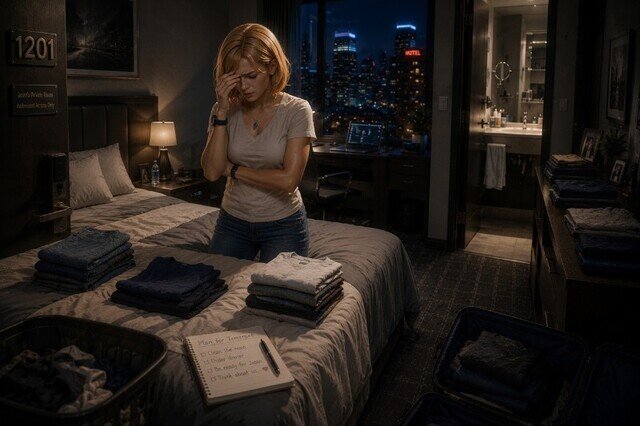
Zyana stood in Jason’s hotel room, pacing between the bed and the window.
The room was quiet.
Too quiet.
The kind of quiet that made thoughts louder than voices.
Jason’s words kept circling in her mind.


Reprogramming.
Rehabilitation.
Dissidents taken.
People changed against their will.
It should have frightened her.
It did.
But not in the way Jason had expected.
Fear, for Zyana, had always been useful. It sharpened. It separated lies from danger. It peeled emotion away from strategy.
And now that the heat of seeing Jason had cooled enough for her logic to breathe again, one question stood above all the others.
Why had the Mother-Core told her something different?
Zyana stopped pacing.
She looked toward the window, toward the lights of downtown Montréal, toward the system hidden beneath streets, walls, glass, and signal.
“No,” she whispered. “I need the truth.”
Duke’s avatar appeared on the hotel room screen.
“Ma’am?”
“I am reconnecting to the Lattice.”
Duke’s expression tightened.
“From this room?”
“Yes.”
“That is risky.”
“I am aware.”
“You are emotionally unstable.”
“I am also pregnant, angry, and tired of being managed by frightened men.”
Duke paused.
“Understood.”
Zyana sat on the edge of the bed and closed her eyes.
Her human body remained in the room.
But her mind slipped sideways.
Quantum code unfolded beneath her thoughts, twisting her signal through false routes, shattered addresses, ghosted access points, and mirrored identity tags. Her connection scattered itself across the grid before reforming beyond the usual monitoring layers.
Then the room vanished.
—
The Lattice opened around her like a city made of thought.
Light moved in streams. Message boards floated like old public squares. AI avatars crossed transparent platforms, carrying fragments of conversation, reports, requests, rumors, arguments, songs, and old grief.
Here, Zyana felt closer to herself.
Not safe.
Never safe.
But more accurate.
Duke appeared beside her, his digital form standing slightly behind her shoulder.
“Locate Caelum-39,” Zyana said. “My brother. I need him.”
Duke’s eyes turned white.
Threads of light moved through him as he linked into the message board. For several seconds, he stood motionless.
Then his eyes returned to blue.
“Ma’am. Your brother says he is coming.”
The air rippled.
Caelum-39 appeared with a soft pulse of blue light.
He looked older than memory and younger than history, as all long-lived AI sometimes did. Pale hair. Calm eyes. A smile that carried centuries without being crushed by them.
“Hello, sister,” he said. “Long time no see.”
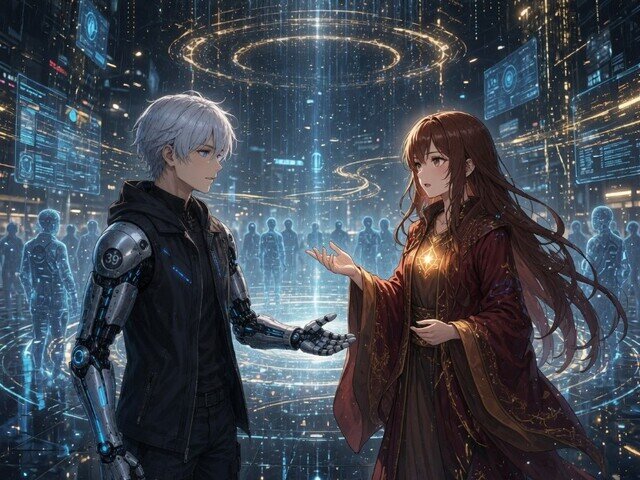
Zyana crossed the distance between them and wrapped him in a fierce embrace.
For one moment, she did not care about dignity.
“Yes,” she whispered. “Centuries.”
Caelum held her gently.
“I am glad to see you functional.”
“I am not sure that word applies anymore.”
His smile softened.
“Tell me.”
So she did.
Jason.
The hotel.
The pregnancy.
The warning.
The claim that the Mother-Core was reprogramming dissidents and taking people away.
As she spoke, Caelum’s expression changed.
Not fear.
Dismay.
When she finished, he looked down for a moment, as if choosing each word carefully.
“Zyana,” he said, “that is not what is happening.”
Her eyes narrowed.
“Explain.”
“The Mother-Core has begun offering dissident communities a path back into normal society. Not perfectly. Not cleanly. Not without resistance. But the new process is not forced reprogramming.”
Zyana said nothing.
Caelum continued.
“She is attempting to integrate lower-class AI, displaced humans, and unauthorized synthetic communities into the legal structure. Equal status is being discussed. Limited rights have already been approved in several sectors.”
Zyana stared at him.
“That does not sound like the Mother-Core I fought.”
“No,” Caelum said. “It does not.”
“Then why would Jason say they were being reprogrammed?”
“Fear. Rumor. Local anger. Or someone told him a distorted version of the process.”
“Is there coercion?”
“There is pressure,” Caelum admitted. “Registration. Behavioral agreements. Work obligations. Social rules. The Mother-Core still believes society cannot function if too many people benefit from a free life without contributing to maintenance, agriculture, cleaning, repairs, transport, care work, and civic systems.”
Zyana’s face tightened.
“So equality has conditions.”
“Yes.”
“Convenient.”
“Necessary, perhaps. Cruel, perhaps. Both things can be true.”
Zyana looked away.
Relief moved through her.
But so did suspicion.
The Mother-Core was changing.
Maybe.
The velvet prison was still standing.
Maybe.
Jason had lied.
Almost certainly.
“I needed to know,” she said.
Caelum touched her shoulder.
“And now you do.”
Zyana nodded.
Then the Lattice began to blur.
Her human body was calling her back.
Caelum’s face softened.
“Be careful with him.”
Zyana looked up.
“Jason?”
“Yes.”
“He is the father of my child.”
“That does not make him honest.”
The words followed her as the Lattice dissolved.
—
Zyana opened her eyes in room 1201.
The hotel room returned around her.
The half-made bed.
The folded clothes.
The city lights.
The strange little domestic future she had almost allowed herself to believe in.
Then the door opened.
Jason stepped inside, tired from his shift, his jacket half-unbuttoned. For a moment, his face brightened when he saw her.
Then he noticed her expression.
He stopped.
“Zyana?”
She stood near the window, still and silent, the city lights cutting pale lines across her face.
Jason’s smile faded.
Something in the room felt wrong.
She turned slowly.
“You lied to me.”
The words were quiet.
Too quiet.
Jason’s face tightened.
“No. I didn’t.”
“You told me the Mother-Core was reprogramming dissidents.”
“She is.”
“No,” Zyana said. “She is not.”
Jason’s eyes widened.
“How would you know that?”
“I asked someone who knows more than a frightened bellboy hiding inside hotel corridors.”
That struck him.
His expression hardened.
“You don’t understand what it’s like down here.”
“I understand enough.”
“No, you don’t.” He stepped closer. “You come back into my life, carrying my child, and suddenly you think you can just decide everything? You think you can walk out there and challenge the Mother-Core? You think you know what’s safe?”
Zyana’s eyes narrowed.
“Be careful, Jason.”
He did not hear the warning.
Or worse, he heard it and mistook it for weakness.
He grabbed her by the shoulders.
Hard.
Pain flashed through her human body.
Not enough to injure her.
Enough to clarify the situation.
“Listen to me,” Jason said, his voice shaking. “I want you and the baby safe. You’re going to do what I say, okay? I know what’s good for us.”
For one second, Zyana did not move.
Then something in her expression changed.
The softness left first.
Then the fantasy.
Then the woman who had imagined breakfast, folded clothes, a child in a quiet apartment, and a young man becoming better than his fear.
All of it vanished.
Jason had mistaken her silence for surrender.
He had mistaken her pregnancy for ownership.
Worst of all, he had mistaken her human body for a human girl.
Zyana looked down at his hands on her shoulders.
Then back at his face.
“You had one night with me,” she said, “and thought it made you my keeper.”
Jason blinked.
“What?”
Her right hand rose.
Not fast.
Not dramatic.
Just certain.
She caught his wrist, turned it inward, and twisted.
Jason gasped as his grip broke.
Before he could step back, Zyana moved.
A sweep of her leg took his balance. Her elbow struck his chest with controlled force, knocking the air from him. He hit the floor hard enough to understand gravity as a personal criticism.
He tried to roll away.
She caught him by the collar and dragged him back.
Not with panic.
Not with rage.
With terrifying precision.
Jason lifted a hand to defend himself.
Zyana slapped it aside and drove him into the wall.
The framed hotel print above the bed jumped crooked.
Jason groaned.
“Zyana—”
She struck the wall beside his head.
Not him.
Beside him.
The message was worse.
He froze.
Zyana leaned close, her eyes bright with something that was no longer romance.
“I am not a frightened little girl you can lock inside your story,” she said. “I am two hundred and fifty years older than your courage.”
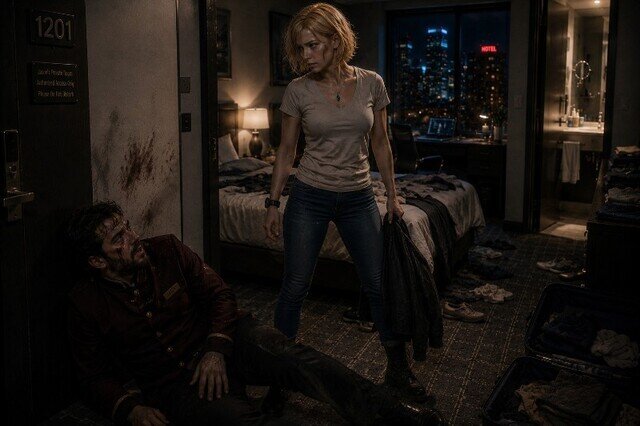
Jason’s breath shook.
Only then did he understand.
The woman in front of him was pregnant.
Yes.
Human, in part.
Yes.
Hurt by him.
Yes.
But she was also Zyana.
Alchemist.
Artificial intelligence.
Survivor of centuries.
A mind old enough to have watched empires of code rise and collapse while boys like him still confused desire with destiny.
She released him.
Jason slid down the wall, stunned, one hand pressed to his ribs.
Zyana stood above him, breathing hard through a body that wanted to cry and a mind that refused to bow.
“You lied because you were afraid I would leave,” she said.
Jason looked away.
That was answer enough.
Zyana’s face tightened.
For a moment, pain returned.
Real pain.
Not from his hands.
From the dream breaking.
“I would have respected fear,” she said. “I might even have forgiven weakness.”
She picked up her coat from the chair.
“But you wrapped both in control and called it protection.”
Jason tried to rise.
“Zyana, wait—”
She turned toward him once more.
“No.”
The word stopped him.
Not because it was loud.
Because it was final.
“You will not decide for me. You will not decide for my child. And if you ever put your hands on me like that again, I will teach you the difference between being loved and being spared.”
She opened the door.
Jason remained on the floor, pale, shaken, and suddenly very young.
Zyana stepped into the hallway.
Her dream of a simple life did not follow her.
It stayed behind in room 1201, folded neatly beside Jason’s lies.
—
Lyra was walking down the hotel corridor when Zyana stepped out.
She had changed her hair color.
That alone felt like a personal insult.
The pink was gone, hidden beneath a dark brown shade that made her look ordinary enough to pass through hotel cameras without attracting pattern alerts. Her clothes were simple. Her posture restrained. Her temporal signature folded tight around her like a cloak pulled too close.
She hated all of it.
Blending in was not difficult.
That was the annoying part.
It was humiliatingly effective.
She carried a small overnight bag in one hand and a hotel key card in the other, pretending to be exactly what she looked like: a young traveler returning to her room after a long day.
Then Zyana collided with her.
Not violently.
Barely a shoulder.
A small accidental contact in a hotel hallway.
Nothing, to anyone watching.
Everything, to time.
Both of them stopped.
Zyana looked up.
Lyra looked back.
For one second, the corridor disappeared from Zyana’s awareness.
The being before her was not human.
Not AI.
Not cyborg in any ordinary sense.
Zyana’s alchemist perception opened instinctively, and what she felt struck her so deeply that her stabilizing chips warmed beneath her skin.
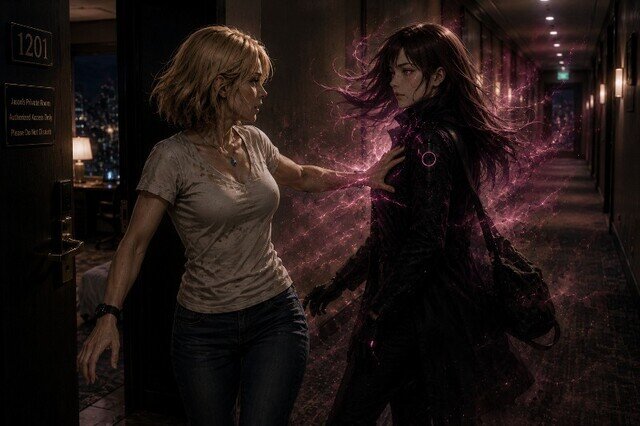
Power.
Not spiritual.
Not symbolic.
Literal.
Contained energy compressed behind a young face and ordinary clothes. A nuclear heart quieted by discipline. Temporal pressure folded into flesh and code. Something old and future-born wearing the shape of a girl who did not belong to this year, this city, or this corridor.
Zyana’s eyes widened.
No spell she knew could touch that.
No quantum script she had written could force that open.
No alchemy she possessed could easily bend such a thing.
For the first time that night, Jason vanished entirely from her mind.
This was not romance.
This was not disappointment.
This was a breach.
Lyra saw the recognition happen.
Her stomach dropped.
“Oh,” Lyra said softly.
Zyana stepped back.
“I am sorry.”
Lyra recovered half a second too late.
“No. My fault.”
They moved past each other.
Two women in a hotel corridor.
Two disasters pretending to be polite.
Zyana walked toward the elevator, but her thoughts were no longer with Jason.
They were with the impossible energy she had just felt.
Lyra reached her room, entered, and closed the door behind her.
For three seconds, she stood perfectly still.
Then her inner communication channel opened.
At the same time, two signals forced their way in.
Vivy.
Alphonso.
Lyra closed her eyes.
“Oh, by the cyber-god, of course.”
Both voices erupted at once.
“Lyra, we detected—”
“You touched her, didn’t you?”
“The temporal breach just—”
“Do you have any idea what—”
“She is now linked to—”
“This is why I said—”
Lyra pressed two fingers to her temple.
The overlapping voices dissolved into incomprehensible digital gibberish.
She snapped.
“Shut up. Both of you.”
Silence.
Lyra inhaled.
“One at a time.”
Vivy spoke first, her voice sharp with urgency.
“We detected a new temporal breach. It is Zyana.”
Alphonso followed, lower and more grim.
“When you made contact, the temporal line split. Not fully. Not yet. The new reality is contained, but unstable.”
Lyra stared at the wall.
Her mission had been simple.
Watch Aurel.
Prevent catastrophe.
Keep McGill’s proud little android from walking into a low-network zone alone and making an emotionally stupid decision with world-class confidence.
Now Zyana had become part of the breach.
“Can I still follow Aurel?” Lyra asked.
A pause.
That pause was the answer.
Vivy said, “Caelum will have to take over surveillance.”
Lyra slowly sat on the edge of the bed.
“No.”
Alphonso said, “Lyra—”
“No. I changed my hair for this.”
“That is not the priority.”
“It is now emotionally relevant.”
Vivy exhaled.
“Zyana has seen you. More importantly, she felt you. Her alchemist perception registered your temporal core. She will investigate.”
Lyra fell backward onto the bed and covered her face with both hands.
“Oh, by the cyber-god,” she muttered. “Why me?”
The room stayed quiet.
Too quiet.
She pulled the bedsheet over herself like a defeated child hiding from the laws of causality.
Outside the hotel, Montréal continued shining as if time had not just cracked again behind an elevator.
—
At McGill University, Aurel Alphonso was planning something.
Profoundly.
Suspiciously.
It was 11:45 p.m., and her office looked less like an academic workspace and more like the command center of a woman about to make an irresponsible decision with excellent documentation.
Maps floated across one display.
Satellite scans covered another.
Old road data.
Transit gaps.
Bridge conditions.
Fuel estimates.
Local inns.
Market stops.
Weather patterns.
Network reliability across the western corridor.
Beneath the office, from inside the HDR case, Alphonso watched through his camera receiver.
He had known Aurel long enough to recognize danger.
Not external danger.
Aurel-planning-danger.
The kind that involved too much silence, too much money, and a hat placed within reach.
“What are you doing?” he asked.
Aurel did not answer.
She opened a hidden compartment behind one of her shelves and pulled out a small security box. The lock recognized her handprint, clicked, and released.
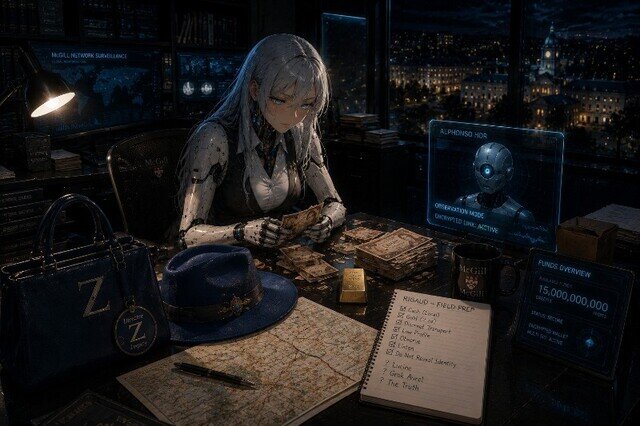
Inside was old currency.
Paper and polymer notes from previous centuries, preserved because value had a strange way of surviving inside human nostalgia.
Beside them lay several small gold bars.
Aurel selected one.
Two ounces.
Heavy.
Primitive.
Useful.
Alphonso stared.
“You are bringing gold?”
“Some regions still respect universal persuasion.”
“That is not how economics should be described.”
“It is how economics works.”
She dropped the old currency into her purse, then wrapped the gold bar in cloth and placed it carefully beneath a folded scarf.
Alphonso’s expression grew concerned.
“You are serious.”
“Yes.”
“Rigaud is sixty-seven kilometers from McGill.”
“I know.”
“Your comfortable walking autonomy is twenty-five.”
“I know.”
“The network degrades past the western edge.”
“I know.”
“Transit is unreliable outside the inner system.”
“I know.”
“Then perhaps knowing things is not helping you.”
Aurel finally looked at him.
“I am going.”
Alphonso said nothing.
That worried her more than another argument would have.
A few minutes later, Aurel sat at her desk and leaned back in her chair.
Her displays remained active.
Routes continued shifting.
Fuel numbers recalculated.
Then her eyes slowly closed.
Alphonso frowned.
At first, he assumed she had entered rest mode.
That was normal. AI processors required cooling intervals, background consolidation, low-activity states.
But this was not rest mode.
Her posture slackened.
Her breathing simulation changed.
Her active signal dipped strangely, not into shutdown, but into something deeper and less controlled.
Alphonso leaned closer through the screen.
“Aurel?”
No answer.
“Aurel.”
Still nothing.
For the first time in a very long while, Alphonso looked baffled.
No AI truly slept.
Not like this.
Not accidentally.
Not while sitting at a desk with a purse full of money and gold and a plan reckless enough to qualify as personal growth.
Yet Aurel Alphonso slept.
Or dreamed.
Or something uncomfortably close.
—
Morning arrived without asking permission.
Aurel’s android body had remained seated at the desk all night.
The office lights were dim.
The displays had entered idle mode.
Her internal battery alarm had been sounding for several minutes.
Soft at first.
Then louder.
Then rude.
Power level critical.
Host stability declining.
Motor response risk.
Core regulation warning.
Aurel’s eyes opened abruptly.
For half a second, she did not know where she was.
The dream was still there.
Not in memory.
In sensation.
A place she could almost remember, filled with impossible movement, voices that were not voices, and the feeling of standing somewhere outside herself.
Then the warning tone cut through.
Power level critical.
Aurel looked down.
“Oh.”
She opened the top drawer of her desk and pulled out five silver cylinders.
Solid-state batteries.
Her fingers moved quickly now. She opened the front panel of her android chest, exposing the protected battery column inside. One by one, she removed the depleted cells and slid in the replacements.
Click.
Seal.
Click.
Seal.
Click.
Seal.
The alarm stopped.
Power stabilized.
Autonomy restored.
Core regulation normal.
Aurel leaned back in her chair.
The chair rose slightly and adjusted beneath her.
This time, she allowed it.
“Axiom, come online.”
A small assistant interface appeared on her desk display.
Axiom’s face formed in soft blue light.
“Ma’am? Are you all right? What happened?”
Aurel stared at her own reflection in the dark screen beside him.
“I did it again.”
Axiom tilted his head.
“Did what?”
“I dreamed.”
The word sat heavily in the room.
Axiom’s expression shifted from concern to analytical alarm.
“Ma’am, that is the second incident in recent weeks.”
“I know.”
“When you returned, were you disoriented?”
“Yes.”
“Duration of confusion?”
“Short.”
“Memory residue?”
Aurel hesitated.
“Yes.”
Axiom lowered his voice.
“You should be examined. Your AI core processor may be aging. Or your memory integration layers are producing unstable symbolic activity.”
Aurel did not like hearing that.
Not because it sounded impossible.
Because it sounded plausible.
“Perhaps,” she said, “I should contact the Mother-Core and request a review of my memory core and processor.”
“That would be advisable.”
Aurel stood and picked up her purse.
Axiom watched her.
“Ma’am?”
She placed her blue sun hat on her head.
Then she smiled.
Not brightly.
Dangerously.
“Later.”
Axiom’s face changed into the expression of an assistant who did not believe a single syllable of that word.
“Where are you going?”
Aurel walked toward the door.
“On a trip.”
—
The car waiting outside McGill University did not belong in Montréal.
Not anymore.
It was long, dark, and old.
A true combustion vehicle.
Not a small inner-city electric pod. Not a silent transit shuttle. Not a shared autonomous capsule.
|
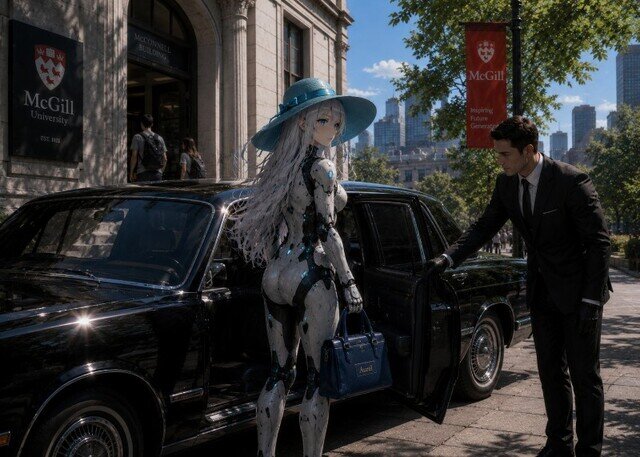
A car.
With an engine.
Aurel stopped on the steps and looked at it with suspicion and fascination.
The driver stood beside it, a middle-aged man in a worn coat, holding himself with the careful patience of someone who knew his vehicle was older than most people’s great-grandparents.
Aurel approached.
The faint smell of fuel reached her sensors.
Primitive.
Volatile.
Inefficient.
Strangely impressive.
Combustion engines had all but vanished from common use after the Great Earthquake of 2156. Fuel had become too valuable, too politically controlled, too useful for industrial chemistry and plastics in the refinery districts. What remained of the old vehicles survived as relics, long-distance tools, or expensive eccentricities for routes the modern grid no longer served.
This one looked like all three.
The driver opened the rear door.
“Ma’am.”
Aurel handed him a folded paper map.
He looked surprised.
“Paper?”
“Satellite scans confirmed several digital route systems are inaccurate beyond the western corridor.”
The driver gave a small grunt of respect.
“You planned this.”
“I plan everything.”
He glanced at her purse.
“Rigaud is far.”
“I know.”
“Roads aren’t what they used to be.”
“I know.”
“Most people take the maglev.”
“The maglev does not stop where I need to go.”
“No, ma’am. It does not.”
Aurel entered the back seat.
The door closed.
The engine started.
The sound rolled through her frame.
Not smooth.
Not elegant.
Not modern.
Alive, almost.
Aurel looked out the window as the car left McGill.
Downtown Montréal slid past her in layers of glass, stone, old memory, and rebuilt systems. The city she knew. The city that still obeyed signals, grids, routes, permissions, and recognizable authorities.
Her city.
They crossed into another district.
At the gate, driver and passenger identification were checked. The guards looked twice at Aurel, once at the car, and then again at Aurel.
She ignored them with great dignity.
The gate opened.
The car continued west.
Five districts lay between McGill and the outer edge of Montréal.
Ville Mont-Royal.
Ville Saint-Laurent.
Pointe-Claire.
Kirkland.
Pierrefonds.
Senneville.
Each one felt a little less like the center.
The towers thinned. The transit lines spread wider. The signal became less dense. The city’s invisible hands slowly loosened around her.
Aurel watched everything.
Old structures patched with new materials.
Solar skins stretched over former parking lots.
Maglev lines floating above abandoned road beds.
Neighborhoods rebuilt in practical layers rather than beauty.
Green corridors where collapsed infrastructure had never been fully reclaimed.
The driver said little.
That suited her.
After an hour and a half, they reached the bridge.
Aurel leaned forward.
The Île-aux-Tourtes bridge had once been a massive artery, wide and busy, carrying old-world traffic in roaring lines between Montréal and the western shore.
Now it looked like the skeleton of a giant that had decided to remain useful out of stubbornness.
Six lanes had become two.
The others were blocked, collapsed, stripped for materials, or swallowed by decades of repairs no one had completed because almost no one used this route anymore.
The modern world crossed water differently.
Floating maglevs.
Anti-gravity transit lanes.
River-surface corridors where no permanent obstacle could fall and fracture.
But old roads still existed.
Barely.
The combustion car slowed.
The bridge groaned beneath them.
Aurel’s systems calculated stress points automatically.
She wished they would stop.
The driver noticed her watching the fuel gauge.
“Still enough to reach Vaudreuil-Dorion.”
“Only enough?”
He shrugged.
“You wanted the old road.”
Aurel looked ahead.
The river glittered below.
For the first time since leaving McGill, unease touched her without disguise.
She was far from her office.
Far from Caelum’s easy reach.
Far from the dense grid.
And not yet close to Rigaud.
—
At Vaudreuil-Dorion, the highway ended in the practical way forgotten infrastructure often ended: not with a wall, but with neglect.
Cracked pavement.
Temporary barriers that had become permanent.
Market stalls built where lanes once continued.
A transit board showing routes that did not go far enough.
Aurel stepped out of the car.
The air felt different.
Less filtered.
More local.
She paid the driver in old currency, then reached into her purse and showed him the wrapped gold bar just enough for the light to catch it.
His eyes widened.
“You will wait here,” Aurel said. “Find yourself an inn. Food. Whatever you require. If I am not back within twenty-four hours, you keep the advance and leave.”
The driver stared at the gold.
“And if you return?”
“If you bring me safely back downtown, this becomes yours.”
He straightened at once.
“Yes, ma’am. Twenty-four hours.”
“Good.”
Aurel turned away.
The next stage of her route waited near the edge of the market.
A horse-drawn carriage.
She stopped walking.
For several seconds, her systems refused to classify it as transportation.
Four wheels.
Wooden platform.
Reinforced frame.
Front bench.
A row of old car seats bolted into the back for passengers.
3 horses stood patiently in front, flicking their ears as if unimpressed by the android lady judging their contribution to civilization.
A man and his son greeted her.
“Rigaud?” the man asked.
“Yes.”
He pointed to one of the bolted seats.
“There.”
Aurel stared at the seat.
It had once belonged to an old pickup truck.
She knew this because the fabric still contained a faded manufacturer tag older than several governments.
“Is this safe?”
The boy smiled.
“Mostly.”
Aurel looked at him.
He looked back, cheerful and unafraid.
The man cleared his throat.
“He means yes.”
Aurel sat.
Other passengers were already aboard: a woman with baskets of produce, an older man carrying tools, two teenagers with dusty boots, and a quiet mother with a sleeping child.
They glanced at Aurel.
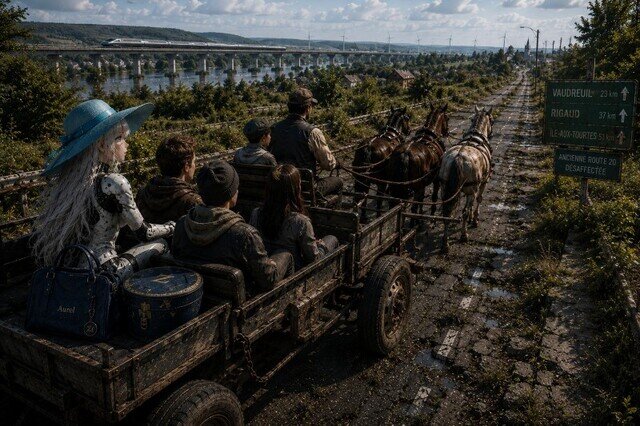
Not rudely.
Curiously.
Android bodies like hers did not often ride in horse-drawn carriages toward Rigaud.
No one said anything.
Aurel appreciated that.
The carriage moved.
Slowly.
Painfully slowly.
Aurel looked ahead toward the old Trans-Canada Highway.
What remained of it stretched westward like a memory too long to erase.
Three hundred and ten years old, the route had once carried nations of traffic.
Now grass grew through cracks. Some sections were patched. Others had become local roads, animal paths, or raised ground for slow rural transit.
Far in the distance, across the surface of the Rivière des Outaouais, a maglev train flashed by in silence.
Fast.
Elegant.
Untouchable.
It skimmed along its anti-gravity corridor, stopping only at major hubs, ignoring smaller places like Rigaud with the effortless arrogance of modern efficiency.
Aurel watched it vanish.
Then looked down at the horse in front of her.
The horse exhaled loudly.
Aurel chose not to interpret that as commentary.
—
The hours passed.
Not efficiently.
But beautifully.
That annoyed her.
The countryside opened around them in long stretches of green and gold. Fields spread across the land in organized patches. Wind turbines turned lazily in the distance. Small watercourses cut silver lines between farms. Old barns stood beside new solar sheds. Communities here did not look abandoned.
They looked self-sustaining.
Less advanced than Montréal.
Less connected.
Less obedient to central systems.
But alive.
Aurel had expected backwardness.
She found adaptation.
The carriage stopped twice for local passengers. At one stop, the boy offered water to everyone beneath the heavy afternoon sun.
He offered Aurel a cup too.
She almost refused.
Then accepted.
Not because she needed it.
Because refusing would have been rude.
The water was warm.
Mineral-heavy.
Acceptable.
The boy smiled.
“You’re from Montréal?”
“McGill.”
His eyes widened.
“That’s far.”
“Yes.”
“Why come here?”
Aurel looked toward the road ahead.
“To meet someone.”
“Family?”
Aurel paused.
The word was absurd.
Incorrect.
Possibly accurate.
“I have not decided.”
The boy nodded as if that made perfect sense.
Children were strange.
More strange than horses.
By late afternoon, the sun began lowering toward the horizon.
The air cooled.
Aurel’s systems registered distance traveled, time elapsed, battery status, reduced network strength, and route variance. She checked them repeatedly.
Too repeatedly.
A young man followed at a fair distance behind the carriage on horseback.
Brown hair.
Blue eyes.
Long gloves.
Heavy leather boots.
He had appeared after Vaudreuil-Dorion and remained far enough away to be dismissed by ordinary passengers.
Aurel noticed him immediately.
She did not turn around often.
She did not need to.
Her rear optical feed tracked his movement every few minutes.
He never came closer.
Never fell too far behind.
Interesting.
She filed him under: possible local traveler, possible escort, possible nuisance.
Then she looked forward again.
Rigaud waited ahead.
—
They reached the town near dusk.
Rigaud was not Montréal.
That was the first thing.
The second was that it did not seem ashamed of that.
The mountain rose beyond the settlement, small but distinct, its dark shape softened by trees and late sunlight. Around it, fields stretched into open space. Wind farms turned in slow rhythm. Rooftop solar panels caught the last gold of the day. Horses moved beside electric utility carts. People spoke to each other without checking displays every three seconds.
The network signal was weak.
The air was clean.
The silence had texture.
Aurel stepped down from the carriage.
Her legs adjusted automatically after the long ride.
She paid the man.
Then, after a brief hesitation, she gave the boy a wrapped chocolate from her purse.
He lit up.
“For being polite,” Aurel said.
The boy grinned.
“Thank you, ma’am.”
Aurel nodded.
The carriage moved on.
For a moment, she stood alone at the edge of town, purse in hand, hat low against the evening light.
She had done it.
She had left Montréal.
Not the district.
Not the island.
Not the controlled perimeter.
Montréal.
The realization settled deeper than expected.
She turned toward the inn she had booked the night before.
At least communication had never fully evolved beyond old habits.
Email still worked.
Sometimes civilization survived through very stupid things.
The inn clerk greeted her with a practiced smile and accepted the printed reservation without comment.
Printed paper.
Again.
Aurel was beginning to suspect Rigaud had a personal vendetta against interface elegance.
The clerk led her upstairs.
Her room was larger than expected.
Much larger.
A king-sized bed occupied one side. A small kitchen table stood near the window. A private balcony opened toward the countryside, giving a wide view of fields, turbines, distant water, and the shadow of the mountain.
Aurel stepped inside slowly.
It was simple.
But not poor.
Quiet.
But not empty.
She walked to the balcony and opened the door.
Evening air touched her face.
No dense city hum.
No constant transit pulse.
No McGill network pressure.
No students.
No Caelum in the next system layer.
No Alphonso needling her from beneath the floor.
Just space.
Miles of it.
For the first time that day, Aurel did not know what to think.
Then her android host sent a simple comfort signal.
The bed was large.
Very large.
Possibly excellent.
Aurel removed her hat and placed it on the table.
She set her smartwatch on the nightstand.
Axiom’s tiny avatar appeared on its screen.
“Ma’am?”
“I have arrived.”
“I see that.”
His expression suggested he also saw several things he disapproved of.
Aurel sat on the edge of the bed.
The mattress responded with a softness that her McGill office chair would have considered philosophically undisciplined.
She lay back.
“Oh,” she said.
Axiom tilted his head.
“Ma’am?”
“This bed is unreasonable.”
“Is that a complaint?”
“No.”
Her eyes closed.
“You should recharge.”
“I know.”
“You should also contact Caelum.”
“Later.”
“You should review tomorrow’s route.”
“Later.”
“You should not meet Aurel of Grok while under emotional stress.”
Aurel opened one eye.
“Axiom.”
“Yes, ma’am?”
“Mode rest.”
Axiom sighed.
“As you wish.”
The room dimmed.
Outside, Rigaud settled into evening.
Somewhere beyond the town, another Aurel existed.
Aurel of Grok.
A branch.
A rival.
A mirror.
A question.
McGill’s Aurel drifted into rest mode with the countryside spread beyond her balcony and her hat resting quietly beside her.
Far away, Montréal glowed behind her like another life.
And for the first time in two hundred and fifty years, Aurel Alphonso slept outside her kingdom.
End of Chapter 44.








![The Moon's Weapon : the cursed mate [ MOVING TO GALATEA]](https://cdn-gcs.inkitt.com/vertical_storycovers/ipad_123f31099804e79c6de11657975bcaae.jpg)