Chapter 1
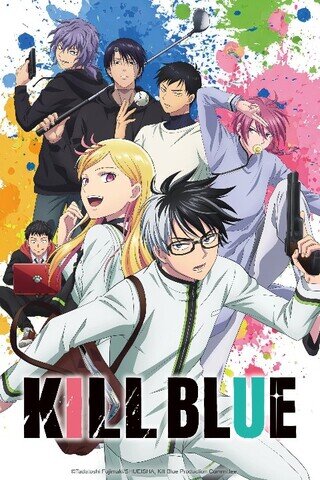


The Strange Afterlife of Kill Blue
Want to talk about a weird situation? Here's one that really shows the gap between how manga and anime work inside Weekly Shonen Jump's pressure cooker.
But first, let me be honest about where I'm coming from.
At first, I thought Kill Blue was just your typical everyday anime. Then it had me hooked. Now, I admit it's nowhere near other similar but acclaimed manga like Sakamoto Days-but at least it's far better than your average anime like Kubo Won't Let Me Be Invisible, Masamune-kun's Revenge, And You Thought There Is Never a Girl Online?, etc. So it was really sad for me to see the manga eventually get axed by Weekly Shonen Jump.
It is very sad that Kill Blue's manga got axed, forcing the author to rush all dangling plot threads into an incoherent ending-yet the anime has become a hit. This goes on to prove that sometimes manga companies like Weekly Shonen Jump need to be more patient with long-term projects rather than axing them prematurely.
How the author can Fix the Ending (If he ever wants to)
There's a classic storytelling trick manga authors use when they want to take back control after a rushed ending. Call it the "that really wasn't the end" structure-often a Part 2 or a subtitle. It lets the author Fujimaki bypass that messy final chapter entirely by throwing in a meta-twist from page one.
If he ever decides to go this route, here's how he can pull it off:
1. Go meta, break the fourth wall.
Open the sequel right where the final chapter ended. Everything looks neat and happy. Then-bam-Juzo Ogami wakes up from a dream, or breaks the fourth wall, or reveals that the "happy ending" was just a cover story (an illusion by the genetic manipulation group, a temporary hallucination, whatever). First page, bold title drop: "Chapter 1: That Really Wasn't the End."
2. Age everyone up.
A sequel is the perfect excuse to jump a year or two ahead. Move the characters from middle school to high school. That naturally resets the plot, brings back unresolved Z.O.O. Assassin Syndicate lore, and gives everyone a fresh start without being weighed down by the original's messy final chapters.
Bottom line: the anime's success means demand is there. Shueisha could absolutely cash in on a continuation.
But objectively? Let the Anime Fix It. This is a far more practical step to take then writing a literal multi volume sequel from scratch. This allows the best of both worlds: The Kill Blue Author gets to finish his story on his terms (in a different medium) and not overburden himself.
Using the anime to fix the ending is way more practical. But here's where it gets tricky-the "faithfulness trap." Production committees usually want one-to-one adaptations. But Kill Blue is in a rare spot where changing the ending actually makes sense for three big reasons.
1. The Anime-Original Ending (A.O.E.) Safety Net
One solution is to go for an anime-original ending (AOE), since the manga's rushed and incoherent conclusion makes a faithful adaptation a nightmare-literally and metaphorically-in this specific scenario, as it would kill the recent buzz the anime has generated and cause review ratings to drop. Instead, the studio could directly work with the author to craft a satisfying ending.
2. Trim the Middle, Fix the Flow
Because Studio CUE knows exactly where the manga ends, they don't have to worry about accidentally cutting something that might matter later. They can streamline repetitive middle arcs, drop plot threads that went nowhere, and reshape the narrative momentum so everything builds toward a brand-new, satisfying conclusion.This prevents the Soul Eater adaptation scenario where the studio caught upto the source material (manga) which was still being written and published during that time.
What the Manga Botched (and the Anime Can Save)
Dropping the rejuvenation bee lore and the Z.O.O. assassin syndicate storylines in the final arc left the manga feeling inchorent. The manga lost what made it a much more engaging read.
The author had to frantically reveal that Noren also had the age-regression condition, rush through her kidnapping by the Yugang group, and resolve the Mitsuoka Pharmaceuticals conflict-all in a handful of rapid-fire chapters. The whole grand conspiracy behind the genetic manipulation company and Juzo's life as a top hitman? Basically gone.
If the anime wants to capitalize on its momentum and deliver a truly satisfying ending, it needs to completely rewrite that final arc.
1. Resolve major character arcs
In the manga, Juzo simply transfers to a new school, Noren kisses him on the forehead, and he just... goes away. Not only does this result in a rushed and unsatisfactory ending, but it also erases all of the protagonist's character growth. What was the point of making friends and forming genuine connections in that school if he was going to leave at the end anyway? This also gives Noren a bittersweet ending that doesn't serve any crucial narrative growth. It feels bittersweet "just for the sake of being bittersweet"-it doesn't serve any narrative purpose whatsoever.
2. Explain the weird genetic lore.
The anime could finally explain the science behind the DNA-modifying wasp sting and the creation of the rejuvenation formula. Instead of treating it like a throwaway plot device, the final twist could reveal a massive corporate war over the technology-making Juzo and Noren's shared condition the absolute epicenter of the conflict, not an afterthought. Due to getting the "soft axe" the author had to abandon all the Z.O.O Assassin Syndicate and the genetic bee rejuvenation lore which resulted in a incoherent and rushed ending.
3. Let Juzo reconcile with his wife and daughter.
The manga barely touched the emotional core of Juzo's situation. He's a 39-year-old man trapped in a teenager's body, and his family is just... out there. A truly great anime ending would give him the chance to finally reconnect with his wife and daughter-not as a distant memory, but face to face. Let him explain himself. Let them react. Give that relationship the closure it deserved from the start
4. Actually resolve the tension between Noren and Juzo in the earlier arcs
The manga just kept inserting the "young girl falls in love with a guy who is literally her father's age". This was downright weird to me and at the ending, Juzo just leaves Noren and all his new made friends to go to another school,leaving Noren sad.The heroine deserved better.
However there are equally valid reasons why the manga why never meant to be as successful as the big leagues:
I'd like to offer some additional insights from a comparative framework:
Reason #1: The manga did have it's own Coherent Identity
There's a reason I brought up Sakamoto Days and compared it to Kill Blue. For context: I haven't read the Sakamoto Days manga, but I did watch the anime. In my view, Sakamoto didn't dominate the assassin space solely because of a three-year head start-the deeper reason is narrative-driven.
While watching Sakamoto Days, I noticed that at its core, it was always a serious story. Sakamoto finds love, builds a family, and makes a promise to his wife that he will never kill again. The comedic moments are integrated naturally-and this is how genre blending actually works.
Reason #2: The Kill Manga couldn't do genre blend properly
Think of My Hero Academia. It's clearly science fiction, yet the logical extremes of certain powers-like One For All's predecessor voices or Gearshift-give it a near-mythical, fantastical aesthetic. The blend feels natural and organic
But the author of Kill Blue didn't pull this off. To me, the genre blending felt forced. It's like trying to combine literature with hard science-it becomes a total mess. Genre blending only succeeds when done naturally and with restraint, much like Horikoshi demonstrated.
A fitting comparison with a different medium (novel) for a comparative viewpoint:
Kill Blue actually reminded me of Stephen King's The Outsider. In that novel, King spends most of the book building compelling evidence on both sides, like a classic locked-room mystery. Then, in the final hundred pages-boom-he metaphorically (and literally) throws in the towel, defaulted to his typical supernatural mode, and left me feeling like a complete fool for trying to deduce a crime scene that ultimately didn't matter.
Kill Blue follows a similar pattern: it reads as if the author didn't know how to naturally blend and integrate the opposing tones of assassin life, high school comedy, and drama.
That being said, I genuinely do love Kill Blue-it just makes me sad that it never reached its full potential.
So yeah-that pretty much sums it up.