Chapter 1
The first drumstroke rolled down from the mountain before Aster Wen had finished folding the dead woman’s blankets.
It came once, deep enough to stir dust from the storage beams. Then again. Then a third time, vast and bronze and impossible to mistake. Across Kohaku, knives paused above vegetables, oxen lifted their heads from winter straw, and every woman and men of the land understood that the temple had spoken.
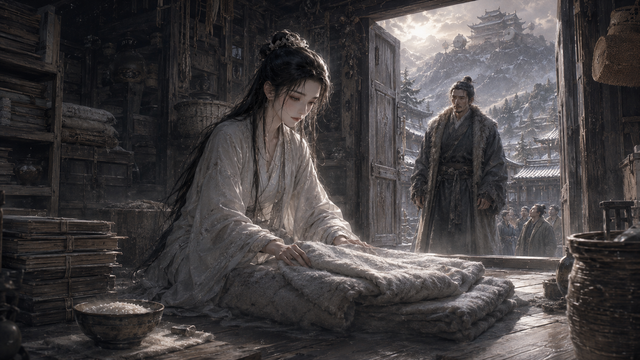
Aster did not rise at once. She remained kneeling on the rough wooden floor of her uncle’s storage room, both hands resting upon a fold of heavy wool, the scent of cheap incense caught in the raw hemp of her mourning sleeves. Thirty-four days had passed since Lin Qiao had followed Wen Tairen into the earth. Already the house of Lin Cheng had begun to close around the space she left behind.
She smoothed the blanket, aligned the seams, and pressed the corners flat with the precision her mother had demanded even in illness. Lin Qiao had taught that a crooked fold invited a crooked mind; that tea poured too hot for an elder was a failure of attention; that silence beside a sickbed could be more useful than prayer loudly performed. Now those lessons were Aster’s only inheritance.
Beside her, a stack of household ledgers leaned slightly out of order. Aster reached out and straightened them before she could stop herself. Her eyes caught the autumn harvest tally, the ink still fresh where Lin Cheng had miscounted the grain owed to the miller. The error revealed itself at once: three measures missing from the second column, one repayment entered twice. Her father would have laughed softly and asked her to prove it in another hand. Wen Tairen had trained her with sticks in the dirt, supply routes in the north, and classical phrases recited until language and number shared the same pulse.
She did not correct the ledger.
Heavy footsteps sounded in the corridor. Lin Cheng appeared in the doorway, his winter robe belted too tightly over a body made lean by anxiety rather than labor. He owned just enough land to fear losing it, just enough education to resent those who had more, and just enough decency to dislike the ugliness of his own calculations. His gaze moved from the folded blankets to the ledgers, then to the small bowl of rice Aster had set aside for her midday meal.
From the inner courtyard came Lin Mei’s laughter, bright and unburdened. Aster’s cousin was complaining about a broken hairpin in the tone of a girl for whom small losses could still be repaired. Lin Cheng’s expression softened toward the sound. When he looked back at Aster, the softness closed.
“Finish the blankets before dusk,” he said. “The winter chill comes early to the mountain.”
“Yes, Uncle.”
Aster bowed her head. She did not resent the command. Resentment required the luxury of believing one’s refusal could matter. Instead she looked at the remaining pile of wool, judged the fading light, and adjusted her pace.
The drums struck again. This time the vibration passed through the floorboards and into Aster’s knees. Lin Cheng turned toward the courtyard. Lin Mei’s laughter vanished. Beyond the storage room, doors opened along the lane, then another, then another, each wooden latch answering the mountain’s call.
From the peak above Kohaku, the bronze drums of the jade temple sounded the summons reserved for Baishé. Not a festival. Not a funeral. A demand.
Aster set the blanket down. For the first time that afternoon, Lin Cheng looked at her not as a mouth to feed, nor as useful hands, nor as his dead sister-in-law’s child. He looked at her as one looks at an answer that has presented itself before the question can be spoken.
Outside, the village of Kohaku held its breath. The officials were coming. Somewhere above the rain-fed terraces and serpent-guarded canals, the mountain had asked for a bride.