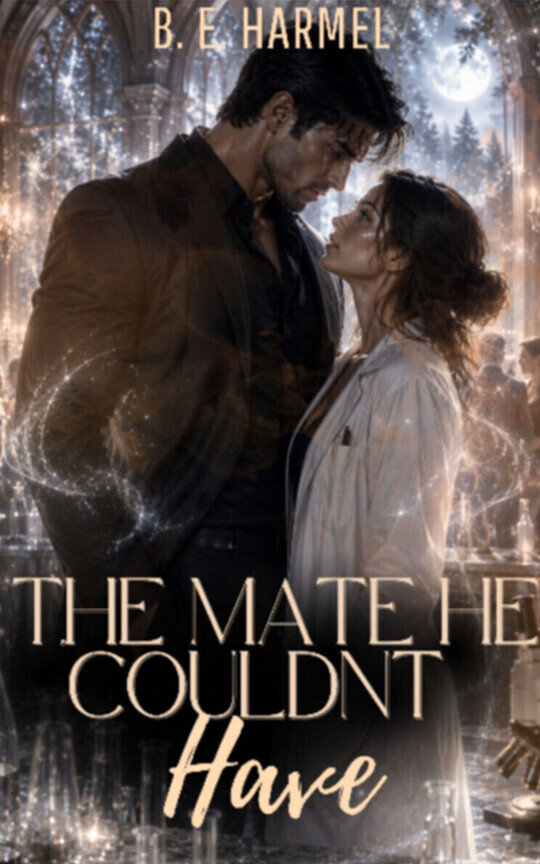
Chapter 1: The Archivist’s Mistake
The dust in the Archives was not dust, and what was truly unsettling was neither its appearance nor its persistence, but the way it made it impossible, over time, to ignore what it suggested: that each particle retained something, a minute memory, an almost imperceptible residue of what had once been alive.
Isolde had understood that without anyone explaining it to her, just as she had learned not to ask unnecessary questions and not to look too long at what was never meant to be understood. She had reached this level of the Archives years ago, when she still believed knowledge was a form of ascent, a tool for escaping the insignificance that marked the lower levels of the city. Now she knew that, in certain places, understanding did not free you: it fixed you in place.
The broom slid beneath the shelf with a dry, repetitive sound that, over time, had acquired an almost hypnotic quality. It was a learned, mechanical motion that allowed her to think without thinking, to keep her mind occupied just enough not to drift toward dangerous ideas. Even so, some thoughts returned with insistence, like dust that never quite went away.
She could not lose this job.
The sentence did not need elaboration to carry weight. It was enough to let it exist, to let it settle at the back of her mind beside the image that inevitably followed: a narrow room, lit by a light too clean to be comforting, Lysa’s fragile body sustained by treatments that did not heal, only delayed the inevitable. Each session cost fragments, and each fragment had a price Isolde could barely manage, even with the relative stability her position offered.
Seventh-Class Archivist.
A minor title, almost invisible in the hierarchy, but enough to grant access to the essentials: food, shelter, and a limited share of what the city called healing.
Enough to survive.
Not enough to fail.
Isolde kept moving down the corridor, letting her gaze pass over the shelves without truly stopping on any of them. She knew what they contained even without reading the labels: vanished bloodlines, altered records, objects whose very existence had been deemed inconvenient. Everything was there, perfectly organized under a logic that pretended to be order, though in truth it functioned as a form of controlled forgetting.
The city did not destroy its mistakes.
It archived them.
The sound changed.
It was subtle, but enough.
The broom encountered resistance where there should have been none, and that small detail was enough to break the automatic rhythm of her movements. Isolde frowned before crouching, more out of habit than suspicion, and brushed away the dust with her bare hand, feeling the ash cling to her skin with an unpleasant persistence.
Then she saw it.
An irregular fragment, embedded in the stone as if it had always been there and, at the same time, as if it did not belong there at all.
No seal.
No mark.
Uncatalogued.
That last detail was the one that truly mattered.
Nothing in the Archives lacked a record, not even the forbidden, not even what was meant to be denied existence. Everything had a place, a code, a warning, even if it was hidden beneath layers of bureaucracy and silence.
This did not.
Isolde felt a faint tension in her chest, not exactly fear, but a deeper alertness, an instinct that did not come from reason but from something more primal. She glanced around reflexively; the corridor remained empty, silent, indifferent.
She could report it.
She should report it.
But reporting it meant attention, and attention at this level of the hierarchy was rarely favorable. Supervisors, questions, performance reviews. At best, a warning. At worst, reassignment.
And she could not afford either.
Her hand stopped halfway, suspended in a hesitation that did not last nearly long enough.
Just a look.
The excuse was weak even to her.
When her fingers touched the fragment, there was no recognizable transition from one state to another; reality simply stopped holding itself together in the way it had a moment before. It was not darkness that enveloped her, but absence, an abrupt withdrawal of everything that allowed her to orient herself in the world: sound, light, weight, even the sensation of her own body.
In its place, there was pressure.
Immediate, total pressure, as if something had found an opening inside her and was examining her from within, moving not across her skin, but through whatever held her together from the inside.
Isolde snatched her hand back with a gasp that felt чужд, as if breathing were something she had just learned all over again.
The fragment vibrated.
Not like a physical object, but like a decision.
And then her shadow stopped obeying her.
At first, the change was subtle enough to be mistaken for a flaw in the light, but that explanation became untenable within seconds, when the edges of her silhouette began to shift with a nearly imperceptible delay, as if they were not fully synchronized with her body.
Isolde froze.
Not by conscious choice, but because something inside her told her any movement would be interpreted.
The shadow stretched slightly, adjusting itself with a deliberate slowness that was more disturbing than any sudden motion.
Then it turned toward her.
The recognition was not visual, not even conceptual.
It was direct.
Immediate.
Intrusive.
“It works,” said the voice.
There was no tone in it that could be associated with human emotion; it was a statement, almost a log entry.
Isolde backed into the bookshelf, finally feeling the weight of her body anchor itself against something solid.
“Who’s there?”
“Not relevant.”
The answer came without hesitation, as if the question lacked structural importance.
The fragment on the floor ceased to exist in that same instant, with no sound, no transition, as if it had been withdrawn from reality rather than destroyed.
“What did you do?”
“You touched it. That allowed access.”
The way it said it, without emphasis, without drama, was more unsettling than any grand declaration.
Isolde clenched her teeth.
“Get out of me.”
“No.”
It was not a defiant refusal.
It was simply a fact.
“You can’t stay.”
“I’m already inside.”
The logic of the answer was unbearable in its simplicity.
“You have no right—”
“Your system uses conscious remnants as an energy resource.”
The sentence was not philosophical or accusatory.
It was descriptive.
“I’m not going to discuss ethics with you.”
“Not necessary.”
A brief pause.
“You are compatible.”
The word cut through her with a rejection deeper than fear.
“Compatible with what?”
“With me.”
Before she could answer, footsteps interrupted the moment, and this time they were not distant or ambiguous, but clear, firm, unmistakable.
Custodians.
Isolde reacted at once, forcing her body back into a normality she no longer felt. She straightened, took up the broom, adjusted her breathing with an effort that bordered on artificial.
“Say nothing,” the voice instructed, now more focused, less scattered.
Figures appeared at the end of the corridor, imposing their presence even before they drew near. Their armor, laced with contained veins of light, did not so much shine as hold a constant internal tension, as if the fragments embedded in them were not entirely inert.
“You.”
“Isolde Veyra. Seventh-Class Archivist.”
“The arm.”
The order did not admit delay.
The crystal needle pierced her skin with precision, and although the pain was brief, what followed was entirely different: an interference, as if the device were trying to read something it could not process.
The light flickered.
Wavered.
And went out.
Not gradually, but abruptly, as though it had been absorbed.
The silence that followed was not long, but it was enough to change the tone of the moment.
“Again.”
“Run,” said the voice.
“I can’t.”
“If you stay, they’ll try to open you.”
The choice was no longer abstract.
Isolde did not think about rules or punishments; she thought of Lysa, of the fragility of that balance that depended on her remaining within the system, and of how all of it would vanish if she became a problem that had to be solved.
She ran.
The world narrowed to movement, to decisions made without conscious reflection, guided partly by memory of the place and partly by the brief, precise instructions the voice offered without explanation.
“Right.”
She turned.
“Lower.”
She descended the steps without stopping.
“Keep going.”
Her breathing grew uneven, but it did not stop.
When she finally found a gap between the shelves, she slipped into it and pressed her back against the wood, trying to regain control of her body.
“What did you do to me?” she asked quietly.
“I opened access.”
“I’m not a door.”
“You functioned as one.”
No emphasis.
Only a record.
The footsteps drew nearer.
“Listen,” the entity said.
“I can already hear them.”
“Not that.”
Isolde closed her eyes, more out of desperation than trust.
“Between them.”
It took her a few seconds to perceive it, but when she did, she could not ignore it: an interval between sounds that was not empty, but charged with a presence difficult to define, as if something there existed outside movement and time.
She opened her eyes.
“What is that?”
“Where I operate.”
The shadow slid toward the wall.
“Follow.”
Isolde hesitated only a moment before moving.
She passed through it.
Not as one breaks through a physical barrier, but as one crosses a layer of reality that had been badly fixed.
The change was immediate.
The air was different.
Denser.
Older.
The lamps did not illuminate in the same way; the light seemed to weaken before it reached the surfaces, as if something were consuming it.
Isolde slowly straightened, looking at the open shelves, the unshelved boxes, the visible remnants where things should have been contained.
“This level shouldn’t be accessible…”
“It isn’t for most.”
Its voice was steadier now.
More present.
“What do you want from me?”
The answer took long enough to suggest it was not automatic.
“To understand.”
“What?”
“Why this is still working.”
Isolde frowned.
“The city works because the stars hold it up.”
“Not exactly.”
The correction was slight, but firm.
“Then what do they do?”
There was a pause, but not a marked one, rather one integrated into the observation.
“They consume.”
The word was not dramatic.
It was precise.
Isolde felt the idea settle slowly, resisted by everything she had been taught.
“That doesn’t make sense.”
“It makes more sense than the version they gave you.”
The shadow tightened slightly.
“They don’t sustain the city.”
An instant.
“They keep it useful.”
Something then vibrated, not in the floor or the walls, but somewhere much farther away.
Above.
Beyond the Archives.
Isolde lifted her gaze reflexively, though she knew she could not see the sky from there.
Even so, she felt it.
A pulse.
Slow.
Enormous.
Not luminous.
Hungry.
Her breath broke before she could stop it.
“I felt it too,” said the entity, and for the first time its voice did not sound entirely certain.
A brief interval.
“That wasn’t there before.”