The Morning the Library Descended
Before dawn, the forest was quieter than Hikaru had ever known it.
The birds had yet to call. Dew gathered at the tips of the leaves and stayed there, brightening as the sky paled. Around him, the woods held a stillness that felt unfinished.
Hikaru stood on the hilltop, facing east.
His grandmother had chosen the two characters that formed his name: light and sea. May light find its way to the sea, she had told him. May you grow to bring distant things within reach.
In the house above the mill road, mornings began with the kettle lid ticking on the stove and his grandmother’s footsteps crossing the floor before sunrise.
At fifteen, Hikaru could not see how his days answered that wish. He was apprenticed to the village record-keeper. He copied weather ledgers, cleaned dust from measuring instruments, and entered dates on reports that might remain shelved for years. Day after day, he gave ordinary facts his full attention.
Only three others in the village were within a year of his age. When an argument over a tide table, a festival date, or the old name of a cove outlasted everyone’s patience, they turned to Hikaru. He could not always settle the matter. What they trusted was that he never made the record say more than it did. Their trust pleased him more than he let them see.
He liked the patience of the work. A voice could cross a century in a line of ink.
Rainfall from a hundred years ago.
The week the flowers opened half a century ago.
Three nights of sea-roar, ten years before.
Someone had stood beneath that rain, watched those flowers, lain awake to the sea, then made a mark so the day could travel farther than they could. When Hikaru copied a number, the life behind it passed briefly into his keeping.
He was halfway to the observation tower when a light separated itself from the late stars.
Beyond the hill, the sea lay under a narrow band of silver. The sky was changing from indigo to violet, and along the seam between them a few points of starlight remained.
At first he mistook the new light for one of them, though it shone too strongly for dawn.
It carried no flame and left no trail. Instead of fading, it grew, surfacing from the depth of the sky.
Hikaru forgot to breathe.
Light became edges. A tower appeared, then windows, then bridges suspended in the air. Through the outer walls, shelves climbed in shadowed tiers. Blue radiance streamed across two vast panels spread like wings. The moving marks might have been script or constellations. Above, tier after tier rose beyond the hill’s scale, the highest arches fading into the dark. Beneath it, rings nested within rings turned without a sound, more intricate than any millwork he had seen.
It was a library.
A library from the deep reaches between worlds was descending into the last blue before sunrise.
Its shadow crossed the hill. The grass and white flowers at Hikaru’s feet fell into shade.
Run, some part of him said.
His heart struck hard against his ribs. His breath shortened.
Then he saw how it was coming down.
The library lowered itself by degrees, pausing between each shift of weight as it tested the air above the hill. Even from the ground, Hikaru could see the effort in the motion.
Just above the earth, the whole structure rocked once.
Blue light fanned open beneath it like wings. Hikaru narrowed his eyes, and the light thinned into the paling air.
The white flowers lifted their heads. Grass streamed outward, then rose again. A clear tremor passed through the soil, leaving every stone in its bed. Its resonance climbed into the sky like the fading note of a bell.
When it passed, warm air brushed Hikaru’s cheek and lifted the damp hair from his forehead.
A moment later, the library stood upon the hill. Its lowest walls shone among the unbroken flowers.
Only then did the rest of the morning return to him: his grandmother setting water over the stove, the record-keeper waiting at the tower, the village asleep below.
He had to warn them. Reach the tower. Wake the record-keeper. Ring the emergency bell. The instructions came back in the order he had learned them.
Still, he stayed where he was.
He wanted one more moment to look.
Morning touched the library’s windows. Beyond the glass, thousands of books gave off a muted glow. Their spines formed constellations along the shelves. Pale motes moved through the aisles, pausing at one book and darting toward another with a purpose Hikaru could not read.
He had always known the world was larger than the village. Until now, larger had been only a word.
Until that morning, the wider world had begun beyond the sea. Now it stood on his hill.
The great doors opened.
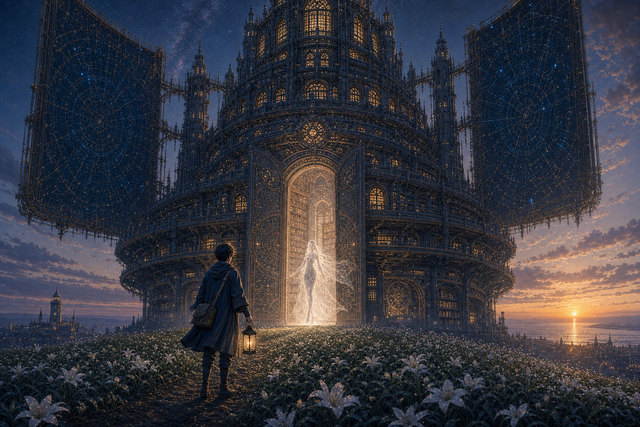


White light spread over the grass, gentler than daylight and steady as a harbor lamp.
A figure stepped through.
The light had gathered itself into the shape of a girl. Her hair floated in pale, translucent strands. Beneath her skin, fine lines of script traveled and rearranged themselves without pause. Behind her, wings opened in overlapping planes of light, each plane traced with stars and routes.
She did not speak at once.
Her gaze moved from Hikaru’s face to the record satchel over his shoulder, the ink caught in the whorls of his fingers, and the flame in the lantern he had carried from the village. When she returned to the ink, the corners of her mouth eased.
“I am glad you were the first to find us.”
Her voice was clear, with a trace of static threaded through its lowest notes.
“I am Lunaris, guide to Astraia—the Stardust Library.”
Astraia.
Hikaru had never heard the name, yet it reached him with the intimacy of a place once known.
“A library,” he repeated.
He looked past her at the structure covering the hill. It bore little resemblance to the village archive, but behind its many windows, shelves receded farther than he could follow.
“All of that?”
“Yes. Astraia holds the memories of distant worlds, languages preserved in a few living voices, and futures no one has yet read.”
“Futures?”
A record belonged to what had already happened. The future existed nowhere yet. How could it have pages?
“The future has not settled into one course,” Lunaris said. “Its possibilities sometimes take the shape of stories. We keep those stories until they reach someone who needs to read them.”
He understood each sentence. He did not yet understand the world they described.
He was not ready to believe her. With Astraia filling the hill, he was not ready to dismiss her either.
“Why here?” he asked.
Lunaris turned toward the village, then lowered her eyes. The script crossing one translucent cheek slipped out of pattern, then found its course again.
“We were bound elsewhere. We lost our route among the stars and drifted until this world came within reach.”
The script at her throat slowed before taking up a new pattern.
“By then, the light that carries us from world to world was nearly spent. So was the power that sustains Astraia. We reserved what remained for one decision: where to land.”
She turned toward the library.
“We wanted that last choice to remain ours.”
Then she looked down at the village, still gathered in sleep.
“People here still read the changing sky. They know the seasons in clouds, tomorrow’s weather in the wind, old stories and possible worlds in starlight. They make room in their lives for what has no name yet.”
When she spoke of the roofs, fields, and narrow lanes below, her voice warmed.
“That is why Astraia chose this hill.”
Hikaru studied the village in the half-light and tried to see it as Lunaris did.
Most days belonged to work. People inspected fields, repaired nets, counted fuel, and planned meals around the month’s ration. The sky shared their attention with every immediate need.
Yet a farmer still raised her face to the clouds before rain. A fisherman paused over a torn net to breathe the wind. People who knew none of the formal names of the stars still placed old tales among them.
Hikaru looked up every morning on his way to the tower.
He noticed how clouds gathered, which stars lingered, what color the sea borrowed from the sky. No one had assigned him those observations. They were simply part of how he moved through the day.
Had Astraia noticed the spaces people kept for wonder between one necessity and the next?
Had it noticed his?
Lunaris faced him again. The warmth remained in her voice, while the script within her chest wavered over the same sequence, writing and rewriting it.
“I have something to ask of you.”
She glanced back at Astraia.
“Some of Astraia’s injuries lie beneath the surface. The force that keeps each memory whole has weakened. In the sealed stacks, words and stories are beginning to blur.”
Hikaru remembered a ledger in the rear of the village archive, damaged by rain.
He had been an apprentice only a few weeks when they discovered that the water had washed one person’s name clean from the page. The paper dried. The writing around it survived. The place where the name had been remained pale.
“Would someone open a book and find they could no longer read it?”
“More than that.”
Lunaris looked toward the long ranks of windows.
“A book carries more than words: the voice that spoke them, the room around it, the scent of a particular morning, and the feeling one person hoped another might receive. When a memory blurs, those things drift apart. In time, a reader can no longer find a way into the life they once formed.”
Ink remained in the whorls of Hikaru’s fingertips. His hands had turned brittle pages, filled a pen, and steadied paper while he copied a fading line. They had learned the care owed to what another person had left behind.
The blank in the rain-damaged ledger had drawn his eye more strongly than any surviving word. He imagined such pale spaces spreading through Astraia: a name here, a voice there, a morning separated from everyone who might have received it.
Lunaris waited until he looked up.
“Read,” she said.
Then, after a breath, “Choose.”
“Astraia can wake only a few memories at a time. Which should rise first? Which stories should be carried into the next age? She needs a reader who will listen before deciding.”
Until then, choose had sounded like opening a door. Now he heard the doors it might leave closed.
He still had to warn the village. That had not changed. One book, he told himself—enough to carry home more than wonder. Then the tower.
Attention was the part he knew.
He had given it to rainfall recorded by hands long gone, to old ink, to the hush before birdsong. He could give it to the first page waiting beyond the doors.
He raised his eyes to Astraia.
Towers and galleries rose in layered shadow. Fine cracks in the stone caught the first sunlight. Some windows remained dim, while deeper within, a low radiance answered the dawn.
Beyond the hill, the sea received the first gold of morning.
He did not yet understand what it meant to wake one memory while another slept. He could begin with what he did understand.
Reading.
“If I can help, I will.”
He drew a breath, unwilling to make the promise larger than he understood.
“I don’t know enough to choose.”
Lunaris waited. The script within her chest held its place.
“But I know I shouldn’t choose before I read. So I’ll read. One book at a time.”
Lunaris bowed deeply.
Before his words had left the morning air, a bell rang somewhere in Astraia’s depths.
Hikaru felt the first note through the soles of his boots. It rose through the hill, deep and clear, until the open sky carried the sound.
Windows opened along the library’s face. Birds made of folded white paper flew out, their wings flashing silver as they circled above the hill.
Far below, a dog began to bark. A lamp appeared in the observation tower.
By the time the last note passed through him, the tightness in his chest had eased. He was smiling.
All his life, the wider world had begun on the far side of the sea. That morning, it opened a door on his hill.
In the white light, the script within Lunaris flowed calmly again.
“Hikaru.”
His name sounded different in her voice—still his, yet already traveling farther than it ever had.
“Welcome to the Stardust Library.”
Hikaru stepped inside.
Beyond the doors, shelves rose through a white distance, holding the unread lives of worlds beyond his sky.