
The Road Beyond the Rain
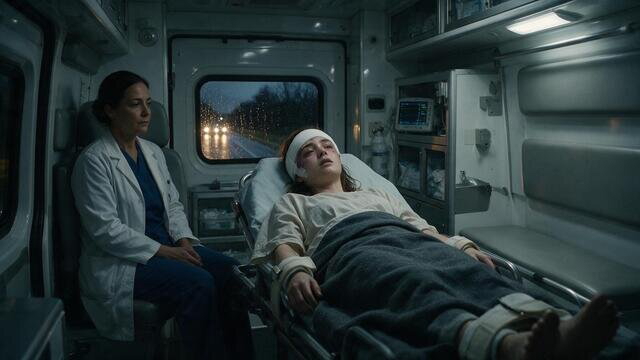


The first thing I heard was the rain.
It struck the roof of the car in an uneven, relentless rhythm, sometimes soft as fingertips against glass, sometimes hard enough to sound like handfuls of gravel thrown into the darkness. For several seconds, I had no idea that I was awake. I floated somewhere between sleep and consciousness, suspended in a darkness so deep that I couldn’t tell whether my eyes were open.
Then came the pain.
A violent pulse behind my right temple forced a gasp from my throat. I lifted a trembling hand to my head and felt the swollen, tender skin beneath my hair. The sensation brought back a fragment of memory so suddenly that my stomach twisted.
Andrew. His voice. The argument. His face changing before my eyes. Then something hard striking my head.
Darkness.
I opened my eyes fully.
The ceiling above me was unfamiliar.
That realization frightened me more than the pain.
I tried to lift my head, but the movement sent the entire world tilting sideways. A wave of dizziness washed over me, and I let my head sink back onto the stretcher, closing my eyes until the spinning began to subside. The interior of the vehicle was dim, illuminated only by passing headlights and the occasional pale reflection of rain sliding down the windows.
There were two people in the front.
A man was driving. A woman sat next to me.
Neither looked at me.
“Where am I?”
My voice sounded weak and unfamiliar.
No one answered.
I swallowed and tried again.
“Where are you taking me?”
The driver glanced at me through the rear-view mirror. His eyes met mine for barely a second before returning to the road.
“You should lie down.”
I stared at him.
“What?”
“You’ve had a head injury. You need to rest.”
My heart began beating faster.
“Where are you taking me?”
He didn’t answer.
A cold sensation spread through my stomach.
The woman finally looked at me. She had a calm expression, almost unnaturally calm.
“Alice, please remain calm.”
I froze.
“How do you know my name?”
She didn’t answer.
“How do you know my name?”
“Alice, you’ve been through a traumatic experience.”
“Who are you?”
“We’re here to help you.”
“I didn’t ask that.”
My breathing became faster. I looked from her to the driver and then back toward the locked door.
“Where is Andrew?”
Silence.
That silence was worse than an answer.
I had no idea where we were.
No idea how long I had been unconscious.
And, most terrifying of all, I had no idea whether anyone knew where I was.
I tried to reach into my pocket, but my hands barely moved. I pulled against the restraints at my wrists and finally realized they were secured to the sides of the stretcher.
“My phone,” I said. “Where is my phone?”
The woman looked at me calmly.
“It’s being kept somewhere safe.”
“Give it to me.”
“You can have it later.”
“Later when?”
She didn’t answer.
Something inside me snapped.
“I need my phone.”
“Alice, you need to calm down.”
“I am calm.”
I wasn’t.
“I am not calm because nobody is telling me where the hell you’re taking me!”
The driver tightened his hands around the steering wheel.
“Please don’t make this harder.”
I stared at the back of his head.
Harder.
The word stayed with me.
As though I had chosen this.
As though I were the problem.
I tried to move again, pulling against the restraints at my wrists. They held me firmly against the stretcher.
“I want to get out.”
Nobody answered.
“I want to get out!”
The woman looked at me again.
“You’re frightened. That’s understandable.”
“Frightened?”
A broken laugh escaped me.
“You locked me inside a car.”
“We’re taking you somewhere safe.”
“Safe?”
I stared at her.
“Where?”
She hesitated.
“A psychiatric facility.”
The words seemed to empty the air from the car.
For a moment, I couldn’t breathe.
“Where are you taking me?”
The woman looked at me calmly.
“To a medical facility.”
“Why?” My voice came out weaker than I expected. “My head hurts. I was hit.”
“You’ll receive medical attention when we arrive.”
I frowned.
“Then why am I being taken somewhere like this?”
The woman hesitated for a moment.
“You’ve been through a traumatic experience. We need to assess your condition properly.”
“But something is wrong with my head.” I swallowed. “I need medical help. Not—”
I stopped, suddenly afraid to say the word I was thinking.
“Not what?” she asked quietly.
“Nothing.”
She looked at me for another moment.
“You will be examined when we arrive.”
The rain continued beating against the windows.
The road stretched ahead of us, black and endless, disappearing beneath the headlights.
And suddenly I was afraid in a way I had never known before.
Not the sharp fear of an argument. Not the instinctive fear of a raised voice or a hand lifted in anger. This was something deeper—the fear of being misunderstood so completely that there would be no way back.
I began to cry.
At first, quietly.
Then uncontrollably.
I covered my face with both hands as my shoulders began to shake.
“I just want to go home.”
Nobody spoke.
“I want to go home.”
The woman looked back at me.
“You’ll be looked after.”
“By whom?”
She didn’t answer.
I closed my eyes.
Two years ago, I never would have believed I could end up here.
Two years ago, Andrew had been someone else.
He had been funny. Charming. Warm. He could make me laugh until my stomach hurt. He knew exactly how to turn an ordinary evening into something I wanted to remember forever.
Then the drugs began.
The arguments followed.
Then the accusations.
Then the first slap.
I remembered standing in the bathroom afterward, staring at my reflection while touching the side of my face.
I had told myself that he hadn’t meant it.
That he was struggling.
That the man I loved was still somewhere inside him.
I had spent months protecting the memory of someone who no longer existed.
And now I was being driven somewhere because of him.
The thought made my stomach twist.
“Please,” I whispered.
The woman looked at me.
“Please what?”
“Tell me where we’re going.”
She hesitated.
“A psychiatric facility.”
The words sounded even worse the second time.
I turned toward the window.
Rain ran down the glass in long, trembling streams, distorting the world beyond it until everything looked unreal.
I didn’t know whether I was being rescued or imprisoned.
I only knew that I was terrified.
When the car finally stopped, I looked through the window and saw an enormous building standing behind a tall iron gate. Its architecture was old and severe, with grey stone walls and rows of dark windows illuminated from within. It might once have been beautiful.
Tonight, it looked like a fortress.
The gates opened.
The car moved forward.
I watched them close behind us.
Something inside my chest tightened.
One of them leaned over me and released the restraints holding me to the stretcher.
“We’re going to take you inside.”
I stared at him.
“Where?”
He didn’t answer.
The two of them carefully pulled the stretcher out of the vehicle and began wheeling me beneath the covered entrance.
Cold rain touched my face for a brief moment before the roof sheltered me from it.
I looked around, trying to recognize something—anything.
Nothing.
I didn’t know where I was.
I didn’t have my phone.
I didn’t know the name of the town.
I didn’t even know how I would find my way home.
The wheels rolled across the polished floor as the entrance disappeared behind us.
Then the doors closed.
And for the first time, I realized that I had no idea where they were taking me.
The warmth of the building should have been comforting, but it wasn’t. The air smelled strongly of disinfectant and something medicinal. The corridor was painfully white, illuminated by harsh ceiling lights that made everything look strangely flat and unreal.
Somewhere far away, a door slammed.
Then silence returned.
The stretcher came to a stop.
A nurse appeared beside me, a clipboard in her hands.
“Alice Morgan?”
I nodded.
“How are you feeling?”
“My head hurts.”
“Are you still dizzy?”
“A little.”
“Do you feel sick?”
“No.”
She glanced at the dressing around my head, then made a brief note.
“Do you remember what happened?”
I hesitated.
“I remember being hit.”
“Anything after that?”
I closed my eyes for a moment, trying to reach through the fog in my mind.
“Not much.”
She nodded.
“All right. We’re going to take you for a CT scan.”
My eyes opened.
“Now?”
“Yes. We need to make sure there’s no internal injury.”
No one explained anything else.
They wheeled me through another corridor, the ceiling lights passing above me in a slow, endless sequence.
The CT room was cold and almost painfully bright.
I remember the machine above me.
The mechanical sound.
Someone telling me to keep still.
Then darkness again.
When I opened my eyes, I was being wheeled back through the corridor.
“Is something wrong?”
The nurse looked down at me.
“The doctor will speak to you tomorrow.”
My stomach tightened.
“So there is something wrong?”
“No. You need to rest tonight.”
I didn’t know whether that was supposed to reassure me.
The stretcher stopped outside a small private room.
Two nurses carefully moved me from the stretcher onto the bed.
My head throbbed as I shifted.
“Easy,” one of them said.
They adjusted the blanket and made sure I was lying comfortably.
I looked at the nurse with the clipboard.
“Can I have my phone?”
“It will be returned later.”
“When?”
“After the admission process.”
I stared at her.
“What admission process?”
She paused for half a second.
“You’ve just arrived, Alice. Try to get some sleep.”
“And tomorrow?”
“Tomorrow, the doctor will examine you properly.”
She gave me a small, reassuring smile.
“For tonight, you need to rest.”
The door closed quietly behind her.
I stared at the unfamiliar room.
The silence felt different here.
Heavier.
More permanent.
Whatever happened next would happen here.