
Six Months
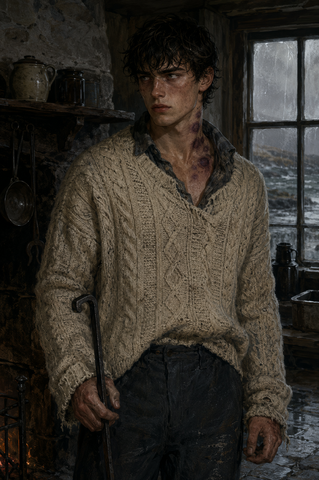


The salt got into the cracks in his knuckles first.
It found the small, red splits where the line-cables bit through rubber gloves, and it stayed there, chewing quietly until the skin turned white and hard like lard.
Cillian didn’t wear the gloves anymore. He liked the sting. It kept him awake while the winch groaned under four hundredweight of grey cod, the diesel fumes from the trawler’s exhaust blowing back across the deck in greasy, yellow clouds.
His father, Tomás, stood at the wheelhouse window. He didn’t speak. He hadn’t spoken more than twelve words a day since October, but his eyes tracked Cillian from behind the salt-crusted glass—measuring the way Cillian dragged the wooden crates, measuring the weight Cillian had dropped from his shoulders, measuring the silence between them.
In Ardglaise, silence was a trade good. You traded it for peace. When someone’s boat went down, you gave the family two weeks of covered casserole dishes, three masses in St. Jude’s, and then you stopped saying the name. You looked past the empty stool at the end of the pier. You scrubbed the fish-gutting tables until the wood bleached, and you acted like the Atlantic was just water, not an appetite.
Six months.
Cillian hauled the last crate of cod onto the ice-pallet, his forearms shaking with the strain. His oilskins were stiff with dried scales and linseed oil. Beneath the heavy rubber, his skin was slick with sweat, but inside his ribs, behind the breastbone, there was only an iron cold that nothing touched. Not the engine heat. Not the hot black tea from the thermos.
Nothing.
The cottage sat sixty yards from the high-tide line, tucked into the lee of the limestone cliff like an old tooth.
Cillian kicked his boots off at the scullery door and stripped down to nothing. The flagstones were fierce cold under his bare arches, but he didn’t hurry to the stove. He walked into the unlit bedroom, his skin pebbled with gooseflesh, and reached for the back of the wooden chair.
The jumper was there. Cream-colored Aran wool, oversized, stretched out at the cuffs where Oisín used to hook his thumbs.
Cillian pulled it over his head.
The wool was coarse, rough against his bare chest, the heavy cables scratching his collarbones and belly. He dragged the wide collar up over his nose and breathed in.
The scent was dying. That was the worst part. Four months ago, it had been sharp—turf-smoke, the pine-tar soap Oisín stole from the cannery showers, the sweet, heavy grease of nineteen-year-old sweat. Now, it was mostly just sheep-lanolin and the damp mold of the cottage walls. Cillian had to inhale until his lungs ached, dragging the wool hard against his mouth, just to find the faintest ghost of Oisín’s throat behind the fibers.
“Jesus,” Cillian muttered into the collar. His voice sounded thin. Dry. Like two stones rubbing together in an empty bucket.
He dropped onto the mattress.
He didn’t sleep on his own side. He slept on the left, where the springs were sunken, where Oisín’s broad back used to create a pocket of trapped heat that lasted until dawn. He pulled the rough woolen blanket up to his waist, naked from the hips down, the cold air of the room biting at his shins while the sweater scratched his chest.
His hand moved before his head permitted it.
It wasn’t desire. It was an ache so thick and physical it felt like hunger, like nausea, like his nerve endings were screaming for friction. He closed his eyes and his palm clamped down, hard, rough skin catching on rough skin.
He remembered the weight of him.
Oisín had five inches and twenty pounds on him, heavy-limbed and clumsy on land, smelling of salt-water and cheap roll-ups. Oisín used to pin him to these exact sheets, wedging a thick, hair-roughened thigh between Cillian’s legs, using his bulk to keep Cillian still while his mouth worked down Cillian’s throat. Oisín never kissed soft. He bit. He left dark red marks along the ridge of Cillian’s collarbone that took a week to fade into yellow-green shadows, claiming territory like a man staking an anchor in rock.
Cillian pumped his hand faster, his breath hitching, his hips lifting off the sunken mattress.
Come on, he thought, the wool scratching furiously against his nipples. Come on, you bastard. Just one more minute.
He tried to summon the phantom pressure—the scrape of Oisín’s blunt fingernails digging into his hips, the hot, wet slide of his tongue against the hollow behind Cillian’s ear, the low, broken grunt Oisín made when he came, his whole heavy chest shuddering against Cillian’s ribs like an engine cutting out.
Cillian spilled hot across his own stomach with a choked, jagged gasp that rattled in his throat.
The heat lasted four seconds. Then the damp air hit it, turning it cold, tacky, and miserable.
Cillian lay flat, staring at the cracked plaster of the ceiling. Outside, the tide hit the seawall with a dull, rhythmicboomthat shuddered through the cottage foundation. He didn’t wipe himself off. He just lay there, shivering inside the dead boy’s sweater, waiting for the ceiling to turn from black to grey.
Two in the morning.
The rain had picked up, slanting hard off the Atlantic and driving against the cottage windows like handfuls of buckshot.
Cillian was lying awake, his hands tucked into the armpits of the sweater for warmth, when the sound came.
Not the wind. Not the gulls.
A knock.
Three wet, heavy thuds against the bottom panel of the scullery door. Low down. Like something dragging itself up the three stone steps from the lane.
Cillian went rigid. The hair on his arms lifted against the wool.
A stray dog, he told himself, his pulse kicking into his throat. Or a loose lobster pot rolled off the trailer.
Another knock. Slower this time. Thump. Thump.
Cillian got off the bed. He didn’t bother with trousers. He walked through the dark kitchen, his bare soles silent on the cold stone, picking up the heavy iron poker from the hearth out of pure reflex. The air in the scullery was freezing—colder than the rest of the house, smelling intensely of rot, bladderwrack, and deep ocean silt.
A dark ribbon of water was already creeping under the door jamb, pooling around Cillian’s toes. It wasn’t rainwater. It was thick, viscous, and grey with sea-foam.
Cillian reached the door. His knuckles turned white around the poker.
“Who’s there?” he called out. His voice was tight.
No answer. Just the heavy, rhythmic breathing of someone whose chest was full of fluid. A wet, rattling intake of air.
Cillian slid the brass bolt back. He turned the iron latch and pulled the door inward.
The gale hit him first, throwing cold salt-spray into his eyes.
Then he saw him.
Standing on the drenched flagstones, framed by the thrashing black Atlantic behind him, was Oisín.
He was bare beneath a ripped, black oilskin tarp draped clumsily across his wide shoulders. His skin was gleaming, slick with rain and brine, the muscular planes of his chest and heavy thighs pale as peeled birch in the storm-light. He wasn’t shivering. His lips were the color of a bruised mussel shell, parted around small puffs of white steam, and his dark curls were plastered flat across his forehead.
He looked up.
His eyes caught the faint orange glow of the kitchen hearth behind Cillian. For half a second, the reflection didn’t look like eyes at all—it looked like deep, unbottomed water.
Oisín lifted one hand. His fingers were gray at the tips, the nails lined with black silt. He reached out, his cold, wet thumb brushing the ridge of Cillian’s jaw with terrifying, familiar precision.
“Cill,” Oisín whispered, his voice thick, salt-rough, and breaking. “I’m fierce cold. Let me in.”



















Goosebumps, amazingly written.