
1: Eclipse
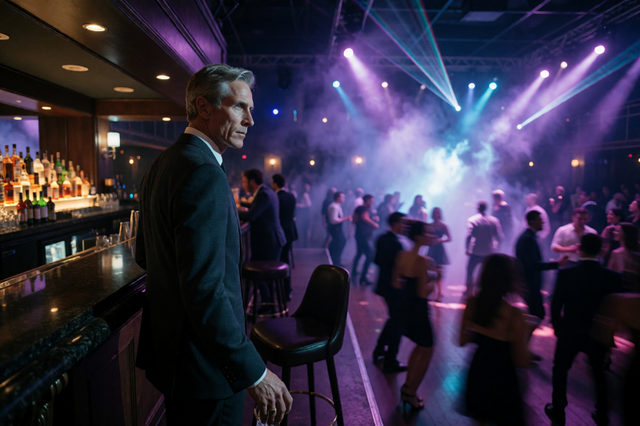
The bass clawed its way through Silas’s chest, each thump a physical assault that vibrated the bourbon in his glass. Three doubles in, and he was counting—of course he was counting, the way he counted everything. The bourbon was his only shield against the pulsing violet strobes that sliced through artificial fog, and even that was failing. The bartender—a young man with more metal in his face than Silas had in his watch—glanced at him with the barest hint of pity before turning to serve the parade of twenty-somethings jostling at the counter. Silas took another burning sip, the expensive liquor wasted in this sensory battlefield called Eclipse.
Eleven thirty-seven.
The dial of his Patek Philippe glowed faintly under his cuff, a relic from another time—much like himself.
The evening had started sensibly enough: the Wetherspoons on Bishopsgate, sticky menus and warm wine, the marketing team’s idea of team building after the quarterly review. But then someone had mentioned Eclipse, and the younger contingent had migrated like locusts, dragging the rest along. Silas had let himself be carried because Grant from Operations—fifty-five, same vintage, same bewildered expression—had said he’d come too. Grant was nowhere to be seen now. Vanished somewhere between the cloakroom and the bar, leaving Silas the sole representative of an entire generation.
Silas' fingers traced the condensation on his fresh glass, the cool moisture a stark contrast to the sweat trickling down his spine. His charcoal Tom Ford—purchased when Eleanor was still alive and fashion still mattered—clung to his skin like a damp shroud. This morning, he could have sworn her perfume still lingered in the fabric, preserved despite countless dry cleanings. The collar, once crisp, now wilted against his neck. He tugged at it—futile against the heat of too many bodies in too small a space.
Eleanor.
She would have laughed to see him here, out of his element and drowning in music that made his molars vibrate. Twenty years ago, they’d spent a week in Barbados for their anniversary, finding a tiny beachside bar with fairy lights strung between palm trees. Eleanor had kicked off her sandals, her sundress catching the breeze as she’d pulled him to his feet.
“Dance with me, Si,” she’d whispered, her breath warm against his ear. “No one’s watching but the stars.”
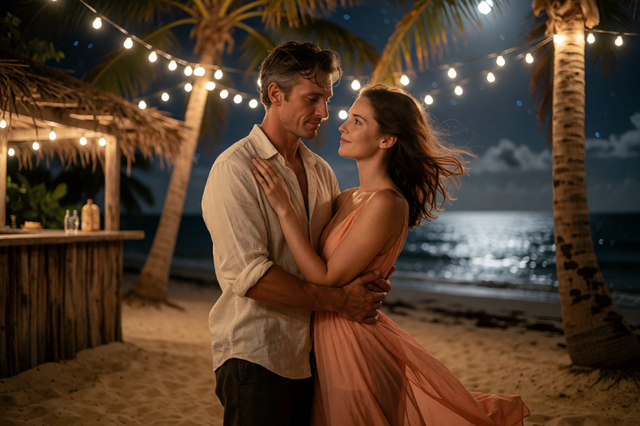
He’d been younger then, less concerned with dignity, with the performance of being Silas Thorne, CEO. He’d wrapped his arms around her waist, breathed in the coconut of her sunscreen mixed with the salt of her skin, and they’d swayed together as the band played something slow and sweet. The memory was so vivid he could almost feel the sand between his toes, the warm trade winds carrying the scent of frangipani and rum.
Now, surrounded by strangers half his age, the memory felt like it belonged to someone else. A different Silas.
He turned on his stool, eyes scanning the heaving dance floor. Lasers carved through the artificial fog in violent slashes of blue and purple, illuminating his colleagues in stop-motion fragments. Anna from Creative, sweat plastering her blonde hair to her temples, head thrown back in a laugh that never reached her eyes. Marcus, tie knotted like a noose, shirttails flapping free as he ground against a stranger. Even Howard from Legal, usually sombre, now a writhing silhouette at the epicentre, his spectacles lost, his mouth open in a silent scream the bass swallowed whole.
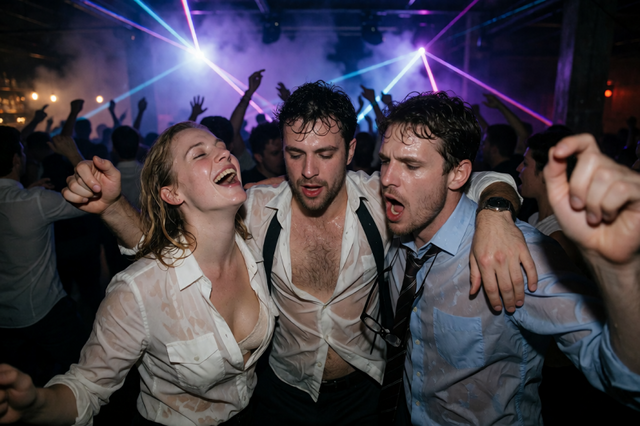
They moved as one organism, a bone-deep dialect of hips and shoulders Silas’s body refused to speak. When he’d stumbled into their orbit earlier, his limbs had locked like rusted hinges. He had stood there, rigid and out of sync, while the crowd flowed around him like a tide of liquid muscle. Simon from Accounting had watched the whole thing, his smirk a scalpel. Heat had flooded Silas’s neck, his collar strangling him, until he’d limped back to the bar’s false sanctuary. Now he watched them breathe as one, a tribe he’d never be baptised into, the distance widening with every shuddering beat of the music.
A woman brushed past him, her hair a shocking pink crown spiked with what appeared to be actual metal. The air around her vibrated with youth, with possibilities that had long since hardened into the certainties of Silas’s life. She glanced at him, through him, around him—her gaze seeking something he couldn’t provide. He sipped his bourbon, allowing the burn to ground him. He felt ancient among them, a fossil trapped in a tar pit of excess and noise, preserved but irrelevant.
He was about to turn back to his glass when he felt it—a gaze, heavy and specific, cutting through the ambient chaos. His eyes found her before his mind could stop them: a woman across the bar, electric blue hair catching the strobes like a live wire. She was looking at him. Not at the crowd, not at her phone. At him.

Silas looked away. The heat in his neck returned, a schoolboy’s reflex—caught staring, or caught being stared at, and either way mortifying. He stared at his bourbon, at the ice melting in its own slow surrender, and told himself she’d been looking at someone behind him. A woman like that—young, striking, deliberate—had no reason to look at a man like him. He was being vain. Foolish. He gripped the glass, waiting for the heat in his neck to recede.
A minute passed. Maybe two. The bass shifted, a slower track bleeding through the speakers, and Silas’s traitorous eyes drifted back.
She was still there. Still watching.
This time he let himself look. A face pale as fractured porcelain, all sharp angles and shadow. Gunmetal eyes edged with kohl so thick it looked carved from obsidian, holding him with an intensity that had no place in a room built for oblivion. While every other body in Eclipse moved, she sat in absolute stillness—a discipline he couldn’t name. A black velvet choker circled her throat, something silver glinting at its centre, but the distance swallowed the detail. She wasn’t drinking. She wasn’t dancing. She was simply there, watching him with the focused attention of someone studying a specimen under glass.

He forced himself to face the bar. His reflection stared back from the mirrored backsplash—grey-faced, hollow-eyed, a man drowning in plain sight. He finished his bourbon. When he looked again, the space where she’d been was empty. Just a vacant stool, the air around it oddly still.
Gone. The disappointment surprised him—a sharp little pang for a stranger he’d never spoken to.
He signalled for another bourbon. The bartender materialised with the bottle, and Silas watched the amber fill the glass with the detachment of a man who’d stopped expecting anything from the night. He’d come here because the alternative was his penthouse, the echo of his own footsteps in the hallway, the bedroom door he still couldn’t bring himself to open. At least here the noise was external. At least here the emptiness was shared.
A laugh escaped him, lost in the cacophony. Eleanor would have smacked his arm. “Stop feeling sorry for yourself, Si,” she would have said, straightening his tie with gentle fingers. “You’re still the most handsome man in the room.”
But Eleanor wasn’t here. And Silas Thorne, fifty-eight, thinning grey hair, taste for single malt, sat alone at a bar in a club called Eclipse, watching life at a distance. The bourbon in his glass caught the light, turning momentarily into liquid fire. He raised it toward no one.
The empty stool beside him scraped against concrete. Silas glanced sideways, expecting another faceless twenty-something.
He found himself caught in a storm.







