Chapter 1: Courtesy Call


There’s a certain charm to watching the world blur by from a train window. That is, until the third hour, when your legs go numb, and the same five landscape presets start looping like a bad procedural generation engine.
Admittedly, it could be worse. I could be back in Vernheit, crawling through Hell itself with Eisen Blut’s trigger-happy androids doing their usual Abyssal extermination mission. Or back in Tsugashi, where my senses are absolutely bombarded by idol advertisement.
Instead, I’m here, somewhere in the middle of the continent, parked in a seat with decent lumbar support aboard Alterra’s Transcontinental Railway System. TCRS, for short. Or, as I like to call it: the long steel apology for everything corporate logistics has ever done wrong.
A few months ago, I was stationed in Eisen Blut, Alterra’s first foothold in Caelum. Brutal efficiency, WWII German aesthetics, with cosplayers and overzealous androids. After that, I transferred to Shin-Sakura. That one was technically a work assignment, but it’s more like a paid vacation. Tsugashi really felt like home, and I honestly almost forgot that I was part of a corporate machine, slowly terraforming an entire fantasy world.
Now I’m back in the saddle, back in the business. HQ apparently wanted me to deal with yet another set of social problems in another part of the world. I’m not sure if the inspector team is just that incompetent or if HQ is overestimating how much I care about my work, but here we are.
This train I’m on is one of Alterra’s biggest flexes. The TCRS slices straight through Caelum’s central continent—from the oriental Xiāngshān in the far east to the steampunk dystopia of Florienne in the west. Somewhere in the middle was my destination, Thasselia. Four subsidiaries, four distinct cultures, connected by one long stretch of reinforced hypersteel. I don’t know who the first guy was to pitch this idea, but I imagine they were either a genius or someone with a bet to win.
Of course, this luxury ride is for employees only. Civilians have to stick with the shorter rail networks. If you want convenience, clock in.
Passing through the border of Thasselia, the world outside had already shifted. The architecture started resembling something out of a historical museum with columned temples, open-air forums, and statues of deities too proud to look you in the eye.
According to the files I skimmed on the ride here, Thasselia’s not really a nation in the conventional sense. Rather, it was a collection of city-states. Each one governed independently, each one swearing allegiance to a different deity. Makes me wonder how the hell Alterra even managed to put a subsidiary here considering the power imbalance between city-states.
Apparently, one city sent an envoy to Eisen Blut. Some scholar curious about the “visitors from beyond.” They came from a city that worshipped the goddess of reason, and decided our tech was worth poking at. I wonder how disappointed they were when they realized Alterra doesn’t hand out tech like party favors.
Still, a deal was struck. A subsidiary was formed.
Prometheus Institute.
A mouthful of a name that probably sounded cooler when someone presented it in a slideshow.
The train slowed. Prometheus Institute—the seat of logic and the center of Alterra’s operations in Thasselia—is here. Just by looking out the window, the city I am entering looked like someone took every Mediterranean city ever and added a whole lot more solar panels and signal towers.
As the train hissed to a halt, I grabbed my luggage, stepped out onto the platform, and took in my new surroundings. As usual, I had to deal with security. Scans, biometric check, and ID verification, done by one overly enthusiastic mass-produced android officer. Something was clearly wrong with that guy, since I don’t remember mass-produced androids being that chippy.
Then came the signage. One sleek silver plaque above the terminal gate read:
OLYMPIA – HOME OF PROMETHEUS INSTITUTE
“Wow... Whoever named this place had the creativity of a wet paper towel.”
Looking around, there was... no welcome party. At least no underage-looking android waving a clipboard and calling me “Kusunoki-san” with an exaggerated deference. Just a sea of unfamiliar faces, each going about their day as if I didn’t just cross half the continent for a job I don’t fully understand.
Maybe Prometheus Institute didn’t get the memo? That wouldn’t surprise me. Alterra’s inter-subsidiary communication was about as efficient as a rubber-band mail system.
Then, without warning, something hovered into my peripheral vision. A soft mechanical whirr. I turned to see a... weird-looking drone-thingy. White, small, oblate, spheroid. A flying tic-tac is what I could best describe it.
It scanned me with a subtle pulse of blue light, paused, then emitted a warm, mechanical voice: “Welcome, Inspector Sakuta Kusunoki. You have arrived at Olympia. Your presence has been logged. Please await escort.”
“... You’re my welcoming committee?”
“Correct.”
I sighed, “Well... I’ve had worse first impressions.”
I’ve seen plenty of drones before. Surveillance models, maintenance bots, etc. But none of them ever floated like this. No visible propellers, and barely any sound. Just a smooth, unnatural glide through the air like a balloon.
“You’re... what exactly?” I asked, giving it a sideways glance. “One of Alterra’s new invisible-propulsion models, or…?”
It replied in a voice that was soft, clear, and disarmingly pleasant—like ASMR with a doctorate. “I am a Mobile Assistant Personality Construct. Unit number three-three-seven-zero,” it said, each syllable evenly spaced. “Also known as MAPCON-3370. Designed and manufactured by Prometheus Institute Engineering Department. I was designed and deployed on the date 15.04.2044, Earth standard calendar, and reinitialized most recently 49 hours ago in anticipation of your arrival. My core functionality includes but is not limited to navigation, cultural interfacing, and on-demand historical—”
“Okay, okay, I get it!” I snapped, holding up a hand. “I just asked what you were, not for your autobiography.”
“... Would you like the abbreviated version?”
“I’d like you to stop talking for a few seconds.”
The drone dimmed slightly, as if disappointed.
“Are you giving me a tour or what?” I asked, gesturing around the empty terminal. “I’ve been standing here for like ten minutes now.”
“Affirmative,” the drone replied, voice as soothing as ever. “Your presence has triggered Orientation Protocol… Theta-Three. This introductory tour is designed to acclimate new personnel to the geography, infrastructure, and operational context of Prometheus Institute’s central city-state, Olympia. Orientation is considered mandatory under subsidiary guideline 12.8—”
“Oh, fu— We’re starting now!” I announced, walking ahead before it could recite all twelve volumes of the handbook.
“Of course. Our tour will begin from the coastline, per standard sequence. This orientation model was developed to reflect the philosophical foundation of Olympia’s design, beginning from the edge of the natural world and progressing inward toward the heights of human reason. Coastal elements serve as both literal and symbolic thresholds—”
“Fucking hell, man...”
The drone drifted after me obediently, still talking to itself in the background like an over-eager tour guide with no off switch.
It didn’t take long before the sea came into view. The buildings gave way to open space, and suddenly I was standing at a promenade overlooking an endless horizon of soft blue.
Olympia stretched out along the coast like a white marble ribbon—residences stacked like amphitheater rows along a giant cliffside, marketplaces layered with smooth cobbled plazas, and terraces blooming with flowering trees that looked like they were grown for postcard photos.
“This is the southern half of Olympia,” the drone began. “Comprising the residential sector, commercial district, entertainment and leisure zones, and other civic-access infrastructure. Prometheus Institute’s academic and research complexes are located further inland, with the exception of the marine laboratories, which are located below the cliffs, beyond the western observation deck—”
“It’s a nice view,” I interrupted.
“... Correct. It is widely agreed among surveyed employees that the southern coastline of Olympia offers high recreational and aesthetic value. The city has been nicknamed ‘The Jewel of the South at the Edge of the World.’"
“Sounds... a bit dramatic.”
“There is currently no quantitative or qualitative research confirming whether the designation is factually accurate. Its validity remains unproven.”
I sighed, slowly. “You’re really fun at parties, huh?”
We stood there a moment longer before the drone turned slightly in the air, its blue eye blinking. “Are you satisfied with the tour so far?” It asked, as if we’d already done more than five minutes of walking.
“Wha— ... We literally just started. We’ve been to one place, and you talked over most of it. Why would you even ask that?”
“Thank you for your input. Your response has been logged for evaluation,” the drone replied dutifully. “We will now proceed to the next designated point of interest, located approximately 4.9 kilometers inland. Estimated travel time on foot: one hour and eight minutes, assuming average human male walking speed—”
“Four-point-nine kilometers— You want me to walk that?! Don’t you have, like, a car or something? Or a hoverbus? Or a fast travel point?”
“Unfortunately, I do not possess the capability to summon, operate, or pay for transportation services.”
“Are you serious right now?” I ran my hands down my face, already on the verge of crashing out.
That is, until I heard another voice—breathless and desperate.
“W–wait! Please wait!”
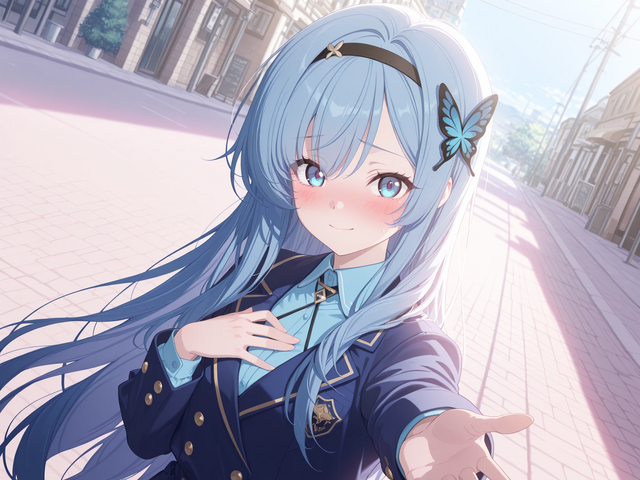
I turned to see a girl sprinting toward me, her shoes slapping against the pavement, arms flailing like she’d just chased a bus for five blocks. Her blue hair flowed behind her, catching the light like polished crystal, and a butterfly-shaped clip fluttered dangerously close to detaching. She wore a formal blue coat, which honestly didn’t quite fit her face. It was like someone combined a lab assistant with a cheerleader.
She skidded to a stop, hands on knees, breathing like she’d just outrun a fire alarm.
“I–I’m sorry,” she gasped. “I was supposed to meet you—I mean, receive you— I mean—!”
“Okay, okay, okay,” I said, holding up a hand. “Breathe first. Words second.”
She nodded, still winded, then straightened up, brushing down her skirt in embarrassment. “I’m Cyanae. I was supposed to… be your guide. I mean— me and the drone. But it flew off without me, and I didn’t realize until... well, now.”
“Cyanae, huh? ... Did the name come first? Or did you name yourself that because of your hair color?”
“H—Huh?”
“Never mind that.”
She turned red almost instantly.
The drone, of course, chose that exact moment to intervene.
“Research Assistant Cyanae is a junior biologist affiliated with Prometheus Institute, specializing in environmental ecology and fauna documentation. She was assigned to your orientation based on her exceptional fieldwork record and personality compatibility algorithms. She was named ‘Cyanae’ due to the hue of her hair. Her favorite animal is the Morpho butterfly, whose wings are considered a visual complement—”
“S—shut up!” Cyanae cried, grabbing the drone out of the air. “How do I turn this thing off?!”
The drone continued unfazed, projecting holographic data about her hair pigment composition and probable mood index. I had to step in before she destroyed that thing. I pretty much don’t want to be responsible for any damages caused by my arrival.
“Alright, alright, both of you,” I snapped. “Let’s just continue the tour before I decide that this assignment is not worth it.”
Cyanae let go of the drone, flustered and muttering apologies under her breath.
“Um, there are... several key areas we need to visit,” she began, brushing her bangs behind her ear and trying to regain her professionalism. “I’ll be guiding you through the rest of them. Hopefully without any more surprises.”
“Yeah, I know that,” I replied. “My problem is that your drone wants me to walk all the way there.”
Cyanae blinked, then smiled awkwardly. “Oh! Your ride is actually parked back at the train station. It was supposed to meet you... when... You arrived.”
“... You mean I walked away from my ride?”
“Yes. Sorry.”
“... Well, I’m not walking all the way back there.”
“Oh...” Cyanae looked mortified. “Wait here, please.”
She turned away, pulled out her phone, and made a quick call. I could hear the stilted conversation even from here—she was apologizing to someone, likely a senior colleague or maybe the transportation AI. She kept glancing at me between words like she was trying to downplay how badly this had already gone.
Poor girl. I was used to bad first impressions. This was probably her first.
After she hung up, Cyanae turned back to me. “Our ride’s on the way.”
“Right.”
And then there was nothing. We just stood there in silence, because neither of us apparently had anything interesting to say.
All that I can say is that the sea breeze here is kind of brutal.
“Nice weather,” I offered.
“Yes,” she said quickly, nodding. “The s-science is... complicated.”
And so we waited. It wasn’t the worst welcoming committee I’ve ever had. But it was definitely in the top three.
Fortunately, it didn’t take long before a sleek white car pulled up to the curb in front of us. The thing looked like a futuristic luxury sedan.
“Here it is!” Cyanae announced, a little too cheerfully, as if trying to compensate for the earlier disaster.
I opened the passenger door and peeked inside. There was no driver, and no steering wheel in sight. Just a dashboard with a touchscreen, some ambient blue lighting, and enough legroom to offend most economy airlines. I slid into the front seat while Cyanae skipped over to the other side and sat where a driver normally would. The drone, silent as ever, glided into the backseat and perched like a smug metal parrot.
Cyanae pulled out her phone and scanned it against the console. A brief chime, a flash of light, and the car’s onboard system hummed to life. And after a brief pause, the car carried us towards our next destination.
“So... self-driving cars,” I mused, mostly to break the silence. “Didn’t really see any of these back in Neu Berlin, or Sakai... or Kowloon.”
Cyanae nodded, hands neatly folded in her lap. “That’s because Olympia uses a city-wide central control hub. It’s... like a massive neural network, interfacing with every autonomous system here. The cars, the drones, even some of the public kiosks and signage. They all rely on real-time environmental data processed through that hub. Without it, most of these machines can’t operate properly.”
“Huh. So you’re saying without the hub, this car would just sit here like a very expensive couch on wheels?”
“Er... You could say that, yes. It needs constant input from the surrounding area to function safely and efficiently.”
I glanced back at the drone, half-expecting it to be taking notes on her behalf.
“Why don’t the other subsidiaries use this system then? Too expensive?”
“I’m... not sure,” Cyanae admitted, adjusting her headband. “Perhaps it’s cost. Or maybe the other regions aren’t built for it. I mean, Olympia is a purpose-built city. The others had to… grow around what was already there.”
“Right,” I muttered. “Feels like a cop-out answer. But I guess Prometheus has the luxury of being assisted by three other companies.”
Outside the window, Olympia unfolded itself in layers. Buildings of polished steel and soft white stone, balconies overflowing with vines, and automated irrigation. The streets were clean and populated with people who didn’t seem to notice or care about the drones gliding above them. Some looked local, others were androids. A few kids were even chasing after a small hover drone like it was a pet.
“Huh. You’d think people would be more freaked out by floating eyeballs scanning them in public,” I muttered.
“They’re used to it. In Olympia, humans, androids, and drones live together like... well, an ecosystem. Think of drones like urban wildlife. The little ones do maintenance, sanitation, and parcel delivery. Bigger ones handle transport. And there are even larger models for construction and logistics. But they all fall under the same classification of ‘drones.’”
I let out a soft chuckle. “A mechanical ecosystem, huh? Feels pretty dystopian.”
Cyanae smiled sheepishly. “We try to make it functional, at least.”
It was quite absurd, really—an entire artificial food chain of machines, each one slotted neatly into a place designed by committee. Still, I couldn’t deny it had a kind of beauty.
After a moment, I turned to Cyanae. “So what do you actually do? Besides awkwardly guiding corporate guests around the city?”
“Well,” she straightened up a little, “my primary job is ecosystem monitoring. I help survey environmental health, checking for degradation, mapping soil quality, tracking reforestation, and species reintroduction. Olympia used to be forestland, so our expansion efforts always require assessment. My team handles that.”
“Huh. You make it sound noble.”
She turned her head slightly, embarrassed. “I just collect data.”
“And yet you’re the one showing me around. Don’t take this the wrong way, but... why not get someone more, uh... qualified?”
“Uh, that’s because...” She looked away. “Everyone else who usually handles inspections and tours is currently assigned outside the city. I was the only available staff member who was... familiar with Olympia’s infrastructure.”
So I got the intern.
I was about to ask what kind of work would drag all their regular guides out of town when the MAPCON drone buzzed to life behind me.
“Now approaching: destination two of eight,” it announced in its soothing, ever-pleasant tone. “Estimated arrival: twenty seconds. Please remain seated.”
I sighed. “Eight?”
Cyanae gave me an apologetic smile. “It’s... a comprehensive tour.”
“Well, then... let’s see if I could comprehend everything by the end of this tour.”
The car came to a gentle stop at the foot of a wide marble plaza. I stepped out, blinking against the sunlight reflecting off white stone. Before us stood a colossal archway—or rather, a gate that doubles as a monument.
The three of us walked underneath its looming shadow. The thing had to be 50 meters tall, at least. Greco-Roman architecture: clean-cut pillars, seamless joints, marble and steel fused like old and new shaking hands.
But what truly drew my eye wasn’t the gate itself. It was what stood inside it.
Centered beneath the arch, atop a giant circular pedestal, burned a fire. Not a flickering little ceremonial flame either. This pedestal was massive, at least several meters tall. The whole thing looked like a... a torch. A very big torch.
Open walls surrounded the plaza, letting light flood the space from all angles. The high, curved ceiling above us made everything echo faintly. And still, the fire in the center roared silently.
“What is this place?” I finally asked, more to myself than anyone.
The drone jumped in before anyone else could answer.
“This is the Fire of Prometheus, the foundational monument of the Institute from which it draws its name and core philosophy,” it declared in a chipper tone. “The fire above you is ever-burning, a symbol of both the light of knowledge and the first invention of humankind. Inspired by the ancient myth of Prometheus, who defied the gods to bring fire to man—”
“Right.”
“—he was punished for this act, bound to a rock where an eagle would eat his liver each day. The fire, therefore, represents not only innovation, but sacrifice—”
“Okay, okay, I get it!” I snapped for what seemed like the tenth time now.
Cyanae stepped forward, brushing a lock of blue hair behind her ear. “It’s... considered a sacred site. Or—well—‘important’ is the official term. Newcomers usually come here first for, um, motivation.”
“Motivation,” I echoed, raising an eyebrow. “For what?”
She nodded quickly. “Uh, you know… Inspiration, symbolic beginnings, that sort of thing.”
The drone floated slightly higher. “There is currently no empirical evidence to suggest the monument has any measurable motivational effect. No quantitative or qualitative study has been performed to verify this claim.”
“... You’re really good at killing the mood.”
Moving on, I took a slow walk around the central pedestal. That’s when I noticed three statues placed at precise angles around the torch, equidistant from one another. Together, they formed a triangle enclosing the flame.
Each one towered above us—maybe seven or eight meters tall. All of them depicted bearded men in robes, gazing toward the torch with stoic expressions. But they weren’t hunched or wizened. They were... ripped, like Olympian gods who just happened to be really into philosophy.
“What’s with the statues?” I asked, motioning toward them.
“They are—” Cyanae opened her mouth, but the drone beat her to it.
“Those are the Socratic Philosophers: Socrates, Plato, and Aristotle,” it babbled, like a proud tour guide. “They form the philosophical backbone of the Institute’s academic doctrine. Their teachings laid the foundation for critical thought, epistemology, ethics, metaphysics, and political theory. From dialectical method to ideal forms to virtue ethics—”
I tuned it out before it reached “post-Socratic legacy.” My eyes were still locked on Aristotle’s abs.
“Okay, but why do they look like... that?” I asked. “Are you sure they’re not some random Greek athletes or something? Is that the models they used when they made this statue?”
Cyanae hesitated, then laughed nervously. “I... actually don’t know. That’s just how they were designed. The proportions were personally approved by the CEO, Prof. Dr. Therasia Hypatia, Ph.D., D.Sc.”
“Sorry? That’s a real name?”
She nodded, a little too seriously. “Yes. Most people just call her Theresa, though. She’s the CEO and Rector of Prometheus University.”
“Oh. So it’s just another one of Heinrike’s sisters,” I muttered.
“Heinrike’s sisters?”
“Never mind,” I waved it off. “So what, is Theresa into buff, oily men?”
The drone chimed in instantly. “In ancient Greek society, physical beauty was considered a reflection of internal virtue and moral character. Prof. Dr. Therasia Hypatia, Ph.D., D.Sc., applied this philosophy and selected these forms based on the golden ratio. The dimensions of each statue are mathematically ideal and therefore scientifically—”
“Alright!” I exclaimed. “Let’s move on, shall we? I’m not very comfortable being surrounded by three buff men.”
We made our way back to the car. Cyanae did her little scanning thing on the touchscreen, and the vehicle whirred to life again. As it glided along the circular plaza, we made a full roundabout around the Fire of Prometheus.
“Now entering inner Olympia,” the drone announced. “This zone contains core operational buildings of the Prometheus Institute. These include Prometheus University, enrichment centres, museums, libraries, and other administrative centers. While the city’s purpose is scientific, a number of recreational areas, eateries, shopping centers, and limited residential units are available for convenience.”
We passed towering structures that looked equal parts elegant and intimidating. Most were constructed in that same neoclassical-meets-futurism style—dome-topped observatories, labs with names in Greek letters, and buildings so precisely symmetrical they gave me a headache.
Eventually, we pulled into a large roundabout in front of an enormous complex.
“Welcome to the Prometheus University Campus,” the drone said.
I sighed. “You’re going to make me walk again, aren’t you?”
Cyanae gave me a pleading look. “Just for a bit? You should at least see the interior. It’s... important.”
The car parked itself beside a polished granite walkway. Inside, the university’s main hall was exactly what I expected: intimidatingly vast, echoey, and overly obsessed with arches. We passed through high-vaulted corridors, watched over by more stoic sculptures and posters depicting things like the heliocentric model and Mendelian peas. I stopped once to admire a rotating orrery in the center of the atrium, but otherwise, I trudged through.
Even Cyanae, for once, seemed hesitant to explain anything. Maybe she could tell I wasn’t in the mood. Or maybe she was just saving me from another lecture on Platonic idealism.
After what felt like a polite-enough loop through the main wing, we returned to the car. Cyanae scanned her tablet again and set the destination. The car pulled away from the curb with its usual eerie smoothness.
“I’m sorry,” she said suddenly.
“Hm? What for?”
“I feel like I’m not doing a very good job showing you around,” she said, looking down at her hands. “You seem... bored. Or annoyed.”
I shrugged. “You’re doing fine. It’s just a lot right now, and I… kind of not in the mood for study tours. Honestly, I— … I just want to finish the tour and get to bed soon. Jetlag and all. Well… trainlag.”
Cyanae smiled weakly. “Okay. We’ll go a bit faster then.”
Things picked up a bit after the torch. We drove in silence for a while, the car gliding forward like a ghost across the sun-warmed roads of Olympia. The air was tinted orange now, filtered through the last hour of sunlight. Cyanae and the drone didn’t say much—probably out of courtesy. Or maybe they were finally picking up on the fact that I’d rather not get another unsolicited TED Talk.
Our next stop loomed before us like twin sentinels: two colossal buildings standing on opposite ends of a marble plaza.
“That’s the Grand Museum on the left,” the drone announced, “and on the right is the Grand Library. For convenience, they were placed facing each other in symmetrical balance—”
“Yeah, yeah,” I cut in, rubbing my eyes. “Symmetry. Ancient Greeks loved it.”
We parked just off the central plaza. I stepped out and stared up at the monoliths. The museum alone looked like it could fit a small city inside. Gleaming columns, massive engraved friezes, statues perched like silent guards. It felt like something ripped out of a dream about civilization, where everything was smarter, older, and far more expensive than I could comprehend.
“Fucking hell, man... Was it really necessary to make them this big?”
Cyanae walked up beside me, hands folded behind her back. “That’s just how it is here,” she said with a faint smile, trying to stay cheerful despite the sag in her posture. “In Olympia, knowledge is extensive. Everything else... well, not so much.”
“...Alright,” I muttered, adjusting my shirt a bit. “Let’s go in.”
She blinked. “Really?”
“Yup. It’s been a while since I’ve been to a museum.”
The museum’s entrance opened with a soft chime and a whoosh of sterilized air. Inside, we were greeted by cool marble floors, cascading banners with historical quotes, and holographic timelines that shifted as we walked by. The entire place smelled like old books and fresh glass cleaner.
There were signs directing visitors along a suggested path—which reminded me of IKEA, except that we couldn’t touch any of the displays. We stuck to it, mostly. The halls stretched wide and high, crammed with display cases, replicas, and artifacts that spanned millennia—both from Caelum and Earth.
We walked for what felt like hours. Every now and then, Cyanae would chime in with facts—always gentle, always unsure if I even wanted to hear them. Sometimes I asked questions just to keep her talking, and she would light up every time.
Eventually, between a wing of reconstructed ancient temples and an exhibit about early Alterra outposts, I glanced at a hanging map of Thasselia.
“...Hey, Cyanae,” I asked, my voice echoing faintly. “What’s the deal with this place? I mean... Thasselia. What am I walking into?”
She stopped walking and turned toward me. “Thasselia isn’t like any other nation. It’s not one unified country. It’s a collection of independent city-states—each worshipping their own god or goddess.”
I raised an eyebrow. “Yeah, I heard that. So... actual religion?”
She nodded. “More than that. Some of the gods and goddesses are real people. Or at least... they are the vessels for the Archons.”
I stared at her. “Huh. So you’re telling me the gods and goddesses of this land mingle with their followers and not just sit on a golden throne somewhere?”
“Well,” she hesitated, “not all of them. But some, yes. The four major cities are Elyria, also known as ‘the Open Harbor’ because of its relative wealth as a maritime trading hub. Kharomnos, the ‘Unbroken Line’ because of its warrior culture. Last but not least is Sophara, also known as the ‘City That Argues.’ They are the closest city to Olympia. Then there is Aionteia, which is basically the closest thing we have to a central government. Unfortunately, their god doesn’t have a human body, so it’s a bit hard for them to claim authority over the other.”
“They really need to up their branding—like what the hell are those names? ... And— which of those is the troublemaker?”
“Uh, I don’t want to point one or the other. Each city has its petty grievances. Sophara is the one who sent an envoy to Eisen Blut. Their patron deity is Thesmara, the Goddess of Knowledge, Logic, and Rhetoric.”
“Sounds fun at parties.”
“Yes, well,” Cyanae said with a small smile, “she once got into a debate with Professor Theresa.”
“You mean your muscle-statue-loving CEO?”
She nodded. “Yes. They argued over whether magic should be considered a legitimate field of knowledge. Thesmara said yes. Professor Theresa said no.”
“Let me guess,” I muttered, “Theresa doesn’t like things she can’t quantify.”
“Correct,” Cyanae said. “It got so heated that Prometheus Institute and Astramanteum—the oldest academy in Thasselia—became rivals. Uh, but I can assure you, it’s not that bad.”
I scoffed. “... Only in academia.”
We got a little lost trying to find the exit. Again, like IKEA. By the time we stumbled back into daylight, the sky had turned to orange. So, we piled back into the car and moved on to our next destination.
We passed through the Enrichment Center. The drone said something about some vast underground facility, but I was too tired to care. Then we passed through the administrative district next—a bit quieter than the rest of Olympia.
Finally, we made our way back toward the Fire of Prometheus. This time, the monument glowed like a lantern in the dusk. Its flame danced gently against the wind, casting shadows over the open plaza.
The car curved along a coastal road before finally pulling into a quiet apartment complex perched over the bay. The water shimmered with fading light. Everything was hushed, like the city was holding its breath before night fell.
The car stopped, and Cyanae stepped out first. I followed, grabbing my luggage from the trunk. She looked hesitant, wringing her hands. The wind tugged at her hair.
“Thank you,” I said. “For the tour. And for sticking with me.”
She bowed her head slightly. “I... I’m sorry it didn’t go the way it was supposed to. I didn’t even get to greet you properly at the station. I—I really thought I could do better.”
I saw her eyes start to glisten. Just barely. She might burst into tears in a few seconds now if I don’t say anything. “... Hey. Don’t apologize. You did well. In fact, you were a lifesaver. If it weren’t for you, I’d still be back at the station arguing with a floating eyeball.”
She let out a shaky laugh.
I gave her a small smile. “Get some rest. I’m sure tomorrow’s gonna be busy.”
She shyly rubbed her eyes and nodded. “Y-yes. I’ll— I’ll come visit… if I’m not busy.”
“You better. You won’t regret it.”
She smiled again, for real this time, and waved me goodbye. Then she got back in the car. I watched the vehicle drift off into the night, her silhouette framed faintly in the window, lit by the interior’s blue lights.
I turned toward the apartment. One day in Olympia, and already I was neck-deep in the philosophy of this city. Hopefully my new assignment won’t require me to test my IQ.
End of Chapter 1.