The End of the Line
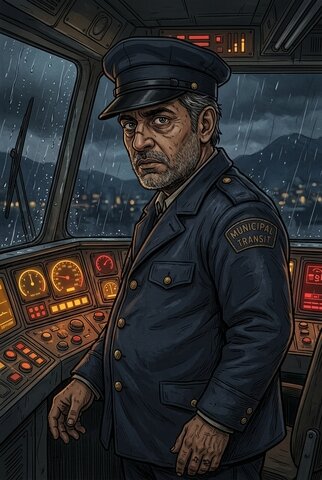
Host: Tariq (Male, 44) — Mag-Lev Express Conductor
Time Remaining: 1,430 Minutes
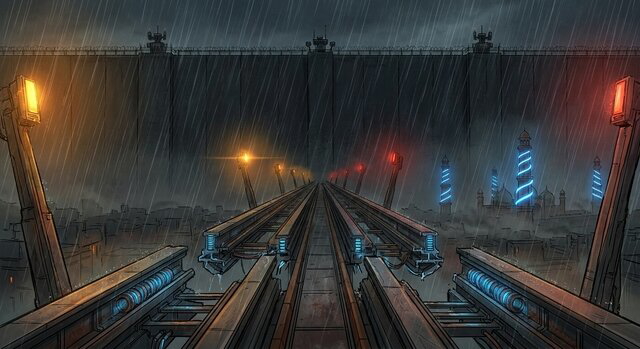
Location: Transit Corridor 09, Approaching Sector 1 Perimeter Wall, Lahore Simulation
The breath in my throat is not mine.
It comes in a ragged, sour pull, heavy with the taste of cheap clove tobacco and chicory root. My teeth ache with a dull, throbbing pressure around the lower left jaw, and when my hand jerks upward to touch the pain, thick, calloused fingers scrape against a rough jawline coated in three days of graying stubble.
I do not know this face. I never do.
C’mon, Sam. Figure it out.
The thought is not a voice in the room; it is an echo embedded in the marrow of whatever body has caught me this time. It arrives every time the darkness tears open, the only word that stays pinned to the back of my mind while the world rebuilds itself around my skin.Sam.Not a rank. Not a title. Just a sound to anchor the drift.
The world slams into focus with a screech of shearing iron.
“Conductor!” A voice screams through the narrow cabin door behind me, accompanied by frantic, rhythmic pounding against reinforced polymer. “The bypass failed! The line is red! Open the door!”
I blink against a blinding cascade of amber light. My eyes—these heavy, rheumy eyes that belong to a man who has worked night shifts for twenty years—burn from the glare of six overlapping holographic displays.
LINE 04 EXPRESS: MAXIMUM TRANSIT
SPEED: 218 KM/H
BRAKE LINE HYDRAULICS: DISCONNECTED [REMOTE OVERRIDE]
IMPACT ESTIMATE: 00:03:12
Through the reinforced glass of the forward cockpit, Lahore spreads out like a bruised, electric wound beneath a suffocating blanket of low cloud. It is night, but the city does not sleep; it festers in neon. High above the sprawl, slicing through the perpetual chemical haze, the four ancient minarets of the Badshahi Mosque stand wrapped in blinding spirals of corporate LED ribbons—cold electric blue and sterile white—pulsing advertisements for cryogenic insurance into the rain. Below them, the dead canal bed runs like a jagged scar through Sector 3, its waters replaced by sluggish, rust-red runoff that catches the streetlights.
Acid rain hammers against the windscreen in rhythmic, oily sheets, streaking the glass with iridescent grease.
My hands—Tariq’s hands—move before I can tell them to. The muscle memory is violent and automatic. My left thumb slams down on the secondary magnetic decoupler, my knuckles white against the black composite grip.
Nothing.
“Emergency bleed,” I mutter. My voice is a deep, raspy rasp, shredded by years of chemical smog and raw tobacco. It sounds foreign in my ears, yet the vocal cords obey the panic of my thoughts. “Bleed the lower rail. Release the guide shoes.”
I yank the heavy yellow manual lever beside the throttle. A pneumatic hiss screams beneath the floorboards, followed by the sickening smell of vaporized copper and ozone. The train lurches violently to the left, tossing my heavy torso against the metal frame of the control console. My ribs scream in pain—Tariq already had bruised ribs, an old injury flaring up under the sudden violent deceleration that fails to take hold.
The digital velocity readout flickers, drops two digits, and then surges right back up as the automated track grid forces the mag-lev coils to compensate.
SPEED: 224 KM/H
PERIMETER SECTOR 1 — TRACK TERMINATED AT POST 44
OBSTRUCTION: 80-METER REINFORCED PERIMETER BULKHEAD
They dismantled the track. The realization hits me not as a technical calculation, but as cold bile rising in the throat. The elite high-rises above the eighty-meter line have cut off the lower transit corridor, and this train is being thrown directly into the concrete foundation of the Barrier Wall.
“Open the damn door, Tariq!” The shouting in the corridor behind me rises into a chorus of terror. Passengers are throwing themselves against the cockpit latch.
I reach out, my thick fingers trembling as I slap the manual release panel. The pressurized seal hisses open, and the cabin door slides back with a shudder.
The smell hits me instantly: wet wool ponchos, spilled sweet cardamom tea, cheap synthetic cumin pastries, and the sharp, sour musk of forty terrified commuters. The lights in Car 1 are strobing in emergency crimson. Men in refinery overalls are clutching the overhead rails; a woman in an embroidered shawl is clutching two weeping children against her chest, whispering frantic verses in Punjabi into their hair.
“The brakes are dead,” I tell them, my voice cutting through the panic with the flat, terrible clarity that always takes me over when the loop begins to close. “Move to the rear cars. Disconnect the manual couplings between Car 3 and 4 if you can reach the latch. Go. Now!”
They don’t wait for an explanation. The crowd surges backward in a wave of shoving shoulders and frantic prayers, trampling dropped bags and paper transit tokens into the wet rubber floor.
I turn toward the secondary manual brake housing mounted in the wall of Car 1, reaching for the steel crowbar strapped to the emergency bulkhead. My hands are steady now, running on the strange, detached adrenaline that belongs to whatever I am beneath Tariq’s skin.
Then I see him.
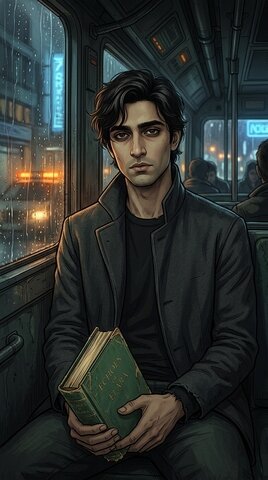
He is sitting in seat 14B, next to a rain-streaked window that reflects the strobing red emergency beacon.
Amidst the screaming rush of fleeing commuters and the violent swaying of a train tearing toward its own destruction, he is entirely still. He wears a dark, high-collared jacket made of dense, unadorned wool—practical, timeless, utterly indifferent to the corporate logos plastered over the train’s bulkheads. His hair is thick and dark, falling slightly across his brow, and his profile has that quiet, clean sharpness that I have looked for across a thousand waking nightmares.
He is twenty-three years old. He is always twenty-three.
In his lap rests an open book. Not a data slate, not a flickering retinal projection. A real book, bound in faded green cloth, its paper pages yellowed and curled at the edges. A luxury that could buy half a district in the lower wards.
The air leaves my lungs in a sharp, involuntary gasp that has nothing to do with Tariq’s bruised ribs.
My soul—whatever fragment of me carries across the dark between bodies—snaps taut like a plucked wire. The terror of the train, the screaming passengers, the smell of burning copper—everything fades into a distant, muffled hum.
I take two stumbling steps down the tilting aisle, gripping the backs of the bolted plastic seats to keep my balance.
“You,” I breathe.
The young man turns a page calmly, his long, pale fingers smoothing the crease of the paper before he lifts his head.
When his eyes meet mine, there is no confusion. There is no searching glance at my heavy, aging frame, no hesitation over Tariq’s gray-flecked beard, his broken nose, or his stained conductor’s badge. He does not see Tariq. He looks straight into the center of my pupils, past the borrowed flesh, past the dying nerve endings, directly at the thing screaming inside the skull.
His dark eyes soften with an exhaustion so ancient and profound it makes my knees want to buckle.
He closes the book with a soft, drythwack.
“You’re late this time, Sam,” he says.
His voice is low, clear, and steady, cutting effortlessly through the roar of the magnetic coils tearing themselves apart beneath our feet.
I grip the headrest of seat 14A, leaning down until I am inches from him. Tariq’s heart is hammering like a trapped bird against his ribs, but my mind is spinning in freefall.
“Who are you?” The words tear out of me, jagged and desperate. “Why do you know that name? What is this place?”
A faint, sad half-smile touches the corner of his lips, but it doesn’t reach his eyes. He slides the green cloth-bound book into his inner coat pocket, his movements deliberate and unhurried, as if we were sitting in a quiet tea stall near the Anarkali bazaar waiting for the rain to pass.
“You ask me that every time,” he murmurs. He tilts his head back against the seat, looking up at me. “And every time, I tell you to hold on.”
“Tell me your name,” I demand, reaching out. My large, calloused conductor’s hand hovers in the air between us, trembling. I am terrified to touch him—terrified that if I lay a finger on his coat, he will dissolve into static like everything else in my fractured memories. “Please. Just tell me who you are.”
“Alex,” he says softly. He doesn’t flinch as the train violently skips a magnetic node, throwing the entire car five inches into the air. The floor groans, metal bucking under the chassis. “My name is Alex. You know that, Sam. Your hands remember, even when your head doesn’t.”
Alex.
The name hits me like an electric current. It isn’t a new thought; it is an old key slipping into a lock that has been rusted shut for a century. A sudden phantom sensation washes over me—not Tariq’s memories, but mine: the scent of woodsmoke, the cold press of glass against a forehead, the sound of someone breathing softly in the dark while rain taps on a tin roof.
“Alex,” I repeat, the syllable tasting like clean water against Tariq’s smoke-cured tongue. “Why are we here? Is this a punishment? What did I do?”
Alex looks at me, and for a fraction of a second, the calm veneer cracks. A raw, jagged agony flashes across his young face—the look of a man who has watched the same person burn at the stake sixty times and cannot look away.
“You didn’t do anything,” Alex whispers, his voice tightening.
WARNING: PERIMETER COLLISION IN 00:00:15VELOCITY: 240 KM/H
Through the front windows, the view has vanished. The smog and the neon minarets are gone, replaced entirely by a sheer, monolithic cliff of blackened reinforced concrete. The Barrier Wall fills the entire horizon, rising straight into the storm clouds like the headstone of a continent.
The screech of the train’s undercarriage is deafening now, a high-pitched scream of metal grinding against metal as the magnetic guidance completely gives out. The ceiling panels tear loose, raining sparks and fiberglass down into the aisle.
The passengers in the rear cars are screaming, but in Car 1, there is only the two of us.
“Alex,” I say, panic finally breaking through the strange trance of his presence. I reach down, Tariq’s heavy arms moving to haul him out of the seat. “We have to jump. The maintenance hatch in the floor—”
“It won’t work, Sam,” Alex says gently. He doesn’t resist as I grab his arm, but he doesn’t stand either. His grip is surprisingly firm as his fingers close around my wrist. His skin is warm. Impossibly, miraculously warm in this freezing, ozone-choked train. “The track ends here. It always ends here.”
“I don’t want to die again,” I choke out. The confession is humiliating, torn from the deepest, most terrified corner of my consciousness. “I don’t know where I go when it goes black. It hurts, Alex. It hurts every time.”
Alex stands up then. He steps into the aisle, closing the distance between us until his chest is inches from mine. Even in Tariq’s taller, broader frame, I feel fragile under his gaze.
He lifts his free hand, his bare fingers coming up to touch the rough, grease-stained skin of my cheek. The gesture is so intimate, so terrifyingly familiar, that the roar of the impending collision completely disappears.
“I know,” Alex whispers, his thumb brushing against my cheekbone. His eyes are bright with unshed tears, reflecting the white glare of the concrete wall rushing to meet us. “I know it hurts. But I am right here. Look at me, Sam. Don’t look at the wall. Look at me.”
The front of the train hits the concrete at two hundred and forty kilometers per hour.
There is no sound. Sound requires air, and the impact obliterates the atmosphere in a single, catastrophic instant. The forward cockpit collapses like a crushed paper lantern, the steel bulkheads folding in accordion pleats of shorn metal and orange fire.
The world does not go black. It turns a blinding, absolute, incandescent white.
The kinetic shock hits my borrowed spine, shattering Tariq’s bones in a microsecond of unimaginable pressure. But before the nerve endings can register the agony, before the host’s brain can drown in its own trauma, Alex’s fingers tighten around my hand.
He pulls me toward him into the white fire.
His voice is the last frequency that survives the collapse of the world, vibrating directly through the bones of my skull:
“Find me in the rain, Sam. Don’t let them take your name.”
Then the white shatters into a billion cascading strings of silence, and I am falling.