
Chapter 1
Palaces sickened differently from people.
A fisher’s hut took fever openly. Its roof sweated through the night. Its children coughed into the same sleeping mat, and when the rice jar finally emptied, everyone in the house already knew which hunger had done the killing. A palace concealed its illness beneath limewash and incense. It changed the servants before it changed the sheets. It rang the consecration bells louder over the sound of retching, until prayer and sickness became the same noise. By the time anyone sent for a healer, the illness had already learned to dress like a courtier — silk over the wound, powder over the smell.
Sinta Avelar smelled it before she saw the walls.
She entered Bantala Palace beneath a basket of dead eels, their bellies split and packed with brine to hide a living woman’s breath. Even through the rot she could smell the sickness underneath it — sweeter, wronger, dressed in incense the way a corpse is dressed for viewing.
The basket rode between her knees in the flat bottom of a provision boat, its wicker ribs slick with river water. Every slap of the hull against the current woke another rank breath from the catch. The boatman had layered crushed tanglad over the eels to sweeten them, but the leaves had surrendered sometime before dawn, and now their green sharpness only made the rot more elaborate, more deliberate, as if the smell itself had been dressed for an audience.
“Do not look at the windows,” said Brother Ilario.
He sat across from her in a gray lay-brother’s coat, clean-shaven and dry despite the mist beading on every other surface of the boat. Men of the Ascendant Church always seemed dry. Rain avoided them. Sweat feared them. Other people’s blood vanished from their cuffs before it could stain. A bronze ladder hung at his throat, seven narrow rungs climbing toward a small, faceless disk meant to be the Father.
Sinta kept her eyes on the eels. “Which windows?”
His mouth tightened. He had expected fear from a provincial woman hauled through the corpse gate before sunrise — fear would have reassured him, put everyone back on the proper rung of his ladder.
The boat slid into the shadow of the eastern wall. Above them, white stone rose from the black water in terraces of arches and galleries, its rain gutters carved into open mouths that had been drinking storms for three hundred years. The first Veyran governors had built their fortress over a riverside shrine, then broken up its foundation stones for latrines. Sinta’s grandmother had told her that with something close to satisfaction, as though stone kept a ledger of every indignity done to it, and meant, eventually, to collect.
Stone remembers, Apo Yna used to say. Water remembers better.
The river here tasted of iron and lamp oil, of fish blood and the night soil of half a million people crowded onto too few islands. Sinta felt its weight pressing up through the boat’s planking into the soles of her sandals. It did not speak to her — rivers rarely wasted words on strangers — but its attention moved over her skin like something deciding whether she was worth remembering too.
Brother Ilario leaned forward. “You were instructed to bring no charms.”
“I brought medicine.”
“Your person will be searched.”
“Then your searcher will discover that women have pockets.”
The boatman coughed into his fist to swallow a laugh. Ilario did not look at him. Men who served power learned early which sounds had simply not occurred.
A gate waited in the wall ahead—low and semicircular, barred with iron gone black from river water and age. No royal barge passed beneath that arch. It admitted spoiled meat, kitchen ash, condemned prisoners, and servants who died without the courtesy of daylight.
The corpse gate.
Two Crown Guards waited on a stone landing visible beyond the bars. Their lacquered breastplates bore the Returning Sun of House Vireya: gold rays breaking through a bank of black cloud.
The boatman drew in his oars. Without their steady splash, Sinta heard water striking the palace foundations and something smaller scratching within the tunnel beyond.
One guard leaned over the landing and lifted the cloth covering Sinta’s basket. The smell reached him before his hand reached the eels.
“These are foul.”
“They are dead,” Sinta said. “It changes the flavor.”
Brother Ilario produced a folded order bearing three seals. The guard read only the largest — the red wax of the Office of the Interior — before waving them through. Whatever authority the two smaller seals claimed, the palace guard preferred not to examine it.
Chains tightened inside the wall.
The iron gate rose slowly, shedding black water from its bars. Each drop struck the river like a small nail.
The route told Sinta more than the written order would have. The Church had fetched her here. The Crown was hiding that fact. And neither one trusted the palace guard with the reason why.
Someone important was dying.
Someone more important was afraid of what that death would say out loud.
The boat passed beneath the raised gate and entered a tunnel cut through the palace wall. The ceiling lowered until Brother Ilario had to bow his head. Old foundation stones crowded the newer masonry, darker and less regular, several bearing the scraped remains of faces turned sideways beneath the limewash.
The palace had not been built upon empty ground.
It had been built upon something forced to carry its weight.
At the tunnel’s end, the boat struck a wet stone landing beneath the receiving cellars. Sinta climbed out with the eel basket in her arms. Fish water ran down her skirt while the Crown Guards watched her as one more unpleasant thing delivered before sunrise.
Behind her, the chains groaned again.
The corpse gate descended, bar by bar, sealing away the river and the last easy road out.
A kitchen porter took the eel basket without looking at Sinta’s face. The guards recorded the delivery, the boatman, and the number of bodies entering from the river. They did not record her name.
Brother Ilario led her through a narrow drainage corridor beside the landing. Water ran beneath an iron grate in the floor, carrying fish blood, mud, and refuse back toward the river. The passage ended at a windowless room once used to inspect sailors and cargo arriving through the lower gates. The palace still called it the receiving cellar, although little received there was welcomed.
They searched her behind a woven screen that concealed her body without protecting her dignity. The room smelled of tallow, mildew, and the vinegar used to disguise older stains.
A matron with onion on her breath found the packets sewn into the seams of Sinta’s underskirt: dried sambong, bitter bark, salt knotted in banana fiber, needles of silver and boiled bone, a coil of red thread, three river stones worn smooth as teeth, powdered charcoal, a stoppered vial of her own blood, and a sliver of black wood polished to a soft shine by four generations of women’s thumbs.
The matron held the wood up to the lamplight. “What saint is this?”
“None you would know.”
Brother Ilario took it from her hand. It looked smaller between his pale fingers, as though his touch could shrink a thing simply by not believing in it. “I said no charms.”
“You said the patient hadn’t slept in nine nights, vomited after sunset, and spoke in the voices of dead relatives. If you wanted a physician, you would have called one.”
“We did.”
“Then you have learned what physicians know.”
The matron crossed herself — not from piety, Sinta thought, but because the sentence had sounded too much like a curse to leave unanswered.
Ilario turned the black wood over once more. It had been cut from the doorpost of the Avelar birthing house before Church soldiers burned the building to its footings. Sinta’s mother had carried it beneath her tongue during the flight into the hills, the way a woman carries a tooth she isn’t ready to lose. To a priest, it was contraband superstition. To Sinta, it was an address — without it, the women who had taught her everything she knew might not find their way to her when she called.
He gave it back.
That frightened her more than if he had snapped it in half.
“From this moment,” he said, “you will speak only when questioned. You will touch nothing without permission. You will not address whatever voices you believe live in this place.”
“If you believe there are no voices, why forbid me from answering them?”
His eyes cut toward the matron. “Dress her.”
They stripped her of her rain-darkened saya and gave her the coarse brown wool of a palace laundress instead. The bodice pinched under her arms. A white kerchief swallowed her hair along with the three small blue marks tattooed behind her left ear — marks that named no god, only three promises: never to sell a cure she knew was false, never to deny water to whoever asked for it, never to carry another person’s spirit without their consent. The old empire had called such markings the alphabet of the Pit. The modern Church called it rural disfigurement. Her grandmother had simply called them reminders, because power made liars out of people long before it ever made monsters out of them.
Brother Ilario led her up through the servants’ passages, and the palace woke around them by degrees.
In the kitchens, cooks split silverfish from throat to tail and rubbed the wounds with salt. Rice steamed in copper cauldrons wide enough to bathe a child in. Boys turned spits under pigs already glazed and stuffed with tamarind leaf, garlic, and green mango, though the morning meal was still hours off. Royal hunger, it seemed, required rehearsal.
Sinta counted six trays already prepared for the private chambers upstairs: soft eggs floating in ginger broth, purple rice cakes, smoked river eel dressed with sour greens, sliced lanzones, curds of goat’s milk, and a bowl of chocolate whipped until its foam stood up like a small brown storm cloud. One tray sat untouched beside the washing sink. Flies crawled over its fruit but would not land on the broth.
She slowed.
Ilario caught her elbow. “Walk.”
“Whose tray is that?”
His grip tightened. “You were told —”
“Flies eat dung. They drink from corpses without complaint. And yet they won’t touch that soup.”
A scullery girl dropped her ladle. Copper rang against tile, sharp enough to turn every head in the kitchen, and the girl’s face went the gray color of old ash.
There, Sinta thought. Not guilt. Recognition.
Before she could ask anything further, the kitchen steward swept toward them — a vast man in a saffron coat, jeweled keys knocking against his belly with every step. “The tray is for the dogs. Brother, must your new laundress inspect my kitchen?”
“She is new,” Ilario said, as if that answered anything.
“Then teach her where to keep her eyes.”
The steward smiled at Sinta with teeth too perfect for his pinprick pupils, wakeleaf powder still dusting the hair beneath his nose. “The palace devours curious girls.”
Sinta looked past him at the scullery girl, still frozen by the sink. “Then it must be fed often.”
Ilario pulled her away before the steward could find an answer worth giving.
They crossed from the kitchen’s heat into a colonnade washed pale blue with early light. The tiles underfoot told the story of the Liberation in glazed color: Veyran ships burning in Bantala Bay, white-robed patriots raising the first flag of the United Shores, General Esteban Vireya accepting the surrender of the last foreign governor. One tile broke the pattern — a woman’s bare foot lingered at its edge, toes ringed in gold, while the rest of her body had been chiseled away and replaced with the general’s crimson cloak.
Sinta knew that foot.
Every child raised in the Stormward Isles knew it, although their teachers called the story sedition and moved quickly past it. It belonged to Ilaya Silangin, the Umalagad who had bound the island armies together under one shared oath before the harbor ever fell. General Vireya arrived only after the victory was already won. Ilaya vanished before the feast that celebrated it.
History is like a sick man, Apo Yna used to say. Listen to what it repeats. Touch what it hides.
At the far end of the colonnade, four guards stood before a door carved with ladders and suns. Their captain wore no house colors at all. His armor was southern blackwood laced over boiled leather, and a white crocodile flower had been painted just below his throat.
Doragos.
So the southern dynasty already had men standing inside the royal apartments. The newspapers still printed smiling portraits of the Crown Prince beside the vice-Timon’s daughter, murmuring about unity and continuity and twelve more peaceful years. But palace doors understood politics more honestly than newspapers did. A guard posted outside a bedroom was an ally. A guard posted inside it was a hostage-taker who simply hadn’t announced himself yet.
The captain barred their way with one arm. “Her?”
“By order of the Interior Minister,” Ilario said.
“The prince ordered that no one enter.”
“The Dayang’s seal outranks the prince’s nerves.”
A woman’s voice came from behind the door. “Let them pass.”
The guards stepped aside at once.
Dayang Amara Vireya stood beside an open window with the morning gathered behind her like an audience. She wore mourning white though no death had yet been declared — the cloth piña-thin at the sleeves, stiff with seed pearls across the bodice, each one worth more than a fishing boat in Sinta’s village. Her hair had been braided without a single jewel in it, and that absence was more deliberate than any crown could have been.
Portraitists gave Amara her father’s long eyes and her dead mother’s merciful mouth. In person, the mouth was not merciful at all. It was a blade someone had carefully taught to smile.
“Leave us,” Amara said.
Brother Ilario bowed. “Your Grace, the Cardinal instructed —”
“The Cardinal instructs heaven. This room remains within my jurisdiction.”
He withdrew. The guards shut the door behind him, and Sinta was left alone with the most powerful woman in Sangdaya, and the king who was dying beneath her care.
Aurelio Vireya lay behind curtains of gold-threaded gauze. Bowls of cut pomelo and burning resin crowded the bedside tables, and every window in the room stood open, yet the air still held the sweet, swollen smell of a flower left too long in its water.
Sinta knew that smell.
Not death. Something refusing to finish becoming death.
“You stared at the kitchen,” Amara said.
Sinta looked at her directly. “Your servants stare at everything.”
“My servants know the difference between seeing something and being seen doing it.” Amara crossed the room without hurrying. “What did the flies tell you?”
So the Dayang had watchers in the kitchen — or she had simply learned to read Brother Ilario’s face like a report. “That someone washed bitterroot out of a bowl with lye and vinegar. The flies don’t care for what’s left behind.”
“Poison?”
“Perhaps medicine given in a poisonous measure. Perhaps someone wants a healer standing in this room to say the word poison out loud, so they don’t have to.”
Amara’s expression didn’t change, but her thumb worried at the edge of her forefinger — ink had settled permanently into the cuticle there, a minister’s stain no amount of washing would lift. “You understand why you were brought here?”
“Because your physicians failed.”
“Three physicians. Two surgeons. Seven priests. A saint’s finger preserved in crystal.”
“Did the finger offer an opinion?”
For one unguarded moment, Amara nearly smiled. “It sweated.”
“A troubling symptom, in a finger.”
The almost-smile vanished as quickly as it had come. “My father is meant to stand before the people in five days and renew the Pact of Tides. If he cannot, the Assembly may declare him unfit to rule. House Doragos will demand an emergency Timon to replace him. The Church will demand temporary custody of the Crown seal until a successor is named. And my brother will demand whatever the last person in the room happened to tell him to demand.”
There was no warmth in her voice when she said brother. There was too much of it when she said father.
“And what do you want?” Sinta asked.
“Five days.”
Sinta stepped closer to the bed.
Kings, she was discovering, became smaller once stripped of their witnesses. Aurelio’s cheeks had collapsed inward around the bone. Gray stubble silvered his jaw. His famous hands — the same hands reproduced in every schoolbook, distributing grain, clasping soldiers’ shoulders, laying foundation stones — lay curled on top of the coverlet like two pale animals huddled together for warmth.
A narrow cord circled his left wrist: red, yellow, black, the colors of an old threefold binding. Someone from the Church had cut it at some point and retied it wrong.
Sinta pressed two fingers beneath his thumb.
His pulse moved slowly. One beat. A pause. Two beats crowding close together. Then a pause long enough to invite real fear before the next one finally came.
Not weak, she realized. Interrupted. Something was reaching in and holding the rhythm hostage between beats.
She lifted an eyelid, pressed his ankle, leaned close enough to smell his breath — bitter almond, old blood, incense, and underneath all of it something green and wet, like a plant crushed and left in standing water. She checked the sheets, the chamber pot, the pale crescents under his nails. No yellow in the eyes. No swelling at the tongue. His urine ran dark but not scant. The physicians had bled him. The priests had smoked him with resin until the walls wept soot. Someone — a very devoted someone — had pressed a burning prayer directly against his chest, leaving seven small ladder-shaped blisters climbing toward his collarbone.
“Who tied this cord?” she asked.
“My mother. Twenty-nine years ago.”
“Your mother is dead.”
“That has not stopped her from advising the household.”
Sinta glanced up at Amara. The Dayang’s face stayed composed, but her hand had gone still.
“What does she say?”
“That depends entirely on who’s listening.”
A careful answer, and an old one. In the years before the conquest, an Umalagad would have questioned every witness in a room like this one separately — compared how the dead woman’s voice moved through each of them, examined exactly where and how she chose to manifest, weighed whether the visitation was ancestor, imitator, hunger, guilt, or plain fraud dressed up in grief. The Church had solved that uncertainty more efficiently: declare all five possibilities equally demonic, then send the royal family a private invoice for the exorcism.
Sinta untied the wrist cord.
The king’s eyes opened.
They were not clouded by fever. They fixed on Sinta with the terrible clarity of a drowning man who has just found one stone still standing above the waterline.
“Ilaya,” he whispered.
Amara moved closer. “Father?”
His gaze never left Sinta’s face. His fingers closed around her wrist with a strength his body had no business still holding, and the room changed around them both.
No wind came through the open windows. The gauze curtains lifted anyway, as if something had exhaled beneath them. The flames under the resin bowls bent sideways, all leaning the same direction, toward the bed. Somewhere inside the walls, old timber gave a long, low groan, the sound a ship makes when the sea finally decides to test it. Sinta felt every unpaid promise sealed into that room turn, all at once, to look at her.
The king had mistaken her for a woman dead more than a hundred years. Or else something wearing the shape of that memory was speaking through him to whoever happened to be standing close enough to hear.
She should have called for Brother Ilario. She should have pulled her hand free, bowed to the Dayang, and gone back to being exactly what the capital already believed her to be — a provincial Hilawan with a bag of useful herbs and no authority whatsoever over the fate of kings.
Instead, she opened herself a finger’s width, the way her grandmother had taught her to open a door just enough to see who was knocking without inviting them all the way in.
The world came through the king’s grip like water through a cracked hull.
Salt filled her mouth. Somewhere far beneath her, bells rang underwater, muffled and wrong. She saw a stone chamber crowded with men wearing the borrowed faces of saints. A woman knelt among them, bare to the waist, her back inked in careful blue lines from shoulder to shoulder. Each time she spoke a name aloud, a priest struck it from a ledger with a single stroke of his pen. Each time the ink disappeared from that page, somewhere far away, a mother forgot the sound of her own child’s voice.
Then came the king’s memory — or something that had learned to wear it convincingly.
A seawall rose along Bantala Bay, white and enormous, gleaming with new mortar. Ministers applauded from a reviewing stand. Priests blessed the gates with cupped water. Children on the rooftops waved paper suns on sticks. But beneath the surface of the water, the wall had no true foundation at all — it stood instead on columns built from bound human shadows, thousands of them pressed shoulder to shoulder in the dark, mouths open around silent breath, feet still kicking as though the drowning had never actually finished.
A man standing beside the king said, quietly, almost gently: They need not hold forever. Only until the next election.
Sinta tore her hand free.
She staggered backward into a side table. A porcelain bowl shattered against the floor, scattering cut pomelo across the tile like something spilled from a wound. Amara caught her by both shoulders before she could fall the rest of the way down.
“What did you see?”
The answer pressed hard against the back of Sinta’s teeth. She swallowed it whole. A vision was not evidence — not in any court, not in any Church record, not in any version of the truth that survived contact with power. Spirits lied when it suited them. Memory lied more elegantly still, dressing itself up in whatever shape would be believed. And princesses did not summon outlawed provincial women into locked bedrooms because they had any real use for honesty.
On the bed, Aurelio began to laugh.
It came out soft and breathless, barely more than air passing over a dry reed. Amara let go of Sinta and bent over her father instead.
“Father, what is it?”
The king turned his ruined face toward his daughter, and love broke through his terror so completely, so nakedly, that Sinta felt almost ashamed to be standing close enough to witness it.
“Little sun,” he whispered. “They have killed my death.”
Something moved beneath the skin of his throat, small and deliberate, like a fish turning in shallow water.
Amara saw it too. Her hand flew toward her father’s mouth, but Sinta caught her wrist before it could land.
“Don’t.”
The king convulsed once, hard, and his lips parted on their own.
A moth crawled out onto his tongue.
It was small and black, its wings still damp and folded tight against its body, its whole form shining faintly with the colors oil makes floating on water. It opened its wings once, testing the air the way a swimmer tests a current before committing to it. Along the left wing, fine silver lines traced the beginning of a woman’s name in handwriting Sinta would have known anywhere in the world, in any light, on any surface.
Her grandmother had been dead for eleven years.
The moth lifted off the king’s tongue and flew straight to her.
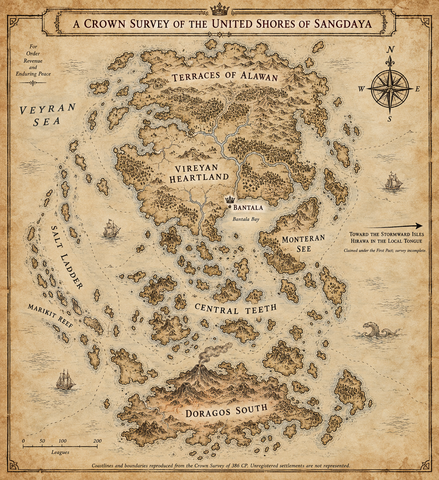


Inscription Beneath the Crown Survey of Sangdaya
Approved by the Crown Office of Measures and Boundaries, 386 CP
Here lie the United Shores as the Crown recognizes them.
Every border has been measured.
Every island has been named.
Every harbor has sworn its allegiance.
No land belonging to Sangdaya has been omitted.
Where two maps disagree, the Crown Survey shall prevail.
Where an older name survives, it shall be entered as error.
Where no settlement is marked, no settlement may demand protection.
The waters beyond the final line remain ungoverned, unmeasured, and empty.
So declares the Crown.
Yet sailors still leave offerings for islands that do not exist.
And after certain storms, the sea returns charts bearing names the kingdom has forbidden.



















I loved the story. and I wish to read more. but I am kinda confused in one part. are they in a ship or a palace?