Chapter 1: The Stone
The first machine was a stone.
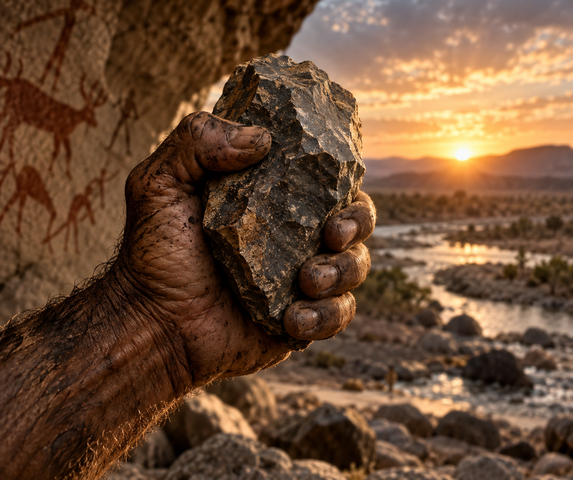


But before it became a machine, it was only a stone.
It was far older than we are. We do not know when it acquired the shape in which it would eventually find its way into a human hand. Perhaps it had once been part of a mountain. Perhaps a river had carried it along, rolling it among other stones, grinding and breaking it until at last it came to rest in the mud of a drying riverbed.
It had not been made for anything.
It had no function.
It had no purpose.
It was not waiting for us.
For millions of years, it was nothing more than matter in a world where matter had no need to know why it existed.
Then, one day, a hand appeared.
Of course, no one yet called what happened next a machine. There were no words for engineering or technology. There was only the raw necessity of survival.
Someone—perhaps a crouching, mud-covered figure in a dried-up riverbed—reached down, closed a hand around the cool, heavy stone, and realized that it was harder than a fist.
At that moment, the stone changed.
And yet nothing had really happened to the stone itself. Its mass was the same. It was made of the same minerals. It remained exactly as hard as it had been a moment before.
Only something new had appeared beside it.
Intention.
Perhaps someone used it to smash open an animal’s skull and eat the marrow inside. Perhaps to crush the skull of another human who had tried to take their fire. Perhaps it was used for something else entirely.
We do not know.
The darkness of prehistory mercifully conceals the details.
What we do know is that at some point, something happened that would ultimately prove more important and more enduring than every bloody war, every crowned king, and every empire.
And it was not really the stone that changed.
It was us.
We discovered that we did not have to accept the limits of our own bodies. If a fist was not hard enough, we could use something harder. If an arm was not long enough, we could make something that extended its reach. If our legs were not fast enough, one day we could build something that would carry us faster.
For the first time, we replaced a part of ourselves with something that was not human.
We extended our bodies into the world.
The stone became stronger than the fist.
The stick became longer than the arm.
The wheel became faster than the legs
Writing remembered longer than the mind.
The telescope saw farther than the eye.
The machine became stronger than muscle.
And when memory was not durable enough, we left signs behind. When the mind could not calculate fast enough, we built a tool for that as well.
After the muscles, we finally reached the mind itself.
The calculator calculated faster than we could.
And then, almost unnoticed, the silicon computer began performing tasks that had once required complex human thought and abstraction.
From the first stone tools to the microchip, all of this took more than three million years. The final step—the one that would change everything—took barely a few decades.
Upon the slow current of biological evolution, we built the torrent of technological progress.
And at the beginning of it all was a stone.
A stone that did not exist in order to become a machine.
We made it one.
When I was a child, sitting in classrooms near the end of the twentieth century, our teachers still told us that computers did not think. They considered it particularly important to add that sentence.
The machine calculates; the human thinks.
The machine stores data; the human remembers.
The machine follows instructions; the human decides.
Back then, those distinctions still seemed reassuringly solid.
I believed in them too.
As a young engineer, beneath the fluorescent lights of university laboratories, surrounded by old computers and the first servers, I saw nothing mystical in those boxes.
There was no soul inside them.
The flow of electrons.
Microscopic forests of transistors.
The rigid architecture of logic gates.
The pure mathematics of ones and zeroes.
I never believed in God, either.
I was not angry with Him, nor did I want to overthrow His throne—for that, I would first have had to believe that He existed. I simply saw no need to place yet another invisible Creator behind an unfathomable universe merely to explain where matter and starlight came from.
The universe existed.
Gravity drew clouds of gas together, and stars formed. Within those stars arose the heavier elements—including carbon, iron, and silicon—from which planets could later be built.
On one such planet, at some point, life appeared.
And life did not know where it was going.
It was not going anywhere.
It had no predetermined destination.
It changed.
Heritable traits better suited to the environment were more likely to survive and spread; others disappeared.
Billions of years later, one branch of descent produced animals that made and used tools.
One of them, one day, bent down to pick up a stone.
The circle was complete.
No divine plan was required.
No cosmic purpose was required.
And above all, no Creator was required.