How to Design a Sloped Yard for Better Outdoor Use
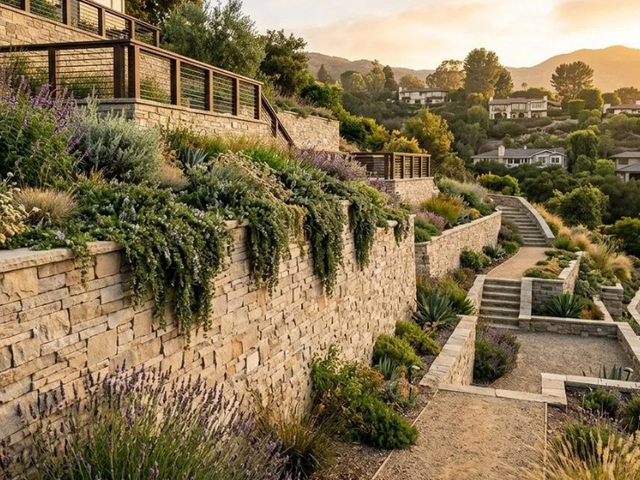


A sloped yard can create challenges that a flat property does not. Uneven ground can make it difficult to place furniture, establish comfortable gathering areas, manage water, maintain planting, and create convenient connections between different parts of the property.
At the same time, changes in elevation can become one of the most interesting characteristics of a landscape.
Instead of trying to make every part of a sloped property flat, thoughtful landscape design can work with the existing terrain. Terraced planting, retaining elements, pathways, steps, patios, trees, and carefully planned drainage can turn elevation changes into useful parts of the outdoor environment.
For homeowners in Southern California, designing around the existing slope can also help address sun exposure, rainfall, soil movement, irrigation, and long-term landscape maintenance.
Start by Understanding the Existing Slope
Before deciding what to install, understand how the property currently behaves.
Walk the yard after rainfall if possible and observe where water travels, where soil collects, and which areas remain saturated.
Also consider:
- The direction of the slope
- Steeper and flatter sections
- Existing retaining walls
- Mature trees
- Erosion
- Drainage patterns
- Access points
- Sun exposure
- Existing patios and walkways
These observations can influence nearly every part of the landscape plan.
A slope is not simply a visual feature. It affects how water, people, soil, plants, and materials interact across the property.
Do Not Fight the Terrain Unnecessarily
One of the biggest decisions in a sloped landscape is whether to reshape the existing ground or work with it.
Large-scale regrading may sometimes be appropriate, but it can also change drainage patterns and require significant construction.
Working with the existing contours can create a more natural landscape while reducing unnecessary disruption.
Instead of creating one large flat area, the property could use several smaller outdoor zones connected through pathways, steps, terraces, or planting.
This approach can make the slope feel intentional.
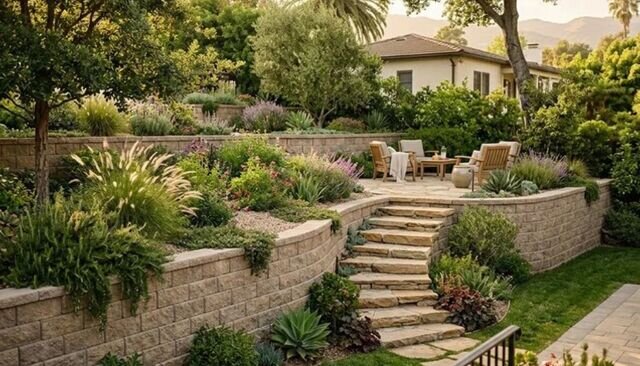
Use Terraces to Create Functional Areas
Terracing can divide a slope into a series of usable sections.
One level might contain a patio, while another could provide planting space or a garden.
A lower section might remain open for lawn or another outdoor activity.
The terraces do not need to look identical.
Different levels can serve different purposes while remaining visually connected through planting and pathways.
However, retaining structures involve structural and drainage considerations. Significant retaining-wall work should be properly designed and constructed by qualified professionals.
Make Drainage a Priority
Water management is particularly important on sloped properties.
Rainwater naturally moves downhill, which can result in erosion, saturated soil, runoff, or water reaching areas where it is not wanted.
Landscape planning should consider how water moves from the highest part of the property toward lower areas.
Potential warning signs include:
- Exposed roots
- Washed-away soil
- Channels forming in planting beds
- Mulch moving downhill
- Water collecting at the bottom of the slope
- Saturated areas after rainfall
- Soil accumulating near hardscape
Drainage solutions depend on the site, grading, soil, structures, and local requirements.
Addressing water movement early can help protect the landscape and make other improvements more successful.
Choose Plants That Work With the Terrain
Plant selection is especially important on sloped ground.
Plants can contribute to soil stabilization and help create a visually connected landscape, but their suitability depends on the specific site.
Consider:
- Mature size
- Root characteristics
- Water requirements
- Sun exposure
- Soil conditions
- Maintenance needs
- Seasonal appearance
- Relationship to pathways and structures
Ground cover can help visually connect different planting areas, while shrubs and trees can establish stronger layers.
The planting plan should avoid creating unnecessary maintenance challenges on difficult-to-access slopes.
Think About Irrigation From the Beginning
Irrigation on a slope requires careful planning because water can move downhill before it has adequately reached the intended planting area.
Different planting zones may require different watering approaches.
Grouping plants according to their water requirements can make irrigation management more practical.
The irrigation plan should also account for soil type, slope, sun exposure, and the arrangement of planting.
Overwatering can create problems on sloped ground, particularly where runoff or saturated soil is already an issue.
Create Comfortable Pathways
Getting from one level to another is one of the biggest functional challenges of a sloped landscape.
A pathway should be planned around the property’s natural terrain and the destinations people need to reach.
Depending on the slope and site conditions, the design may incorporate steps, landings, pathways, or other transitions.
The route should connect important areas such as:
- The home
- Patio
- Garden
- Driveway
- Side yard
- Outdoor kitchen
- Seating areas
- Lower landscape zones
Changes in direction can also create opportunities to introduce planting, views, or small outdoor destinations.
For substantial changes in elevation, pathway and step design should be professionally planned with appropriate safety and accessibility considerations.
Use Landings to Break Up Long Routes
A long continuous slope can make movement feel tiring and visually monotonous.
Intermediate landings can create useful pauses.
A landing might contain:
- A small seating area
- A garden feature
- A wider pathway section
- A planting focal point
- A transition between levels
These spaces can make the landscape feel more varied while breaking a larger slope into smaller experiences.
Turn the Slope Into a Visual Feature
Elevation changes can create opportunities that are difficult to achieve on a completely flat property.
Higher areas can provide views across the landscape.
Lower planting zones can create depth.
Trees can emphasize changes in elevation, while pathways can guide the eye through different levels.
Rather than hiding the slope, the design can use it to establish a stronger sense of structure.
Plan Seating Around the Terrain
Outdoor seating needs a stable, comfortable surface.
On a sloped property, simply placing furniture on existing ground may not be practical.
A terrace or properly designed patio can create a more usable area for dining and relaxation.
The location should also consider views, privacy, sun exposure, access to the home, and the relationship with nearby planting.
A small level seating area can sometimes be more useful than attempting to create one enormous flat backyard.
Use Retaining Elements Carefully
Retaining walls can help establish usable levels, but they should not be treated as purely decorative features.
Their design may involve soil pressure, drainage, foundations, materials, property conditions, and local requirements.
The landscape around the retaining element also matters.
Planting can soften the appearance of a wall and help connect one level with another.
Where retaining structures are necessary, the landscape plan should coordinate the structural and planting components rather than treating them as unrelated installations.
Consider Existing Trees
Trees on a slope can be valuable landscape assets.
They can provide shade, visual structure, privacy, and a strong connection to the established property.
However, their location needs to be considered when planning grading, retaining structures, pathways, and other construction.
Avoid assuming that a tree can simply be relocated or that construction can occur around its root zone without consequences.
Existing vegetation should be evaluated as part of the site assessment.
Use Planting to Define Each Level
Different terraces do not need to look like separate gardens.
Planting can create continuity between them.
For example, repeating selected plant forms or textures across multiple levels can visually connect the landscape.
Trees can provide vertical continuity, while lower planting can soften retaining walls and pathway edges.
The objective is to create a cohesive composition even though the property contains multiple elevations.
Make Privacy Work With the Slope
Sloped properties can create unusual privacy conditions.
A neighboring property may sit higher or lower, changing the sightlines between yards.
Landscape design can address specific views using trees, shrubs, screens, fencing, or other appropriate elements.
The best solution depends on the direction of the view and the mature size of the vegetation.
Instead of completely enclosing the property, focus on the sightlines that actually affect outdoor comfort.
Think About Sun Exposure
Elevation and surrounding structures can influence how sunlight reaches different parts of the yard.
A higher portion of the property may receive different exposure from a lower terrace.
Observe the landscape throughout the day before choosing plants or positioning outdoor living areas.
This can help determine where shade-loving plants, sun-tolerant planting, seating, and shade structures should be placed.
Plan for Long-Term Maintenance
A sloped property can become difficult to maintain if every section requires frequent access.
Place high-maintenance planting in areas that are easy to reach.
Use lower-maintenance approaches on steeper or less accessible portions of the landscape when appropriate.
Pathways and access points should also allow for routine pruning, irrigation inspection, cleanup, and other maintenance needs.
The landscape should remain practical after the initial installation is complete.
Design With Future Growth in Mind
Trees and shrubs planted on terraces can eventually change the balance of the landscape.
Their mature size should be considered before installation.
Avoid selecting plants solely because they look appropriately sized when newly planted.
Instead, consider how their canopy, roots, height, and spread may affect pathways, retaining structures, views, patios, and neighboring areas in the future.
Planning for maturity can reduce the need for major corrections later.
Local Landscape Conditions Matter
A sloped landscape in Southern California can have several factors that influence the final design, including seasonal rainfall, sun exposure, soil conditions, existing vegetation, drainage, and property layout.
For homeowners researching Pasadena hillside landscape renovation, the existing terrain and established residential landscape may provide the starting point for a more tailored design. Properties with distinctive elevation changes can also benefit from San Marino sloped garden planning that combines planting, circulation, and outdoor living. Homeowners considering outdoor improvements can explore Glendale landscape design for uneven properties when looking at ways to organize different elevations into functional spaces.
Each property should be evaluated individually rather than applying the same approach to every sloped yard.
A Sloped Yard Does Not Have to Be a Limitation
An uneven property can offer opportunities for layered planting, interesting views, distinct outdoor rooms, and stronger landscape character.
The key is to design around the terrain instead of treating the slope as a problem that must disappear.
Drainage, circulation, planting, hardscape, retaining structures, privacy, irrigation, and maintenance all need to work together.
For homeowners planning a sloped-yard renovation, Ridgeline Outdoor Living can help develop a landscape concept that responds to the property’s existing conditions and outdoor living goals.
Ridgeline Outdoor Living
If your yard has uneven terrain, difficult transitions, drainage concerns, or underused areas, contact Ridgeline Outdoor Living to discuss your landscape renovation and explore a design that turns the property’s elevation into part of its character.
A thoughtfully planned sloped landscape can transform challenging terrain into connected, functional outdoor spaces that are designed for both everyday use and long-term enjoyment.
Learn more here:
Pasadena: http://ridgelineoutdoorliving.com/locations/pasadena/
San Marino: http://ridgelineoutdoorliving.com/locations/san-marino/
Glendale: http://ridgelineoutdoorliving.com/locations/glendale/
Homepage: http://ridgelineoutdoorliving.com/