PROLOGUE: THE LAST STEP OVER THE ABYSS
The wind at the cliff’s edge howled with a vengeance, tearing with jagged claws at the hem of her thin dress. The clouds above the sea resembled a ragged, ash-gray banner through which the cold, lifeless light of Sidus bled only in fleeting gasps.
Ela stood on the sheer brink, where the stone crumbled beneath her bare feet. Her heart had shrivelled into a handful of razor-sharp shards. Every motion, every breath drove those fragments deeper into her soul, turning her very existence into a slow, suffocating torture.
“Please...”
The voice behind her broke into a desperate cry, but the gale swept it instantly away toward the ocean.
Behind Ela stood Tristera. Her immense, dazzlingly white wings seemed pale as cinders in the twilight. Their feathers trembled, their tips slicing the air like blades. The angel reached out, her palm almost brushing the girl’s shivering shoulder—yet her fingers passed through the cloth as if through mist.
“Do you hear me? This is not the end, Ela!” Tristera’s eyes, heavy with a grief that mirrored the sorrow of the entire world, never left the back of the girl’s neck. “One broken heart is not all that you are. The world has not gone dark—it has merely shut its eyes. Hear me!”
For Ela, the world had narrowed to a strip of crag and the roaring black water below. Rare drops of rain, heavy and freezing, struck her face. They rolled down her cheeks, mingling with bitter tears, until she could no longer tell where the sky ended and her own despair began.
It seemed to her that if she took this single step, the shards inside would finally cease their cutting. That the abyss was merely a vast, quiet bed—a place without pain, without memory, and without that unbearable, suffocating love that had turned to poison.
Tristera poured the whole of her immortal essence into her scream, her wings igniting with a golden blaze: “Do not surrender everything for a single loss! Tomorrow there will be light... I promise you, there will be another light!”
But Ela only squeezed her eyes shut tighter. She stepped forward, feeling the drop pull at her skirt, inviting her into its embrace.
Within Ela’s mind whirled a vortex of shattered possibilities. What if I had stayed silent that evening? flashed through her thoughts. What if we had left for the sea, as we dreamed? What if...
These what-ifs were like venomous blossoms. They bloomed in her memory, teasing her with the scent of unfulfilled happiness, only to wither instantly, leaving behind nothing but gall. Every dream—of a home with a hearth, of children’s laughter, of quiet dawns shared together—now felt like a cruel mockery. If none of it existed, what was the use of all the rest? Why this hollow sky, and this cold, unfeeling world?
Tristera saw these thoughts. She watched the last sparks of hope die within the girl’s soul, and her own heart—which had witnessed the birth of stars—coiled tight in agonizing helplessness.
“Please... not again,” the angel whispered, her voice snapping.
She remembered them all. The faces of those behind whose backs she had stood for centuries. The youth with a slit throat in a muddy ditch; the mother weeping over an empty cradle; the old man who had lost his faith. How many had there been? Dozens? Hundreds? Tristera remembered every name, every final breath. And not one—not a single one—had ever heard her whisper.
Why had the heavens endowed her with the will to protect, yet stripped her of the right to be heard?
In a surge of despair, Tristera lunged forward and pressed her palm to Ela’s back. She poured into that touch all her radiance, all the love of which a seraph was capable. She wanted Ela to feel the warmth of the sun on her skin, the scent of summer grass, the taste of hope...
Yet the angel’s fingers merely passed through the girl’s shoulder blades like a draft of cold air. Ela only shuddered. To her, it was nothing more than a gust of icy wind.
“Why do you not hear me?!” Tristera shrieked, looking up into the indifferent, storm-wracked sky. “Why do you choose the dark, when I stand here, made entirely of light?!”
Ela took the final step, out toward the place where the tide shattered against the crags.
The world beneath her feet vanished. Ela fell, and in that moment, she felt no terror. She was like a severed autumn leaf borne casually by the wind toward the earth. No scream, no flailing of arms. Only tears, slipping from her lashes, flew upward—outpacing her as she plummeted toward the sharp stones where white-headed waves broke in fury.
“NO!” Tristera threw herself after her.
Her wings unfurled like immense sails as she dropped like a lead weight, attempting to intercept, to cradle, to slow the descent. She circled the falling girl, crying out in rage and grief, beating her wings so violently that feathers tore free, mingling with the driving rain.
“Again... again?! Not you! Ela, wake up! Grasp hold of me!”
Yet Ela fell through the angel’s translucent body as if passing through smoke. Tristera could only fly beside her, watching the wind whip the girl’s hair in the final seconds of her life, powerless to arrest the plunge.
Below, amid the roar of the water and the thunder of the surge, eternity waited. And in the sky, above the very abyss, circled an angel whose cries were quieter than the rustle of the rain.
The angel continued her descent behind her, arms outstretched, through the rain, through a scream trapped somewhere between her throat and forever.
But down there, nothing remained.
Only foam. Only the waves licking the jagged rocks with indifferent tongues. Only the darkness of the water closing over a human life, like eyelids shutting over a dead eye.
Tristera hovered above the water.
Her wings beat against the air, shedding feathers. She circled. She dived. She cut through the surges with her incorporeal frame, passing through them only to rise again each time with empty hands.
“No, no, no, no...” Tristera whispered.
She searched until she lost all count of time. Sidus parted the clouds only to hide once more, as if ashamed to look upon the shore. The wind gradually died away, ebbing from a howl into a weary sigh. Only the sea remained unchanged.
Tristera drifted onto the strand. Her bare feet touched the wet sand. She took a few steps and froze.
Lower down, at the water’s edge, lay something dark.
The angel drew near.
It was a hand. Slender, long-fingered, with a chipped nail on the pinky—the nail Ela had broken yesterday while fastening the buttons of her dress. She had laughed then. Tristera remembered that laugh. Clear and ringing, like shattered glass.
Now the hand lay upon the sand, and a wave washed over it, gently, as though seeking to console.
Tristera fell to her knees. She extended her palm—brimming with grace—and tried to cover those cold, dead fingers.
The fingers remained beneath her hand. She could feel the sand, the chill of the tide, the sharp edge of a seashell—but not the skin. Through. Everything passed through.
The angel lifted her head to the sky.
“Why?” she asked softly. Without tears—for angels do not weep; they have no tears, only a light that burns out from within when the pain becomes too great to bear. “I was here. I stood behind her. I screamed. I reached out. Why did You grant me sight if I cannot stop it? Why did You grant me love if I cannot save?”
Sidus was silent.
It was always silent.
Tristera walked into the sea. She walked as one who had no wings, no purpose, no remaining thing save for the hollow, pulling emptiness beneath her ribs. She waded through the water, and the sea yielded to her, allowing her passage, for even the elements recognize when a being before them has ceased to be holy.
A rock thrust out from the deep a hundred paces from the strand—black, slick with kelp, carved by the smashing tide. A place merely to... exist. Until existence withered away.
Tristera collapsed onto the stone, dangling her legs into the icy surge, letting her wings drop like sodden rags. Feathers brushed the foam, and the waves worried at them as stray hounds worry at discarded cloth. She bore no resemblance now to those angels painted upon the vaults and icons of the cathedrals.
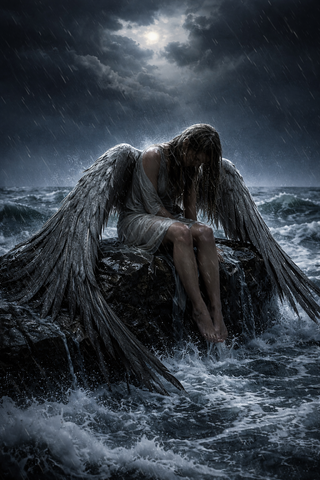


She stared out toward the horizon.
Where the sky met the sea, there was no seam. Only an endless gray gloom. Nothingness blurring into nothingness. Sidus had withdrawn entirely. No other stars shone. The world had shrivelled to a single sMahll crag in the midst of vast, unfeeling waters.
Every thought within her head had simply burned away. Naught remained but ash, which the gale dispersed through the vacant halls of her memory. She saw faces. So many faces. They rose and crested like the waves, and every time, Tristera had stood behind them, reaching out, screaming—and every time, they had passed straight through her, like smoke.
How many more?
She did not know.
Her wings had ceased their light. They were merely gray now—the color of that which can never be made white again. The light within her, that which made her an angel, that which allowed her to discern hope where mortals saw only dark—now barely smoldered, like a ember spending its last heat before turning to dust.
What if they are right?
The thought came unbidden, sinking to the bed of her consciousness like a stone cast into a cold sea, resting there.
What if I am truly unneeded? What if all I do is a farce performed for myself alone? I reach out. I scream. And they do not hear. They never heard. They never will.
Tristera looked down at her hands.
They still held a faint glimmer, like a firefly that has forgotten why it glows yet continues out of habit. Fine, beautiful hands with slender fingers, through whose skin silver bled—the blood of angels, forged of light and love.
Love.
She realized with a sudden jolt that she hated the word.
She hated it with all the fury a creature fashioned from it could muster. For love was a promise never kept. It was a hand reaching out to you, only to pass through. It was a voice shrieking “I am here!” when no one listened.
I am made of that which mortals deem the greatest of virtues. Yet my love has saved not a single soul. Not one.
Tristera closed her eyes.
Within her lay nothing. Only an infinite void seeping into the places where light had once burned. She could not even weep. Yet had tears been granted her, she would have cried all the seas of the world, and they would have turned bitter with her grief.
She sat upon the stone.
The sea pounded against the crag. The wind lashed at her gray, lifeless wings. And she stared ahead with glassen eyes that had once mirrored the hope of all mankind, but now reflected nothing at all.
Not even the dark.
For to hold the dark, one must still be something. And she was ceasing to be.
The waves surged and ebbed. The wind quieted only to rise anew. And still she sat, hardening into a piece of that stone, of that sea, of that nameless, boundless gray sky.
At some point, the ember in her chest went out...
She no longer felt the cold. She no longer heard the breakers. She no longer remembered Ela’s name.
All that remained was the silence, and a sea that had no care for angels.
Needles of spray leapt above the tide. They slammed into Tristera’s face, but she did not blink. Raindrops pierced her gray wings like shattered glass. They struck as if seeking to cut her, to sever that motioning mask, to force her to feel something—anything.
She felt nothing.
The clouds overhead compressed into an immense, leaden vault pressing down upon the horizon. The rain whipped in a solid sheet, as though the entire world had dissolved into a single gray agony. But Tristera was beyond agony.
Within her, the light burned no longer.
And then—far, far away, beyond the edge of the gale and the rain, beyond the boundary of this cursed world—she heard the Call.
It arrived as a thin, high vibration, like glass chimes struck gently by fingertips somewhere at the dawn of the universe. The tone pierced the rain, pierced the wind, pierced her numbed, hollowed form.
A new charge.
Tristera did not open her eyes.
No.
The thought did not come swiftly. It forced its way through the ash, through the void, through the heavy, freezing silence in which she had entombed herself.
Again?
Her fingers gripped the wet stone so fiercely her knuckles turned white.
Why... again?
The Call repeated itself. Louder. More insistent. The chimes deepened into a silver chime that tore through the gray veil of rain. Someone out there, in the realm of the living, was praying. Someone was in dire need. Someone had laid open their soul—and that someone was already hers.
Always hers.
Always Tristera.
She had not chosen. She was granted no choice.
“No.”
The word escaped her lips—rasping, wet, foreign. She did not recognize her own voice. Angels were not meant to sound thus. Angels were not meant to sound like mortals who had lost everything and had nothing left to lose.
“No. No. No.”
She thrusted her head side to side. The rain whipped her face, mingling with that moisture angels could not shed, yet which somehow burned behind her eyes.
“I will not come!” she shrieked into the heavens. Into those heavy, indifferent clouds. Into that vast gray emptiness that was called sky, though it had long ceased to be one. “Do You hear me?! I WILL NOT COME!”
Her voice cracked into a thin, broken, unhuman shrill.
“I do not wish to protect anymore!” Her wings shuddered, rearing above the water—wet and leaden—only to collapse back onto the stone like broken limbs. “IT IS ALL FOR NAUGHT! They do not hear anyway! They never heard! I stand behind them, I scream, I reach out, and they... they...”
She could not finish.
A lump lodged in her throat.
“You granted them freedom,” she whispered, and within that whisper lay a fury no mortal scream could ever contain. “You granted them the freedom to choose the dark. You gave them the right to be deaf. And You made me a witness. Why?! WHY?!”
Sidus in the sky was silent.
It was always silent.
The Call chimed a third time. Now it was desperate. Impatient. The one praying out there, in the cold world, already felt that their angel faltered. That something was wrong.
“I do not want to,” Tristera uttered, softer now, on a dying breath, all strength spent.
Her voice sounded like that of an ancient, broken woman, though she was as old as the stars.
“Not again. Not after her. Not after Ela. Please... only not again.”
She wrapped her arms about herself—a comical, futile, human gesture. Her fingers dug into her shoulders. Her wings lifted and enveloped her like two gray, sodden blankets. She curled into a ball upon that rock, beneath that rain, in a world that took no note of her tears, for they did not exist.
“I will not come,” she whispered one last time. “I will not come. I will not come. I...”
The Call faded.
The chimes fell silent.
Somewhere out there, in the world of the living, the one who prayed opened their eyes—and went quiet. For their angel was not coming. Her angel remained upon a stone in the midst of the sea.
And the world grew a little colder.
The rain kept falling.
The wind kept howling.
And Tristera sat upon the crag, arms wrapped tight around herself, with gray, dead wings and hollow eyes.
She did not go.
She remained.
And the Call did not return.
The sea roared on.
And somewhere in the dark, a soul wept softly in solitude—because for the first time in millennia, its angel had said “no.”