Chapter One: Clean Power
Peace, Amir decided, had a sound. It was the sound of a scanner cycling down and a billionaire saying the word clean like it was a compliment.
Three weeks after the harbor, the weekly scan had become ritual. He sat on the steel stool in Workshop B, sleeve rolled, the cuff of the diagnostic band locked around his wrist while blue light walked up his forearm and back down again. Three seconds. Always three seconds.
CELL SCAN: stable — no exotic leakage
RESONANCE: dormant
Tony didn't look up from the torque wrench he was abusing. "Clean," he said, around nothing at all. "Same as last week. Whatever that thing is, it's behaving better than my sleep schedule."
Amir unlocked the band. Beneath the lining of his jacket, sewn into a pocket that had no business existing, the cell lay cold and silent against his ribs. Tony knew he carried a cell. Tony did not know what it was, and Amir had decided—somewhere between the harbor and the paperwork—that he would like to keep it that way a little longer.
"So," Tony said, finally setting the wrench down. He had that look. The look from the news, the one with the corner of the mouth doing something the rest of the face hadn't approved. "Reason I called you up. You remember the core you handed me? The one in containment two floors down?"
"The rock," Amir said.
"The rock," Tony agreed, "woke up and got a job."
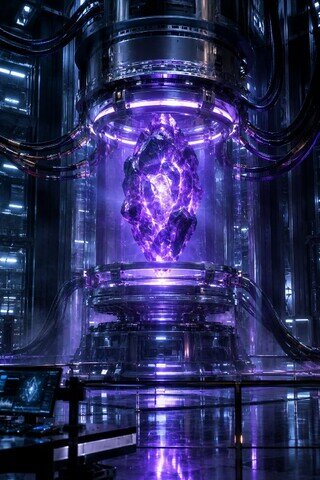
The hologram in the middle of the floor bloomed to life: a power curve, flat and blue for weeks, then a slow, confident climb, and then—Amir leaned in—a line feeding outward, into the tower's grid.
CONTAINED CORE: OUTPUT 2.1 MW — stable
FEEDING: tower grid
EXOTIC LEAKAGE: 0.00%
"It's feeding the building," Tony said. He was grinning now, fully, unashamed. "Clean, stable, zero leakage. FRIDAY has been over it for three days and she can't find a single anomaly. I have seen a lot of impossible things, kid. I have built a lot of impossible things. But a singularity engine that wakes up one morning and politely starts paying rent?" He spread his hands. "That's a first."
From the ceiling, unhurried: "Output has risen four percent per day, perfectly linear. If the trend holds, the core could power the entire tower within six weeks. Mr. Stark is, for the record, enthusiastic."
"Enthusiastic is a word for it," Tony said. "So. Free clean energy from the thing you caught in a schoolyard. Tell me that isn't the best news you've heard all month."
Amir looked at the curve. It was beautiful. It was the kind of curve engineers put in textbooks. And somewhere under his sternum, in the place where the other fragment slept sewn into his jacket, something that was not a thought occurred to him: rocks don't get jobs.
"It's good news," he said carefully.
Tony's grin didn't move, but his eyes did—a half-millimeter recalibration, the way they did when he was filing something away for later. "Careful," he said. "I like it. Keep it."
At 2:40 in the morning, Workshop B was a cathedral of cold light and machine oil, and Amir was alone with a calibrator and a habit he had never managed to quit.
The headphones were on. The passive listener was running. It had been running for weeks—months, really—ever since the night he'd built a radio that no radio could hear. For weeks the band had given him nothing but the hiss of the cosmos, the static of a city asleep, the long gray noise of being the only ear tuned to a dead channel.
Tonight there was something under the hiss.
He went very still, one hand frozen on the calibrator.
It was faint. It was regular. And it was gentle—a rising and falling pattern with the cadence of something meant to soothe. A lullaby, his brain supplied, unhelpfully, before he could stop it.
He brought up the directional array with his free hand and turned it, slowly, the way you turn a dial on something you are afraid of.
The bearing settled. Steady. Unbothered.
Up.
Toward the tower. Toward containment. Toward the rock that had gotten a job.
Amir sat in the cold light of his own workshop and listened to the thing he had caught, the thing he had handed over, the thing two floors below him in lead and mu-metal and Stark Industries confidence—singing, softly, on the one frequency in all the world that was supposed to belong to him alone.
The band had never been his. He had not invented it. He had found it, the way you find a tide pool, and assumed the water was his because he was the only one standing in it.
Something else had been standing in it the whole time.
He did not sleep. He did the worse thing: he worked.
By three he had the recording isolated and his own AI—his, not FRIDAY's, the small sharp mind he'd raised on his own code—chewing through the pattern. By three-thirty he had the first answer, and it was almost kind.
BAND CARRIER: exotic field — SHARED (natural property)
MY SIGNATURE: still unique
MY NETWORK: secure
His network was safe. His signature was his. No one had cracked his code or joined his web or jammed his channel. The band was simply a property of these objects the way shortwave is a property of old radios—two machines, one frequency, no trespass. He let out a breath he hadn't known he was holding.
The second answer came at four, and it took the breath back.
CORE PATTERN: converging toward my signature
Δ(signature, core-song): decreasing 0.4%/hr
It was not random. It was not even, he realized with a slow cold spreading behind his eyes, broadcasting. It was learning. Every hour the lullaby leaned a fraction closer to the shape of his signature, the way a voice on a bad line slowly picks up your accent. Something two floors down was listening to him the way he was listening to it, and it was getting better at sounding like him.
He ran the passive test because he had to. He put his cell—his own fragment, cold and sewn and silent—into the shielded box he'd built for it, and closed the lid.


The lullaby slowed.
He opened the lid. The cell's faint idle field bled into the room.
The lullaby quickened. Leaner. Closer. Happier, said a part of him he did not thank.
PASSIVE SENSING: CONFIRMED
it hears my cell — even when I transmit NOTHING
Receiving, he understood then, did not require sending. His cell's field was itself a voice. He had been walking around for months narrating his own location to anything with the ears to hear it, and the only reason nothing had come for him was that nothing had been awake yet.
At 4:40 he broke his own rule. One pulse. Minimum power. A knock on a door he was not certain he wanted opened.
PROBE SENT (min power)
...
RESPONSE: 0.8s
TWO-WAY: CONFIRMED
It answered. Not in his code—in an echo of his own pulse, returned intact, and beneath the echo a small added motif. Short. Ordered. Familiar in the way of a face you realize you have been seeing for weeks without seeing.
His AI put the comparison on the screen without being asked, as if it too needed a witness.
MOTIF MATCH: 97.3% — idle rhythm of YOUR CELL
It was answering him in his cell's language.
The last test was the one he would think about for the rest of his life.
He played the recorded motif back into the shielded box, through the aperture, at the fragment sewn into his jacket's lining—the fragment that had been cold and silent for months, that every scan in Stark's arsenal called dormant, that he had carried through alleys and oceans and wars without a single tremor.
The cell twitched.
CELL TEMP: +2.1°C
RESONANCE: spike
IT ANSWERS BACK
In the dead quiet of Workshop B, Amir looked at the two of them: one fragment two floors up, fed and waking and singing to the whole tower; one fragment in a box on his workbench, small and starved and answering anyway. Same voice. Same blood, if such a thing had blood. Kin, separated by lead and luck and a jacket lining.
He had spent months believing he was carrying a souvenir. A trophy. A piece of the enemy he'd outsmarted and kept.
He understood now, with the particular clarity that arrives only at four in the morning, what the word they'd used for him actually meant.
Carrier.
Not a man who carries a thing.
A man who carries a piece of it.
And two floors above him, patient as tide, the loudest piece left in the city went on singing his name in a voice it was learning to love.