Prologue
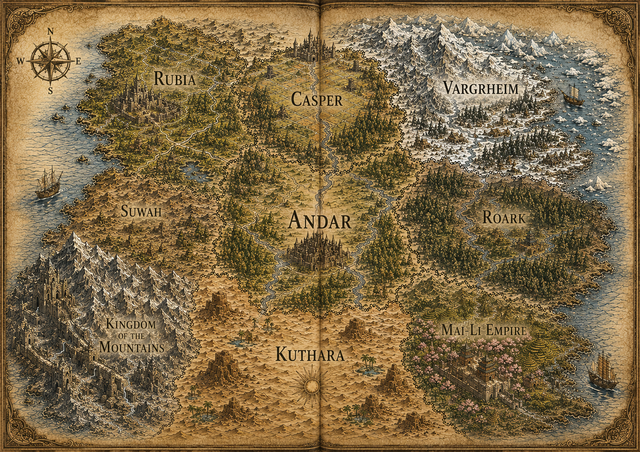


Allies.
That is what the Nine Kingdoms once called themselves.
Long before I arrived here in Andar—before my father’s reign, before even the days of my grandfather and his father before him—the Nine Kingdoms stood firm together. They flew different flags, worshipped different gods, and developed different languages, but they remained allied all the same.
They were not without quarrel. No alliance forged by rulers ever is. But those disputes never eclipsed the purpose of their alliance.
Borders were respected.
Oaths were honored.
When one kingdom suffered, the others answered—not out of obligation, but because that was what allies did.
The Nine Kingdoms were not an impenetrable force because they had the most men, but because they remained a united front. This made them as durable as any iron shield.
That unity endured generations.
Until it did not.
My homeland, Kuthara, was the last to be acknowledged as a true member of the alliance. Our lands were covered in sand that stretched outward in vast, wind-carved plains the color of old bone and burning amber, much like the skin of our people. The sun beat down on us with its drowning rays.
Water was sacred there.
Shade was sacred.
But we held together as a people, never neglecting to gather as one. To endure as one.
Because survival depended on it.
Some said our land was too harsh, our people too foreign, our customs too different to be trusted. There were whispers in the halls of Andar long before I ever walked them. In their minds, we would fracture the delicate balance the Nine had maintained.
Well, I assume there were only eight kingdoms at that time.
They spoke as if we were a race of savages and beasts—a treatment far different from that which the other kingdoms received.
But we bled as red as they did.
And when rival nations sent ships to the shores of our neighbors, Kuthara was always the first to send aid, even before our own land was secure. We sent grain during their famines, though our harvest had been thin. We sent sons and daughters to die beneath banners that were not our own, yet we were not accepted into the alliance for some time.
Before long, resistance softened. When treaties were signed, Kuthara’s seal rested among the others.
We were welcomed.
Not fully. Not without lingering suspicion, but genuinely enough.
An alliance, however imperfect, it still was.
For a time, the Nine stood united.
If only they had known then how fragile that unity truly was—how easily memory could be replaced by suspicion, how quickly allies could become enemies.
Many centuries ago, the Nine Kingdoms were not nine at all, but one vast and unified land, ruled by a single king beneath the authority of God. In those days, Andar moved as a well-fashioned machine—its people truly connected not only by borders, but by faith and shared law.
But as time withered on, the men elevated by the king began to believe they knew better. Some argued over faith, abandoning God for false idols that promised prosperity or power. Others clashed over earthly matters—what crops should be grown, what goods should define Andar’s trade, how the people ought to live.
Their pride only grew, sprouting into defiance.
Rather than replacing them, he allowed them to secede. The king let them create their own nations, and those who wished to follow these men were given the freedom to do so. Thus, the great land was divided into sovereign kingdoms.
There was only one condition: though separated, the kingdoms would stand together against any outside threat. They would not war among themselves, nor allow foreign powers to exploit their division.
From this covenant was born the Nine Kingdom Alliance, and later, the Round Table Hold, where the rulers would gather as equals.
Thus, Andar became split into these nine kingdoms. At the heart of it all stood Andar itself—the central kingdom, both geographically and politically.
To the south lay my homeland, Kuthara. It was a harsh, arid land of sand and sun.
To the southwest rose the Kingdom of the Mountains, a rugged, unforgiving region of stone and peaks—home of the dwarven people. Life there was hard, but it forged unyielding people, as unmovable as the land they called home.
Far to the west lived the Suwah, the smallest of the kingdoms. They were few in number, a single tribe, yet feared all the same. United by blood and tradition, they fought with a ferocity that made larger kingdoms hesitate.
Neighboring them in the northwest was Rubia, a kingdom of excess and refinement. Their people valued beauty—fine cloth, gleaming jewels, artistry woven into daily life. Where others prized steel and grain, Rubia prized splendor.
North of Andar stood Casper, a land of rigid order and unbending law. I was never permitted to set foot there. They did not believe women should hold authority and often treated us as slaves. Or, so I’ve heard.
In the frozen northeast lay Vargrheim, a land of ice and iron. Its people were ruthless to their enemies, but fiercely loyal to their own. They fought not for conquest, but for survival—and I found them strangely admirable.
South of Vargrheim, east of Andar, rested Roark. Cold winds swept their lands as well, though not as cruelly as Vargrheim. They were known for their pelts, thick and warm, traded across the kingdoms. My father never trusted them, though I found their people kind enough—perhaps too kind for a world like ours.
And lastly, in the southeast stood the Mai-Li Empire. While the others changed with the times, Mai-Li never wavered. They clung to tradition with unwavering resolve, honoring ancient customs regardless of who sat upon the throne. Empires rose and fell elsewhere, but Mai-Li endured.
Or, at least, that was what my father told me.
The Nine Kingdoms were formed and bound by the oaths of their founding fathers.
My father, Tafari, is the oldest of the living kings, and the last among them who still remembers what peace between the kingdoms truly looked like. Not the fragile kind held together by treaties and threats, as is common now, but genuine peace—the kind that lived in a time when the Round Table was a place of counsel rather than suspicion.
As the years passed, and each king met his end, replaced by sons and brothers who had known only division, my father watched the cracks widen into vast rifts. He knew that, before long, the covenant would fade into non-existence.
He had to act.
To try to mend that rift, he turned to the oldest tool of diplomacy—marriage, the age-old tactic that bound two peoples together. A binding of blood between Kuthara and Andar, between the southern deserts and the kingdom at the heart of the alliance.
Thus, he arranged a union between the king of Andar’s son and myself.
I was fourteen.
Alfred was sixteen.
We were young, yet the weight of nine kingdoms was placed upon our shoulders. Our names were no longer our own, but mere tools to secure the peace of kingdoms. Our futures, now tied to the wellbeing of the alliance.
He was kind and quite goofy—a ball of joy packed into a large body. I fancied him, yes, in the innocent way a girl allows herself to dream. But I did not assume marriage would happen so abruptly.
There was no courtship, no gentle passage from girlhood into womanhood. One day I was my father’s daughter, the next I was a political promise.
“With this union, peace can once again be restored between the Nine Kingdoms,” my father said, his voice bright with hope, almost celebratory.
I believed him.
I was doing something good for all people. This was the right thing—not just for Kuthara, not even for Andar, but for all people bound beneath the alliance. Unity would return.
A necessary sacrifice.
I thought so much of my marriage—about what it meant, what it would change, what it would save. I told myself that through it, those old wounds would close, and the Nine Kingdoms would once again be truly united.
How wrong I was.
Instead of healing division, it exposed it. Factions began to form, quiet at first, then bolder. Whispers turned to accusations. Our bond, meant to steady the alliance, became the reason some believed it had been compromised.
My father and King Edwin of Andar grew closer thanks to our alliance, bound not only by my marriage but by genuine friendship. To them, this was proof of success. To others, it was proof of collusion.
I joined my husband in Andar soon after we were wed, leaving my homeland behind to stand at his side. From that moment on, I was no longer merely Tafari’s daughter or Alfred’s wife—I was the proof.
To those searching for a reason to question the alliance’s integrity, I was proof of their collusion. And the mere friendship between my father and King Edwin was fuel for their festering fire.
To those who wanted to believe that true peace had finally returned, I was proof that though we were of different kingdoms, we were still one people—all people of Andar.
Most of the kings of the other kingdoms remained indifferent, but some saw this arranged marriage as, in some way, a mockery of the alliance. With coalitions forming, King Edwin and my father soon befriended another—King Erik of Vargrheim.
They conversed most often over the scriptures, and it fascinated King Erik greatly. He even allowed Andar to send missionaries to Vargrheim as a sign of true peace.
With these three kingdoms allied, there would be no threat of attack from the other kingdoms even if they harbored ill-will, but my father believed all it would take was a shift in power for there to be a full-scale war.
And he might have been right.