Prologue
Lomero,[1] the commander of King Layo’s[2] forces, stood before an old deserted well, two metres wide and tens of metres deep. Its ancient walls were covered with thick vegetation, and the dark bottom seemed like an endless abyss.
Behind Lomero, long lines of soldiers awaited his orders. Lomero quietly swiped one finger across the traces of blood along the edge of the well, staining his fingertip red. He lifted it to his nose and inhaled, immediately recognising the distinctive scent carried by the blood of only one devil in the world.
Vermon …
Lomero, confident that the seven wanted men were hiding at the bottom of the well, fixed his eyes on the dark depths.
“In the name of King Layo, sovereign of the Kingdom of Empamalangon, I give you one final order: surrender at once. Come out of the well!” he commanded.
In the darkness, Commander Lomero’s shouts reached the ears of the seven comrades and Jerboa. Akinos, who had clutched his bleeding stomach, leaned against the wall, his eyes scanning the faces around him. Over his shoulder stood Jerboa with a troubled look on his face.
Beside Akinos stood Vermon, his right hand severely lacerated and bleeding profusely. With his other arm hooked beneath Aroman’s arm and wrapped around his back, Vermon supported most of his weight and kept him upright. Aroman was conscious, but harsh wheezing came from his lungs, and a streak of blood trickled from his nose.
Tippa, who stood before Aroman, glanced up and down, his large eyes blazing with sparks and fire in the darkness. Standing beside him, Mingan remained vigilant, though he could not help but sympathise with Ackoleet.
Panicking, Ackoleet’s anxious gaze darted from one side of the narrow well to the other, then upward.
“I see dead people here!” he whispered in terror. “The place is teeming with them.”
Unfazed by his comrade’s panic, Habot exchanged glances with Akinos as he wiped his blades clean of his victims’ blood, preparing for another round of combat.
Commander Lomero stepped back, mounted his horse, and signalled the rear ranks to retreat six metres. Instead, a unit of eight soldiers advanced. They marched directly towards the well, spread evenly around its circular rim, and formed the innermost ring. Once each man had taken his position, all eight extended their palms over the darkness below.
At Lomero’s signal, each soldier began channelling raw elemental energy. Eight streams converged above the centre of the well, gradually merging into a single luminous sphere. For several minutes, the soldiers maintained their positions as the sphere grew denser and brighter, its surface trembling under the pressure of the forces compressed within it.
Behind them, the remaining one hundred soldiers stood in a much wider circle, six metres from the well. They remained motionless, awaiting the order to raise the defensive barrier.
When the elemental sphere had reached its full size, Lomero straightened in the saddle.
“THREE — TWO — ONE!” he commanded. “FIRE!”
Without hesitation, the eight soldiers clenched their fists, severing their stream of energy from the sphere. They watched as the sphere plunged slowly into the well, into the black depths. The attacking unit immediately broke formation and retreated from the rim, moving into the protected space between the well and the outer ranks.
The weapon they had released was a military fusion of fire and compressed air, its flames confined beneath layer upon layer of elemental pressure. Upon rupture, the imprisoned air was intended to expand violently, feeding the flames and transforming the narrow shaft of the well into the barrel of an enormous cannon.
The moment the eight soldiers cleared the rim, the outer formation of one hundred pairs of hands rose simultaneously.
Streams of energy surged upwards from the wide circle of soldiers and converged high above the well. The separate currents merged overhead, forming an immense dome-shaped barrier that enclosed the well and the immediate ground around it, beneath a translucent wall of flowing energy. Its purpose was to contain the impending blast and protect Lomero, his forces, and the inhabitants of the neighbouring town.
Everyone waited, but nothing happened.
A few soldiers exchanged uneasy glances but did not dare abandon their positions, their arms raised and rigid as they listened for the detonation that should already have come.
Lomero’s expression was impossible to read because his helmet masked his face, but his lips were tightly pressed together, and his fingers tightened around the reins.
Something was wrong. The sphere should have ruptured almost immediately upon reaching the target depth.
However, just as Lomero opened his mouth to issue an order, the earth trembled. It was only a brief tremor travelling beneath the horses’ hooves and the soldiers’ boots.
Then the well exploded with a deafening detonation that tore through the valley as fire and compressed air erupted from the well’s opening with terrifying force. A column of thick black smoke shot upwards in a vast cylindrical mass, striking the dome’s inner surface.
The violent rupture split the barrier’s flowing energy overhead, and part of the blast burst beyond the dome in a roaring surge of smoke, heat, and pressure. Several soldiers maintaining it were driven backwards; others dropped to one knee as the force travelled through their extended arms. Men shouted over one another, and discipline fractured for several moments.
“Hold your positions!” thundered Lomero against the panic.
The soldiers struggled to regain formation, forcing their hands upwards again as the remaining sections of the dome strained against the escaping pressure.
The eruption climbed higher before spreading horizontally above them, rolling outwards into a vast black cloud. Smoke swallowed the glowing sunset, casting that side of the valley into darkness.
That was the moment the explosion began to subside, and the soldiers fell into an uneasy silence, uncertain whether the attack was truly over.
Lomero remained mounted, his gaze fixed on the well. Around him, men slowly lifted their heads towards the darkened sky as they watched something descend through the smoke.
Charred lumps of flesh rained upon them. Pieces struck helmets, shoulders, boots, and the scorched ground. One landed against a soldier’s chest before sliding down his uniform. Another struck the earth beside a horse.
Then came the blood. Countless crimson droplets fell through the smoke, spattering faces, armour, and the soldiers’ once-white uniforms until red stains spread across the ranks.
The sight of the sky seemingly raining human remains over them shattered what remained of the men’s composure. Several recoiled with cries of disgust, while others staggered backwards, brushing frantically at their uniforms. One soldier nearly abandoned his position before a comrade seized his arm and pulled him back.
Meanwhile, Lomero did not move. The explosion had happened; the contents of the well had been destroyed, and the mission was supposedly successful. Yet he was troubled by the delay of the explosion and the failure of a barrier, maintained by one hundred trained soldiers, to contain the blast completely.
Whether Aroman or Akinos had tampered with the sphere, Lomero could not yet prove. But he refused to dismiss the possibility.
Once the smoke thinned and the last tremors beneath the ground had faded, Commander Lomero dismounted and walked calmly towards the well.
He stopped beside what remained of its outer wall; the opening was completely buried under soil and shattered stone.
The commander removed the white handkerchief wrapped around his neck. Without ceremony, he tossed it onto the debris covering the ruined well. Then he stepped back.
“The Seven Devils League, which brought chaos and terror to the world, is hereby eradicated,” Lomero declared. He raised a hand. “All units move out!”
After two days of relentless pursuit, the Special Forces of the Empamalangon Kingdom finally eradicated the seven rebels on the third day.
As night fell, the highlanders of Pyrom[3] peered from their doorways and windows, curious. Uncertain how to respond to the news, they watched in awe and reverence as the Empa forces passed through their settlements under Commander Lomero’s command. The soldiers’ once-white uniforms were now stained red by the crimson rain of blood that had erupted from the well.
Leaving Dambala Valley behind, the forces advanced towards Lipin in a strict, dignified formation. The kingdom’s banners flew above their ranks, while flaming torches lit the road ahead. Drums and flutes accompanied their march, proclaiming the success of their mission to every settlement they passed.
Thus, the victorious procession continued through the night, along the roads of the kingdom, until, at last, the soldiers reached Lipin,[4] the capital.
Over the following days, the Kingdom of Empamalangon launched fireworks into the sky to celebrate the elimination of the most dangerous criminal league that had threatened its peace for months.
Lipin took centre stage in the exuberant celebrations for two reasons. First, the Royal Palace, in the heart of the city, presided over the celebrations. Second, the king’s high-ranking supporters controlled the markets and major parts of Lipin.
At the King’s directive, the markets remained open day and night. They sold paper lamps adorned with illustrations of the young King Layo and his heroic father, the late King Solabom, who sacrificed his life defending the kingdom in its final war against the enemy, Toraria.[5]
Various performing artists staged one-scene plays across the kingdom, portraying King Layo’s triumph over the leader of the seven rebels through the might of his sword.
In one play, the actors portraying the doomed rebels actively involved the common people, allowing them to participate by beating and verbally insulting the actors as part of the performance. In another play, the actors ludicrously impersonated the seven members, providing amusement for the spectators.
However, celebrating the Kingdom’s victory unexpectedly became an occasion to glorify the popularity of these even men, even though the world declared them enemies.
Street vendors organised shooting games in which participants paid to shoot moving targets depicting the seven rebels. However, the targets were grotesquely unattractive and bore no resemblance to the seven well-known, handsome men. As a result, fans of both sexes, objecting to the targets’ unsightly design, refused to take part in these games.
Modest sketches depicting the faces of the seven villains, along with their tattoos and trinkets, adorned cloth bags, paper folders, and writing tools. These items proliferated throughout the markets, almost rivalling the illustrations of the new king and the esteemed leaders of the kingdom.
The influence even extended to the culinary domain, as the seven villains were renowned for their refined tastes. Consequently, Mingan’s Cake, Aroman’s Tea, and Tippa’s Dipping Sauce, newly introduced to restaurant menus, swiftly gained popularity and subsequently rose in price.
Beyond merely popularising food names, chewing raw meat became a trend. There were rumours that one of the seven villains had a penchant for ordering his meat raw, relishing the act of slicing it with his blade and unabashedly letting the blood smear his face as he ate.
Tales and songs about the seven villains circulated, and their lives, deeds, and adventures became more exaggerated than the king’s victories.
This continued until the king, recognising their overwhelming influence, reduced the celebrations to three days instead of ten.
However, the lingering presence and influence of the seven villains remained formidable and intimidating.
For instance, among the highlanders, popular tales circulated about the ghosts of the seven villains, who, after their demise, wandered every night in Dambala Valley.
Some claimed to spot a ghost ship with tattered sails and collapsed masts haunting the shores of Overum[6] on stormy days. A few even shared accounts of red phantoms ascending and gliding lightly across its deck and around its masts before the ship altered its course and eventually turned away from the land frontier.
Concerned that their people were idolising and venerating the seven villains, the world’s monarchs ultimately decreed the levelling of the land around the destroyed well. Despite this effort, it only attracted more people to Dambala Valley, which had been abandoned for decades.
The newfound devotees commemorated the seven villains by undertaking a pilgrimage to the sad spot and making offerings of baked goods, bottles of drink, or valuable items.
Some made these offerings in fear of retaliation, believing the souls of the villains could return to inflict torment on those who opposed them and revelled in their demise.
People who could not go to the valley celebrated the birthdays of the seven and erected monuments dedicated to their favourite heroes in discreet corners of their homes or in their yards.
The most renowned among the seven was Aromandia, their one-eyed leader. According to the prophecy, he was deemed the third curse of his time for defying death, bringing the other dangerous rebels under his control, and amassing devoted followers from various corners of the earth.
This instilled a sense of awe in the hearts and souls of his human worshippers and followers worldwide, explaining why he garnered the greatest share of rites and celebrations.
Intrigued by the seven, some devotees went further, writing manuscripts that documented their costumes, hairstyles, and related ornaments. Other manuscripts delved into their physical features, personality traits, origins, and approximate ages.
Conversely, some authors penned distorted and exaggerated biographies and tales about the villains for marketing purposes. These endeavours only served to immortalise the seven, endowing them with influence, enhancing their images in people’s minds across the world, and casting doubt on the justice of the monarchs who persecuted them.
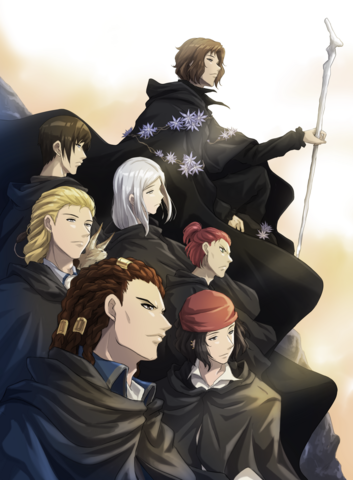
However, among the most renowned books chronicling the seven villains, two volumes, Veraro I and Veraro II, authored by Risayam[7], stood out as perhaps the most valuable. They presented an accurate account of the villains’ lives and adventures, featuring illustrations closer to the truth than the exaggerated depictions found in government-sanctioned books.
As a precautionary measure to safeguard the histories of the monarchies from distortion, manuscripts and books concerning the seven villains were prohibited and seized, except those that aligned with the monarchs’ policies and portrayed an embellished image of their power.
Consequently, prospective readers found it difficult to acquire genuine and compelling books about the villains in authorised stores. Their only access to the banned materials was through book smugglers.
Over time, the villains became widely recognised among the common people across all monarchies as “The Sapphire Cloak League,” owing to their distinctive sapphire-blue cloaks and masks. They were also known as “The Seven Brothers,” and, in more extreme cases, driven by fear of the monarchs’ oppression, they were called “The Seven.”
The seven were additionally recognised as the “Veraro League” because of their distinctive eight-petalled blue flower symbol, representing the seven known members and the enigmatic eighth member, whose identity remained undisclosed.
The only available information about this mysterious figure was considerably less reassuring: wherever he appeared, eerie jingles followed, and anyone unfortunate enough to hear them soon fell into an eternal sleep.
Ultimately, death did not end their story; instead, it bestowed upon them a new beginning, a form of immortality.
End of Prologue






![Fated to My Ex- Best Friend [Moving to Galatea]](https://cdn-gcs.inkitt.com/vertical_storycovers/ipad_49edb1dbf9a28b50b9c4d68d8598359b.jpg)
![Werewolf Hollow [GALATEA DATE TBA]](https://cdn-gcs.inkitt.com/vertical_storycovers/ipad_76bbf380fa2e8dc2f70694197487ab81.jpg)