
: „...Just a Matter of Formality...”


Dear Readers,
Every storyteller knows that a book is not just made of the words printed on the pages—it is built from the deep, hidden roots that lie beneath the surface. When I first began weaving the slow-burn journey of Mila and Weles in our main saga, I wanted the wilderness around them to feel heavy, raw, and completely authentic. I did not want to give you a cheap, pop-culture version of magic; I wanted you to feel the unyielding weight of ancient traditions, the scent of historical herbs, and the true, somber physics of the sacred knots.
As our story unfolded, something wonderful happened. You—my incredible, perceptive readers from all corners of the globe—started asking deep, brilliant questions. You wondered about the status of a szeptucha’s single braid, the true nature of the Great Mother Mokosz, and whether the ancient forces of the forest operated on a strict, unbreakable taboo.
Your curiosity inspired me. I realized that the historical and mythological foundations of this world are too vast to be hidden only within the dialogue of our main chapters.
That is why I decided to create this Companion Book. It is designed to be your official, illustrated guidebook to the wilderness. Here, parallel to our main story, we will explore the real academic research, the regional folktales, and the complex demonology that shapes our universe. Think of it as a quiet sanctuary where we can sit by the hearth together, look at the historical blueprints of the Slavic cosmos, and understand why the wilderness functions the way it does.
But before we step onto these mossy paths and examine our first gods and monsters, we need to address a few structural realities... just as a matter of formality.
To truly understand the dark, misty wilderness where the paths of Mila and Weles unfold, we must first break down a major misconception that exists in modern global fantasy. For many international readers across the continents, from North America to Asia, the word “Slavic” is often mistakenly reduced to a single monolith, usually associated entirely with Russia. But the reality of the ancient European woods was far richer, vaster, and beautifully diverse.
The ancient Slavs were never a single, uniform empire. They were a massive, sprawling family of independent tribes and cultures, historical geography neatly divides into three distinct branches:
The West Slavs: The proud ancestors of the Poles, Czechs, and Slovaks, as well as the ancient, forgotten Elbe tribes. This is the raw, rugged cradle of our story, set against the granite peaks of the Karkonosze and the Jizera Mountains.
The East Slavs: The builders of early medieval strongholds who laid the foundations for Ukrainians, Belarusians, and Russians.
The South Slavs: The tribes who settled closer to the sun-drenched valleys and Mediterranean borders, evolving into Serbs, Croats, Slovenes, Bulgarians, and Macedonians.
While all these brother-nations shared the same primordial cosmic roots—worshiping the heavy thunder of Perun in the skies and swearing solemn oaths by the subterranean waters of Weles—each region developed its own unique local folklore, distinct herbal wisdom, and deep regional demonology.
This brings us to the ultimate, heartbreaking challenge of writing Slavic fantasy: the problem of the lost records.
Unlike the ancient Greeks, Romans, or Norsemen, who left behind vast libraries of written epics, stone inscriptions, and detailed eddas, the early Slavs lived in a purely oral culture. They did not write down their myths. Their entire universe—their prayers to the Earth Mother Mokosz, their complex rituals of the sacred knots, and their fear of the winter sovereign Marzanna—was woven entirely into spoken songs, whispers passed down from mothers to daughters, and the secret lore of village healers.
When the heavy tides of Christianization swept across Central and Eastern Europe, this fragile oral heritage faced systemic erasure. Sacred groves of ancient oaks were systematically cut down, wooden idols carved from centuries-old trees were thrown into rivers or burned to ash, and the old priests were silenced.
So, how do we know anything about them today? How was this world painstakingly rebuilt?
The reconstruction of the Slavic cosmos is a rigorous, monumental puzzle. Historians and ethnographers must piece it together from three fragmented sources. First, from the biased, often hostile records of foreign chroniclers—German monks, Byzantine diplomats, and Arab merchants who traveled through the wilderness and noted the strange customs they witnessed. Second, from medieval judicial records where early courts tried to ban local superstitions. And third, from the most resilient treasure of all: living folklore.
In isolated, mist-shrouded mountain sanctuaries like the Jizera range, the old ways refused to die. Cut off from the larger medieval cities by treacherous terrain and endless bogs, the rural communities cloaked their ancient gods in new garments. The great Earth Mother became the patron of weavers and harvest, the household spirits retreated safely beneath the kitchen stoves, and the secret knowledge of wild plants remained locked within the leather bags of solitary wise women.
By taking these fragmented historical bones, dusting them off, and infusing them with the zmysłowy texture of a slow-burn narrative, this guidebook and our saga aim to restore that stolen balance. You are not just stepping into a fantasy book; you are entering a sanctuary of whispers that survived the fire of centuries.
Welcome to the wilderness.
Primary Historical & Academic Sources :
- “The Mythology of All Races: Slavic” by Louis Herbert Gray & Jan Máchal
- “Slavic Myths and Symbols” by Dr. Mark Kulikowski
- “The Slavs” by Marija Gimbutas
- “Russian Folk Belief” by Linda J. Ivanits
- “Primary Chronicle (Tale of Bygone Years)” (Historical Record, 12th Century)



![Werewolf Hollow [GALATEA DATE TBA]](https://cdn-gcs.inkitt.com/vertical_storycovers/ipad_76bbf380fa2e8dc2f70694197487ab81.jpg)












I'm really loving this! And I especially love that you included references at the end. It almost feels like a journal or research book, which makes everything feel so much more legit and professional. I would 100% keep a physical copy of this book if that were ever possible. ❤️
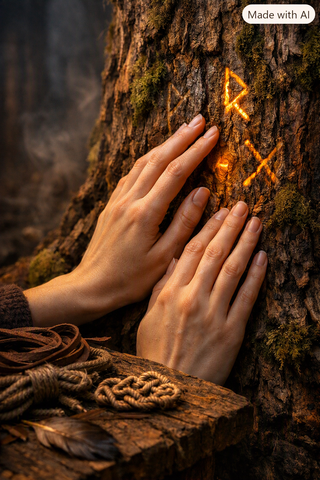
Also, I actually recognized those symbols in the last photo! I have some agate stone runes at home with some of those same symbols. I don't use them as often as I used to, but I have used them from time to time for personal guidance.
Now I'm wondering, though... would using them that way be considered taboo or disrespectful in any way? I genuinely don't want to misuse or disrespect the tradition or meaning behind these runes, especially because I really love them and have always found them fascinating.
So please tell me if there's anything I should be mindful of when using them! I'd genuinely love to learn more about them and make sure I'm treating them with the respect they deserve. ❤️