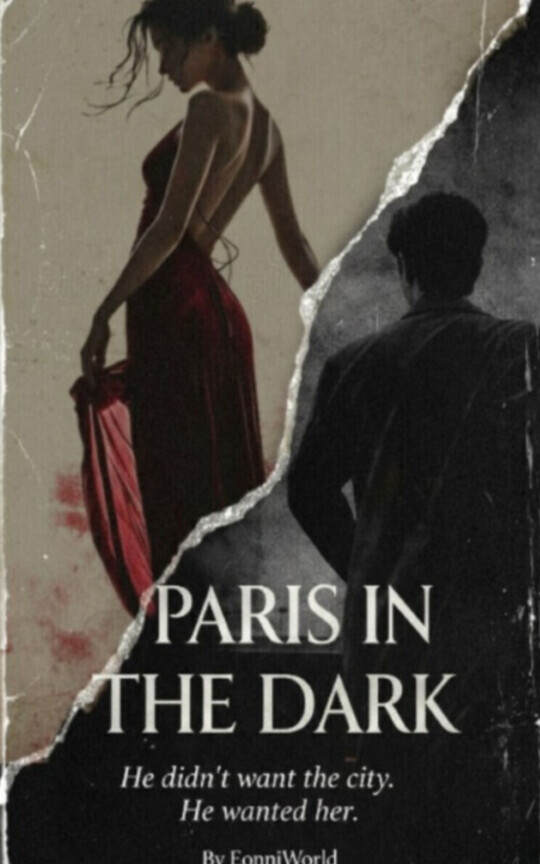
The Letter
HÉLOÏSE
What I know about debt is its smell. The paper first — the bank’s reminders smell of hot toner, of fear printed in large type. Then my building: the washed-out stairwell of rue Oberkampf has a breath of ancient must, of failed-student macaroni, of forty years of tenants who left. Me, I smell of ink. For fourteen months, I have been smelling the ink of all the books I can no longer manage to write.
There are 412 euros left in my account. On my table there is a dead novel called The Taste of Salt, my second, the one for which I was advanced twenty thousand euros I have not paid back. There is, in my letterbox, a letter from the notary of my former publisher that uses the word “recovery” with an undertaker’s courtesy. And there is, tonight, a black envelope.
It has no stamp. That should be my first clue: nobody sends me anything important enough to be carried by hand anymore. The address is written in black ink, an upright, tall handwriting in which each letter seems applied rather than traced — the handwriting of a man who has never had to hurry. On the back, a red wax. A single letter in the wax: A.
I open creditors’ mail standing up, on the fly, the way you tear off a bandage. This one, I set down on the table. I watch it drink my tea across from it for ten minutes.
Ten minutes is long, a black envelope. You take inventory of your own life without meaning to: the blanket that has been pilling for two winters, the pile of rejected manuscripts doing duty as a side table, the radiator that cracks every quarter hour like a discontented stage director, and the silence of the telephone, which is the largest piece of furniture in the apartment.
I had time to remember that the last time something was carried to me by hand, it was flowers, at my grandfather from the north’s funeral, six years earlier, and that I had already found old-fashioned those people who still carry things — and here was someone carrying one to me, a thing, by hand, a thing heavy with money and rules, in a city that no longer sends any.
Then I opened it, because creditors do not seal their threats in red wax, and men who pay for wax do not travel for reminders.
There is a sheet. One side only. I expected letterhead paper, lawyers, clauses in small type. I find handwriting, the same as on the envelope, and eleven lines. I know them by heart now, and I would know them if I ever forgot the language:
Madame,
You need thirty-five thousand euros. I need your pages. Ten thousand euros a page, paid on delivery of each text, against four rules. One: you will write your desires, not invented desires. Two: every detail will be true. Three: you will never seek to know me. Four: one word, from your mouth or from mine, and everything stops — that word, you will never write. It is the only one that is not for sale.
The first page is worth the ten thousand. It will be a test. If it is true, we will continue. If it is invented, we will never have existed.
— A.
I reread the word “page” four times. Ten thousand euros a page. A page holds between three hundred and six hundred words depending on the hand. I am a novelist: I know how to count what a word is worth when it is worth something, and nothing I have ever written has sold at that price, not even to the editors who still believed in me. You do not pay a page that price. You pay for a confession. You pay for a submission. You pay for something that exists nowhere else but in a single head.
And it is there, precisely there, at the exact spot where a sane woman should feel the trap, that I feel something else. A low, quick, shameful heat. Because I am a novelist in the other way as well: I know what he is asking for.
He is not asking for made-to-order erotica, the kind one manufactures for series, with its rises and its calibrated climaxes. He is asking for my desires. Mine. The ones I have never put in any book, or in any mouth, or in any bed — the ones I grant myself only at night, eyes closed, in the dark where they belong to me alone.
No one has ever wanted them. Perhaps that is why they have remained so intact.
I should call the notary back. I should call Sophie, who has fed me for six months and who would say, with her family-cop laugh: Héloïse, this is obviously a trafficker, a fetishist, a gentleman who collects broke women. I should tear up this page and ask for waitress hours at the Bistrot des Foires, across the street, which has been displaying “Staff wanted” since the summer.
At ten forty at night, I am still in front of the notebook page, the lamp on, my finger resting on the first line the way you set a foot on the step of a ticket window. One page. One desire. A single one, true. I am thirty-four, I have been loved five times badly, published once well, and it happens that when someone asks for my desires, I discover, with a slow astonishment, that I know them all by order of rank, the way others know their mistakes.
I write. I am not going to tell you here what I write — the readers of this book will know on the next page; that is the rule of the game, he taught it to me: what a woman writes for a man is not told, it is paid for. I will say only this: there is a library in what I wrote.
There is a man who did not ask permission. And there is that sentence in the middle, the one my hand wrote without consulting me, and which made me close my eyes over it: We remember the pleasure we had more than the pleasure we never dared.
In the morning, before sunrise, the page is finished, folded in three, under the envelope. I hesitated over the wax — I have none. I ended up putting a stamp on it like everyone else, and it made me ridiculous to high heaven: ten thousand euros of addressee, a La Poste stamp.
I posted it at the rue de Charonne office, at the hour when the mailman empties the boxes. Closing the iron shutter of the box again, I heard myself think, distinctly, with the clarity of a sober alcoholic: this is the first word you have written in fourteen months, and you have just sold it.
I walked to the canal drinking a coffee standing up, for two euros, the most expensive thing in my debt. The sun arrived on the water on the quais de Valmy side, across from the glass roof of the Hôtel du Nord, and I told myself the truest thing of my week:
We remember the pleasure we had more than the pleasure we never dared. And I, for fourteen years, dared nothing. But that is untrue, in a way. There was one time. There was that night. And no one will ever know—
No. That is not for sale. It has no price. You do not pay a page that price.