THIRTEEN SWIPES - I: Match


I promised myself thirteen more swipes, then I was deleting the app.
Not thirteen matches. Thirteen profiles, counted with the grim focus of someone waiting for a delayed train. My thumb caught on the chipped corner of my phone case. A bowl of cold noodles sat beside my laptop, where I had rewritten a button label from “Submit” to “Send request.”
My last relationship had ended in August, after two years of making plans that felt like rescheduling. We had broken up over coffee and divided the air fryer. My friends said dating was easier when you stopped treating it like an administrative burden.
I was a UX writer. I knew how to make a process feel less like a process. I could not make myself enjoy this one.
Swipe eleven: a man holding a fish with an expression of mutual disappointment.
Swipe twelve: a smiling architect whose bio said he loved “adventures,” without clarifying whether this meant travel or brunch.
I set a timer for thirteen seconds, because I resented the app having the last word.
The next profile loaded. I started to swipe, stopped, and leaned closer.
The man in the photo had dark hair, a small crease between his brows, and a smile that seemed to be happening despite his better judgment. He wore a white shirt open at the throat. In the second picture he was laughing at something outside the frame, one hand lifted, a silver ring catching the light.
I knew that face.
My thumb hovered while I tried to find where I had put him in my memory.
Theo Mercer, the profile said. Thirty-four.
“No,” I told the empty kitchen.
Then I swiped right.
The match appeared immediately. A message arrived before I could decide what to do with the familiar face.
Hi, Mara.
The normal opening unsettled me more.
The crease between the brows, the mouth. I knew the face, but the memory wouldn’t settle. I tapped away from the app and searched the full name from his profile.
The first result was an obituary. Theodore Mercer, twenty-one, died in a car accident on October 19, 2013. The date was thirteen years ago. The paragraph beneath the photograph was brief, a list of surviving family and a sentence about his bright curiosity. The photo showed the same crease in his brow.
I turned off the overhead light.
I found your obituary.
I assumed you would.
You’re dead.
Yes.
I hated the calm of that answer. I hated that I had asked it.
This is a sick joke.
It would be.
The three dots blinked. Then a photograph arrived.
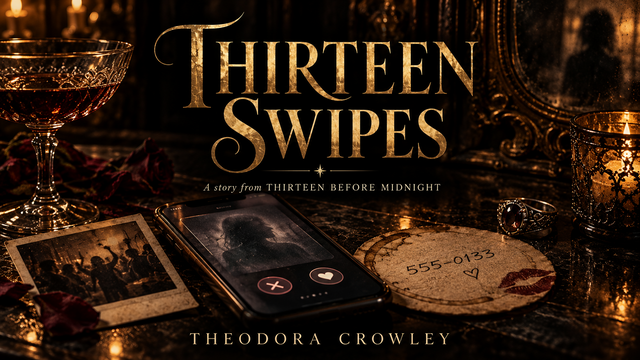
It was grainy, badly lit, taken in the same party kitchen I remembered. Someone had caught us shoulder to shoulder by the counter. I was laughing, my green sweater sleeve pushed up, my hair pinned in a way that had lasted perhaps an hour. Theo’s face was turned toward me, not the camera. In his hand, at the bottom edge of the frame, was a paper coaster.
My handwriting crossed it in black ink. My phone number, crooked because I had written it standing up, with a little loop on the seven that I still made when I was tired.
I had given him that coaster. I had spent years telling myself he never used the number.
Where did you get this?
It was with my things.
The photo could have come from an archive, and the obituary belonged to a dead man with the same name. Neither explained my handwriting in the hand of a man who had kept my number.
I put the phone facedown and took it back up again.