Mercy Lands Hard
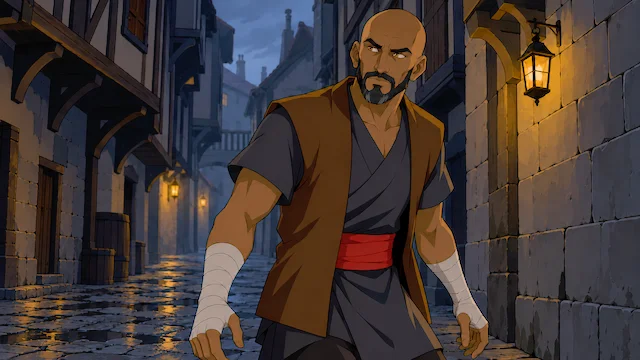


Rishi heard it before he saw it.
A boy’s voice—panicked, defiant, cracking with fear.
A man’s voice—hard, angry, trained to command.
And the third sound: the hiss of a blade being drawn from its scabbard.
He turned into Butchers’ Lane and took in the scene at a glance.
The buildings leaned close, shoulder to shoulder, blotting out most of the sky. Lantern light smeared across wet stone and through smoke.
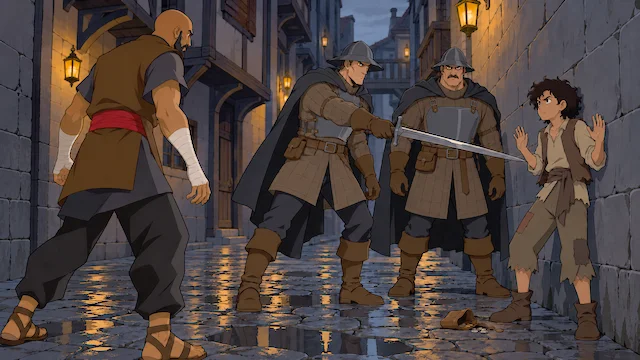
Where the alley narrowed, two Blackstone guards blocked the passage.
Between them, a boy no older than twelve, dressed in patched clothes, was pinned against a wall. He kept his hands raised and empty, but his chin remained stubbornly lifted. He was still talking, defiance in his words despite the fear in his voice. A torn purse lay on the ground, coins scattered in the dirt.
One of them raised his sword.
Rishi didn’t hesitate.
He stepped between blade and boy, inside the swing, and caught the swordsman’s forearm just above the wrist.
The impact shuddered through his wrapped palm, climbed his forearm, and rang his teeth. His shoulder nearly gave. He held anyway, turning the sword arm away from the boy as he shifted his weight beneath it.
“If a blade must fall, let it fall on me,” Rishi said.
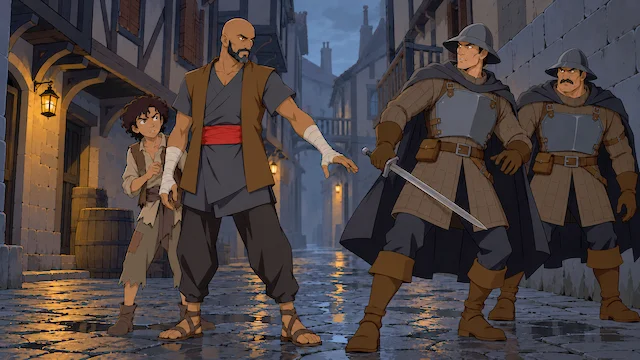
He let the arm go and lowered his hand slowly, controlling his breath to hold back the growl rising in his throat.
The swordsman staggered half a step back, eyes wide with surprise—more offended than afraid. “What the hell—”
The boy stared at Rishi, confused. Gratitude and terror warred in his expression, neither winning.
The second guard moved in, anger already flushing his cheeks. His gaze settled on Rishi, who didn’t step back.
“You interfering bastard,” the man snapped. “This whelp runs with thieves. Alley-trash.”
He said it like a verdict. Like it made the rest easy.
Rishi shook his head. “Not trash. Lost.”
The guards exchanged a quick, complicit look. Then the first one grinned.
It wasn’t a villain’s grin. It was worse. It was the grin of a man who had found a way to enjoy what he was already going to do.
“You want to take his punishment? Fine,” the swordsman said, sheathing his sword.
Rishi didn’t raise his fists. He only turned his head enough to catch the boy’s eyes.
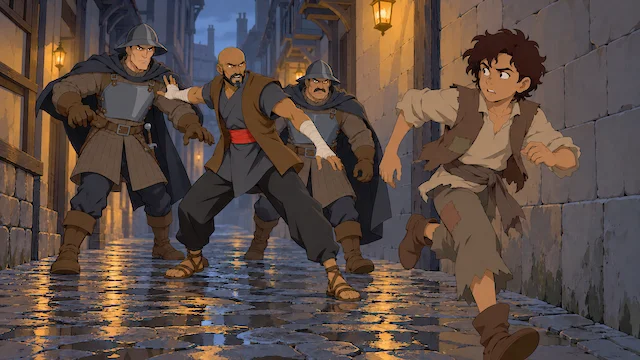
“Run!” he shouted.
The boy bolted past the broken cart. He looked back once. Then he vanished into the maze of balconies and shuttered windows.
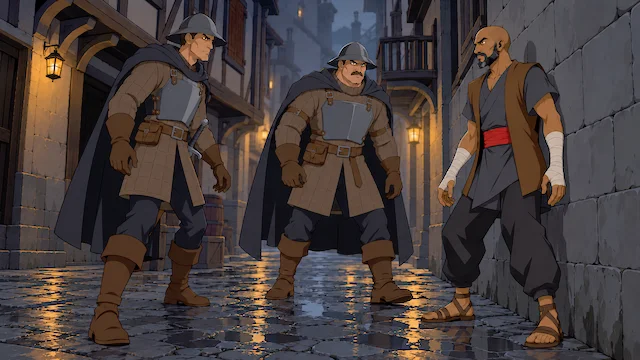
Rishi faced the two guards again. The alley gave him nowhere to breathe: wall at his right shoulder, cart to his left, slick stone underfoot. No room to maneuver.
Their armor made them careless—leather, metal, weight. His padding was rags and needlework, good enough for rain and scrapes, not for two trained men.
Rishi took one slow breath in. Not to become calm. Just to be present for what he had chosen.
The first man came in hard, crashing into Rishi’s guard and driving Rishi’s own hands back into his face. Pain flashed through his jaw. His teeth clicked together. He tasted copper.
Before he could raise his guard again, the second man kicked Rishi hard in the outer thigh, and his leg went dead.
They didn’t fight him. They dismantled him.
One stayed in front, keeping him busy, pushing him back into the wall. The other shifted to his side, angling into his blind spot.
When Rishi protected his head, they went to his body. When he protected his body, they went back to his head.
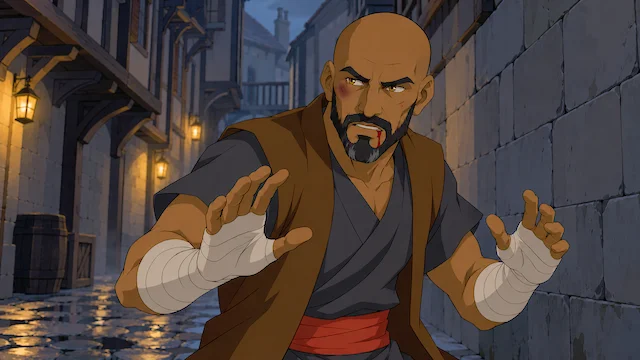
Rishi moved like someone trained to survive being hit. Chin tucked. Shoulders high. Elbows tight. Hands open.
He turned to soften the blows and took what he could. His steps were not meant to evade; they made the angles imperfect.
When the blows came too fast, he grabbed one of the men just long enough to break his momentum. The man snarled, surprised by the contact. Rishi let go immediately.
He would not let this become a fight.
He felt fear, sharp and animal, when a blow landed too close to his eye.
He felt anger, hot under his skin, when he heard the men laugh between breaths.
He knew exactly how to end this—where to strike, how to drop them, how to walk away and leave them moaning in pain on the stones.
And he stayed anyway. He had agreed to take the boy’s punishment. If he ran or fought his way free, they might go after the boy to finish it.
His ribs burned. Each breath scraped against something cracked.
His mouth filled with blood. He swallowed it.
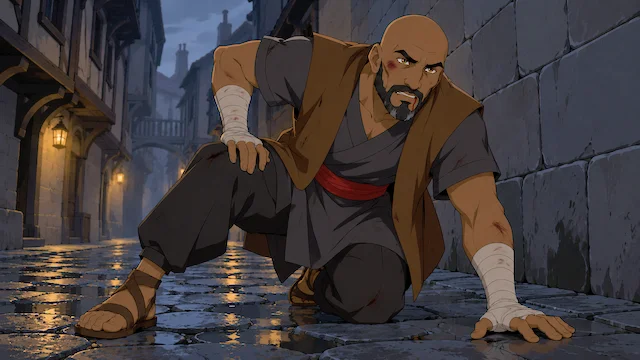
A knee buckled. He fell to the cobbles.
He pushed himself back to his feet, shaking.
Another kick struck him in the hip and drove him sideways. His shoulder hit the wall hard enough that his arm went numb. He blinked, dazzled.
Breathe, Rishi thought.
Don’t panic.
Stay up long enough for the boy to get away.
The beating stopped when the swordsman lowered his fists—not from mercy, but exhaustion.
“That’s enough,” he muttered, rubbing his knuckles.
The other spat on the ground and wiped sweat from his brow with the back of his wrist. “Let’s throw him in Blackstone. Let him meditate on minding his own god-damned business.”
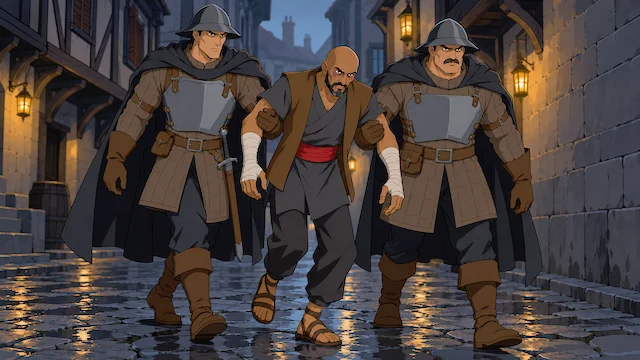
The men grabbed Rishi by the arms. Their metal gauntlets bit into bruised flesh as they hauled him up like a sack.
Rishi didn’t plead or explain. He focused on his breath. The one thing still his.
The alley blurred. Lanterns smeared into streaks. He caught a glimpse of the scattered coins on the ground, dull and dirty now, and thought how small they looked measured against what he’d just paid.
Then the alley was behind him, the fog swallowing it as they dragged him toward the looming walls of Blackstone Castle.
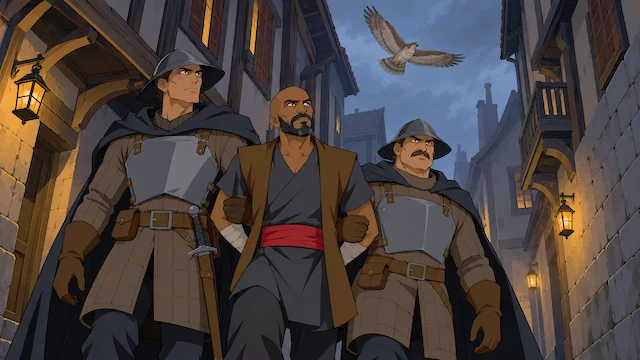
A hawk passed above him, its sharp cry cutting through the alley.
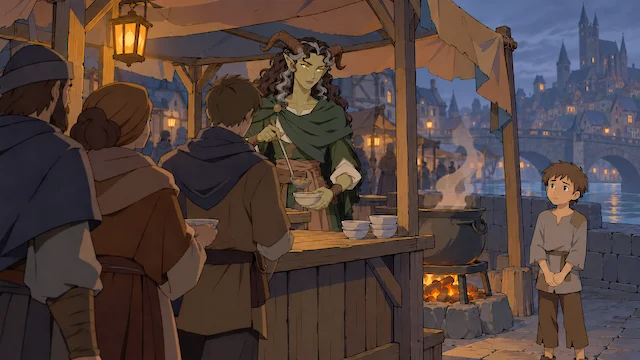
At her stall on Changers’ Bridge, Maeril kept busy behind a plank counter. The cookfire hissed, a pot steamed, and bowls rested on the counter. It was late in the evening, and a few customers still waited in line, trying not to look hungry.
Her hands had been moving by habit—ladle, bowl, coin, smile—threading an evening’s work through the bridge’s constant noise. The wind off the river carried smoke from the bridge. The sharp smell of onions drifted from the stalls.
People surged past, shouting prices, laughing too loudly, coughing into sleeves. A child hovered near the edge of her canopy, pretending not to look hungry.
Moments earlier, the hawk’s gaze had settled on Butchers’ Lane.
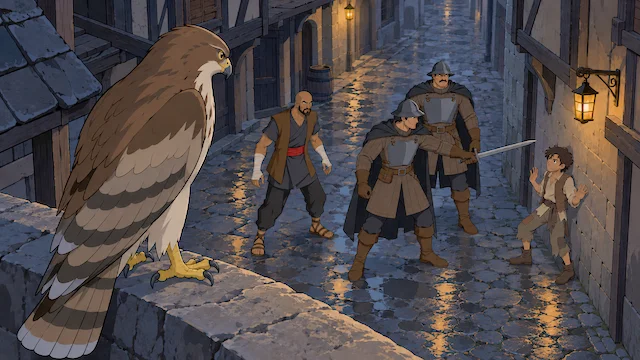
Two guards. The boy—Rook—cornered against the wall. A sword lifted.

Maeril’s stomach clenched.
I told you to stay away from the gang. There are easier ways to die than becoming a cutpurse, she thought.
A stranger stepped in. A wrapped hand caught the swordsman’s forearm. And then—fists, boots, two men taking turns breaking another man because they could.
Anger rose in her so fast she tasted it, hot and bitter.
Men. Always giving yourselves the right to be cruel. Same old story.
But beneath the anger, the stranger held her attention. He was scared. He was hurt. Even under their fists, he kept his hands open.
And he stayed anyway.
By the time the guards dragged him toward the prison, Maeril’s breath had gone shallow without her noticing. Even as they dragged him, he still tried to recover his footing—a reflex the beating had not erased.
Her ladle hung above the pot. Broth dripped back through the steam.
Someone cleared their throat in front of her, impatient.
Maeril sent one thought to the hawk. Follow him.
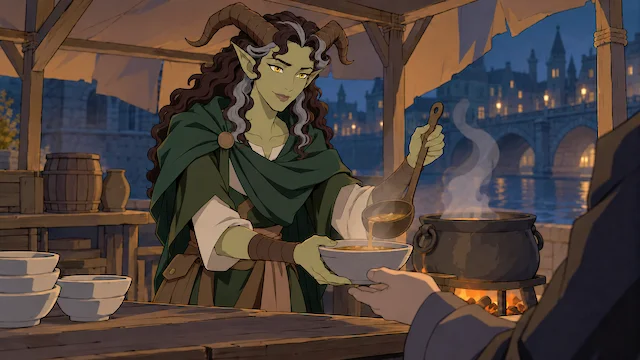
She went back to work, ladle in hand.
She could not abandon everyone who was hungry for one man. But she could watch.
She dipped the ladle into the pot and filled the bowl held out to her. She handed it back with a smile by way of apology.
Then she quietly slid another toward a child in threadbare clothes without asking for a coin.
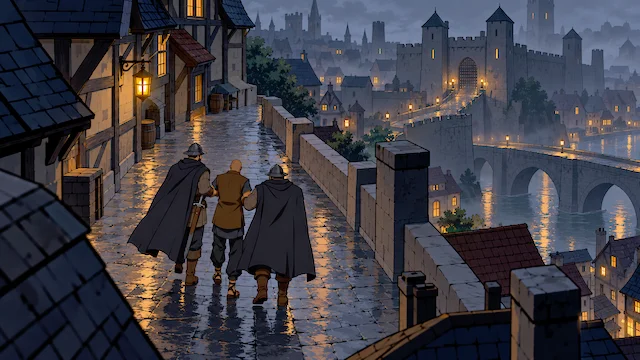
Through the hawk, Maeril kept the monk in sight as the guards dragged him toward the prison.
“All right, then.”
“Let’s see where you land.”