Chapter 1 The Wrong Signature


Owen Mercer had the pen in his hand, and then he didn’t.
The kitchen came back in pieces: the drip of the coffee maker, Erin’s voice from the mudroom telling Lucy she had two minutes, the smell of eggs going cold on the stove. March light through the window over the sink, gray as dishwater. Grant’s courier had run the papers over at seven, in a hurry, already late for something else—she’d pressed them into Erin’s hands at the door and been gone before the coffee finished. The package still sat where it had been dropped: the guarantee, thirty-one pages, holding the place of honor between the salt shaker and Owen’s toast. His phone had lit up twice since seven-twelve, Grant’s name on both. Owen had watched them die on the counter.
Only one page mattered. His name was already typed under the signature line. All he had to do was put ink over it, and the lender’s representative waiting in Grant Vale’s office would have what she needed by nine. The rest of the document was fine print—Grant’s business, Grant’s promises, Grant’s math, the kind of math that had a way of adding up to other people’s names at the bottom.
He had done this before.
Not remembered doing it—done it. Same chair, same cup of weak coffee going cold, same off-key humming from Erin while she packed Lucy’s lunch. He had signed to buy time. Grant had called it a formality: the lender wants skin in the game, Owen, it’s paper, you and I both know what the business is worth. Owen had believed that, or had wanted to, and for seventeen years the two had felt like the same thing. The pen had a slick of ink on the grip from his own thumb. He’d been holding it for a while. He didn’t remember picking it up.
The memory was not a story. It was the smell of diesel and hot brake dust, a freight truck’s grille filling the windshield, the sound his own ribs made against the dash. It was eighteen months compressed into the space between two heartbeats: the forbearance agreement he’d signed that morning and called a lifeline; the covenants he missed by a rounding error; the demand letters that started polite and stopped being anything at all; the yard emptying one driver at a time, trailers leaving for good, the forklifts quiet in the dark; Erin’s face across a kitchen table in a house they were losing, her voice very flat, asking what exactly he had signed. And Lucy—eight, standing in the doorway of their new rental with her backpack, telling him it was okay, because the new school had a science club. And the truck that killed him: green light, a load of pallets, a driver who never saw him coming. Owen had been too tired to look twice.
The pen was still in his hand.
He set it down.
“Owen?” Erin was in the doorway, Lucy’s backpack over one arm, coat half on. “You all right? You look like you saw something.”
He checked his phone. March 15. He checked the calendar on the fridge—Lucy’s school calendar, the spring science fair circled in red on the 29th. In the other life he had missed the setup day for a yard emergency, and Erin had gone alone, and he had told himself it was fine. He remembered the drive home that night, the empty seat beside him, the radio.
Eighteen months. He had eighteen months back, and they started this morning.
“I’m fine,” he said. “Just give me a second.”
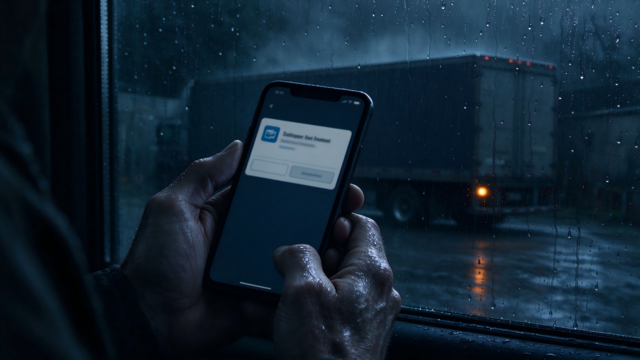
His phone buzzed. Yard notification from the Vale system—he still had read access, and his old operational authorization was still on file, the one Grant had asked him to sign last fall so the yard can run when you’re out on the road. He remembered signing that one fast. He was good at that—signing fast when Grant needed paper moved. “Standard stuff,” Grant had said, sliding the good pen across his desk. “You’d have done the same for me.” He thumbed the notification open.
CreationDoc_DocX_CrossFilePaste_Display_no_toast
Owen read it once. Twice. A third time, slower.
Load 7418 was in the yard. He knew it the way he knew the feel of his own work boots: he had stood next to it at nine the night before, checking the seal on the trailer door, and Rosa’s board had the truck rolling no earlier than nine-fifteen, and the appointment at the consignee wasn’t until noon. There was no version of the morning where that load was delivered, signed, and confirmed at 7:52. At 7:52 Owen had been in his own kitchen, watching his coffee go cold; the yard was twenty minutes up the interstate. The trailer hadn’t left the lot.
But the system said it had. And the system said he had signed for it.
He opened the attachment—a scanned delivery receipt. The signature sat in the box, scrawled, the O looped and the M slanted just the way he wrote it. Close enough that a clerk checking boxes would wave it through. Close enough that nobody would look twice. He zoomed in on the trailer number, then the time stamp, then the scrawl of the signature again. The O looped, the M slanted. His. Nearly.
The truck hasn’t left, he thought. And somebody signed my name to it.
“Owen.” Erin again, sharper. “You’re white as a sheet. What’s wrong?”
He looked back at the guarantee. Page one: unlimited personal guarantee, in favor of the lender, of the obligations of Vale Regional Warehousing LLC, in the aggregate principal amount of twenty-four million dollars. Twenty-four million. It fit in a signature box the size of a postage stamp. He had read that page in the other life, signed it, and shaken Grant’s hand, and Grant had said this was how you kept a company alive.
In this life, Owen picked the pen up—and put it down on the far side of the plate, out of reach, like a thing that could bite.
“I’m not signing this.”
Erin went very still. “Grant’s rep is waiting in his office. He called twice this morning. He said if the signature isn’t there by nine, Vale goes into default and the whole financing—”
“Then Vale goes into default.” His own voice came out level, and it surprised him. “Or Grant finds another way. Grant always finds another way, Erin. He just likes using mine better.”
“That’s not—” She set the backpack on the counter, slowly, as if the floor had tilted under her. “You’ve told me for a month this is the only thing that saves the company. The only thing. What changed?”
Eighteen months changed, he thought. A truck that never left the yard changed.
“I want to read it first. All of it. I want to know what I’m guaranteeing before I sign my name to twenty-four million dollars of debt that isn’t mine.”
“You’ve read it—”
“I’ve skimmed it. There’s a difference.” He picked up his phone instead and held it out to her, receipt up. “Look at this. Look at the time. That load didn’t leave the yard this morning. I stood next to it last night. And the system says I signed for it at 7:52.”
Erin took the phone. Read. Her face did something complicated—suspicion first, then worry, then the start of a question she wasn’t sure she wanted answered.
“Maybe it’s a mistake,” she said. “A glitch. Systems glitch, Owen, you’re the one who always says—”
“Maybe.” He pocketed the phone. “I’m going to find out. But I’m not signing the guarantee until I know who’s using my name.”
His phone lit up again. Grant: Rep is here. She needs the page by nine. Sign it, scan it, send it. One page. I’ll handle the rest.
Erin read it over his shoulder. “He says it’s one page.”
“It’s thirty-one pages.” Owen set the phone face-down. “He’s just never made me read the other thirty.”
She was quiet, and in the quiet he could hear the clinic in her voice—the way she talked about a double-booked afternoon, every moving part, everything that could go wrong before lunch. “That’s not all of it,” she said. “You didn’t go white over a delivery receipt.”
For a second he wanted to tell her everything. The letters. The empty yard. The truck. The sound his ribs made. She had a right to know; that was the whole lesson he’d never learned, the thing he’d never once given her—the truth about what he was signing and what it could cost them both.
“Not yet,” he said. “Let me be sure first. Then I’ll tell you all of it. I promise.”
She studied him, looking for the old reassurance, the I’ve got this he’d worn like a uniform for seventeen years. It wasn’t there. Something else was, and she didn’t have a name for it, and neither, exactly, did he. But she nodded. It was the most honest exchange they’d had in months.
He stood. His coffee was cold. His eggs were cold. Somewhere in Grant’s office a woman was looking at her watch, and Vale was eighteen months out from the wreck he remembered, and between the two of them sat a truck that had never left the yard—with his signature on the paperwork anyway.
“Dad?” Lucy came clattering down the stairs, one shoe on, one shoe off. “My lace.”
“Buddy.” He knelt, took the shoe, tied it—one loop, one knot, like he’d done a thousand times in a life that was gone. “There you go.”
“Are we going to be late?”
“No.” He stood, and for a second he let himself look at her: the crooked part in her hair, the science-fair flyer crumpled in the pocket of her backpack. “No, we’re not late. We’ve got plenty of time.”
He said it for her. He was starting to understand, for himself, exactly how much of it he’d been given back.