
Bethune Hall
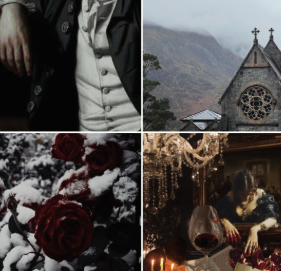


Bethune Hall
Winter, 1854
The first snow had come three days before Christmas, and in the Highlands it did not fall so much as settle, as though the heavens themselves had chosen to lay a pall across the hills.
By morning, the whole country around Loch Mòr was altered beyond recognition. The familiar ridges had softened into pale, ghostly forms beneath their burden of white; the firs stood black and rigid, each branch plated with frost; and the loch, dark as iron beneath the overcast sky, gave back no cheerful reflection, only a sullen gleam where the light touched. The roads were whitened and nearly erased. The walls of the old crofts along the lower slopes disappeared almost entirely beneath drifts that climbed to the window ledges. Even the wind seemed to lose itself in the wide silence, drifting over the water with a long, lamenting sound, as if it wandered the Highlands searching for something lost.
Upon the rise above the loch, Bethune Hall stood with a stubborn dignity.
The house was old - old enough that no one in living memory could say precisely when the first stones had been laid, though the family histories claimed an origin older than the present kingdom, older even than the last Jacobite rising, older than the neat arithmetic of modern men. Over the centuries the Bethunes had added to it in intervals of prosperity and necessity: a wing here, a tower there, a gallery when vanity and fortune happened to align, a pantry built into the thickness of the wall when a hard winter had made such a thing useful. The result was not elegance in the fashion of Edinburgh squares or London terraces, but a kind of grave, hereditary grandeur, part fortress and part manor house, with narrow windows in the oldest sections and taller, more graceful ones in the newer. Its stone was weather-darkened and silvered in places by age, its chimneys rose like sentries above the roof, and its grounds, once carefully tended, had begun in recent years to look as if winter had claimed more of them than summer could restore.
Bethune Hall had not been poor when Senna was a child. It had never been rich in the spectacular, opulent manner of some great houses, but there had once been enough: enough for new repairs, enough for servants in proper numbers, enough for summer plantings in the formal gardens, enough for the keeping of horses without counting every measure of oats.
Then the years had become harder, as they had for so many Highland estates. Crops failed. Tenants left. Some families emigrated with their few possessions and their faith in something better across the sea; others remained and learned to survive on thinner porridge, smaller fires, and a kind of stoic silence that bordered on prayer. The potato blight had stripped whole districts of their certainty, and though Bethune Hall had resisted the cruellest practices of its neighbours, it had not escaped the strain. Whole rooms stood unused in winter now. Some corridors were lit only where needed. Fires were maintained in the principal chambers and shut down in those the family could no longer afford to warm.
The house endured, but it endured with the severe economy of a body conserving its strength.
In the western tower, where the stone was thickest and the wind made the window panes mutter softly in their frames, Senna Bethune stood looking out over the loch.
She liked the tower room best. It had once been a place for maps, ledgers, and the sort of records her father kept with almost religious care. Now it had become, by long habit and because no one in the household objected, her private retreat. The small chamber smelled faintly of old books, cold stone, and the peat smoke that crept even into the most remote corners of the house. Its walls were lined with shelves bearing family histories, travel journals, and volumes of poetry with cracked leather spines. A narrow writing desk stood near the window, its polished surface scattered with papers, ribbons, and the beginnings of a letter she had not yet found a reason to finish. One chair sat before the fire, its deep red cushion worn by use; another had been dragged nearer the window by a former occupant and never returned.
A fire burned there now, low and steady, lending the room what little warmth it could against the winter.
Senna stood with one hand resting lightly against the stone of the embrasure, her gaze fixed on the world beyond the glass.
At twenty-four, she had an air of thoughtfulness that made strangers sometimes assume she was older. Her thick chestnut brown hair, which no amount of patient arranging could wholly persuade into obedience, had been pinned at the back of her head but had already loosened itself in several curls around her face. Her eyes were greenish-brown, though in certain light they seemed more gold than green, and the fire softened the strong line of her nose and the pale pink steadiness of her mouth. She wore a winter gown of deep green wool, with fitted sleeves and a high collar fastened by a small brooch of garnet and silver. Over it she had wrapped a knitted shawl whose fringe had been repaired twice and was in need of a third mending. There was nothing extravagant about her appearance. The old fashion plates in her mother Elizabeth’s correspondence folders might never have chosen her for admiration. But there was a directness in her face and expressions that people remembered.
Outside, the snow lay upon the slopes beyond the loch in great white folds, smoothing the land while making the more distant hills seem at once nearer and farther away. A flock of crows rose suddenly from the trees along the lower bank, a black scatter against the pearl-grey sky. Senna watched them wheel and vanish into the west.
A knock came at the door.
Three measured taps, followed by the door opening at once.
Brigid entered carrying an armful of folded garments.
“There you are,” she said.
Senna turned with a faint smile. “Were you looking for me?”
“I was searching every room in the house in hopes of finding someone accountable for you.”
“And did you?”
Brigid snorted softly and crossed to the chair by the fire, where she laid the garments with care. Her dark hair, drawn back beneath a cap, had escaped in a few wisps around her temples. She was near Senna’s own age, perhaps a year or two younger, with the kind of quick face that showed amusement even when she tried to appear serious. It had once been more obvious to everyone that she was a maid and Senna a laird’s daughter; now, after years of shared confidences and the private economies of girlhood, the distinction had softened into something like sisterhood without ever quite ceasing to be what it was.
“Mrs. MacLeod says you are to wear this,” Brigid said.
Senna glanced at the gown. “The dark blue?”
“Aye. She says it is ‘sufficiently becoming’ and ‘not too mournful.’”
“Hmm.”
“She also said,” Brigid added, with visible relish, “that if you intend to stand at a window and dream away the last hour before guests arrive, you may at least do it in a garment of proper dignity.”
Was that her exact wording?”
“Not exact. More refined. But the meaning was clear enough.”
Senna moved back to the window and looked once again across the loch. “It has turned very cold suddenly.”
Brigid, who had begun laying out hairpins and gloves upon the dressing table, glanced at her reflection rather than the view. “It is winter.”
“It is a sharper cold than usual.”
“That is because you have spent the afternoon in a tower chamber made of stone.”
Senna smiled, though she did not turn. There were days when she liked Brigid precisely because she made every unease sound slightly ridiculous.
Below them the estate lay subdued beneath the snow. One of the tenant cottages near the lane sent up a thin ribbon of smoke. Beyond it, the kitchen garden was a pale geometry of buried beds and clipped borders. The stone wall enclosing the grounds was partly hidden by drifts. Farther off, near the edge of the woods, the ruined old chapel stood with its roof gone and its broken arch black against the white of the landscape. Senna had always thought winter made the Highlands beautiful in a way that summer never did. Summer could be generous, ever crowded with green and light. Winter stripped everything down to its essence. The land became honest.
And yet there were days when the honesty of it disturbed her.
Brigid came to stand beside her.
“The guests will arrive soon,” she reminded. “Your mother has been in the hall since the early morning, overseeing candles as though the lighting of a room were a matter of state.”
“Elizabeth Bethune would oversee the sun itself if she thought it might be persuaded.”
Brigid smiled. “And your father?”
Senna’s gaze softened a little. “With the newspapers, I suspect.”
“And your brother?”
“At the lower landing when I last saw him. In a mood which suggested either duty or defiance, I could not tell which.”
Brigid gave a small, sympathetic sigh. “Mr. Duncan has had a great deal to think upon these past weeks.”
Senna said nothing at once.
She had, in truth, thought often of Duncan’s newspaper, folded and unfolded at the breakfast table, the war reports from Crimea spreading steadily through the household like a second, distant weather system. Every few days a new dispatch arrived from Inverness or Edinburgh, bringing news of a battle, a bombardment, a charge whose bravery the papers praised and whose cost they could not conceal. Balaclava. Sevastopol. The names had begun to collect in the hall like an accumulation of clouds. Some evenings Duncan read them aloud with an expression of tight concentration, and their father would listen in silence, his fingers resting near the edge of the page as though he could feel the future moving beneath the print.
Across the Highlands, young men were going to war. Some out of duty. Some out of hunger. Some because there is always a part of youth that mistakes danger for destiny. Senna knew enough to see that Duncan was troubled not merely by the war itself but by what it might ask of him. As heir to Bethune Hall, he should have remained at home, learning the burdens of the estate in preparation for the day when they would be his. Yet there were moments when she saw in him the old Bethune restlessness, the urge to prove that privilege did not absolve one of obligation.
A family might survive famine, debt, and the pressure of the age, but it was harder to survive one's own conscience.
Downstairs, a bell rang once.
Then again.
The first arrivals.
Brigid turned from the window. “You had best prepare.”
Senna sighed faintly and reached for the gown.
As Brigid began to help her unfasten the plain wool she had been wearing, Senna looked out once more across the snow and thought, not for the first time that week, that the landscape itself seemed to be holding its breath.
By the time Senna descended the staircase, Bethune Hall had altered itself from house into ceremony.
Every main room used for the gathering burned with candlelight. The great hall, with its high timbered ceiling and ancestral portraits looking down from the walls, glowed gold against the darkness beyond the windows. Evergreen garlands had been drawn through the banisters. Holly and pine had been set upon sideboards and mantelpieces. The silver candlesticks had been polished so that each flame stood reflected a dozen times over in gleaming surfaces. The smell of beeswax, woodsmoke, mulled wine, and the roast cooking in the kitchen filled the air with a richness that would have seemed abundant in better years and now felt almost ceremonial.
The gathering was smaller than Senna remembered from childhood.
Much smaller.
There had been a time when the solstice dinner at Bethune Hall was crowded enough to feel festive, with neighbors, cousins, tenants of some standing, the minister, the factor, and a dozen other people whose presence gave the evening its sense of life.
But the Highlands had changed. People had gone. Some had emigrated. Some had died. Some no longer came because they could not afford the carriage hire or because the roads in winter were too treacherous, or because the war had made everyone careful about where they spent their money and with whom they chose to associate. A few families who had once attended every year were absent now for reasons that were never spoken plainly. The empty spaces were noticeable because they belonged to memory. One did not mourn only those who had died; one mourned the shape of life after they were gone.
This year the hall held only a modest company.
The Reverend Callan MacRae and his wife.
Two neighboring lairds from estates not far from Loch Mòr.
An elderly widow whose son had recently gone to Crimea.
A merchant from Inverness with his wife and sister.
And several others who belonged to the circle of the Bethunes by old friendship rather than any flourishing prosperity.
Senna stood briefly at the foot of the stairs and took it all in.
Her mother was near the hearth, receiving guests with the composed grace that had always made Elizabeth Bethune capable of ruling a room without raising her voice. She wore a gown of deep plum silk, modest in cut but rich in texture, the colour darkening to near-black in the candlelight. Her hair, once the same chestnut brown as Senna’s, had softened with silver at the temples and was arranged in neat braids around the crown of her head. She smiled as she spoke, and her smile had a way of settling people; they believed, when they stood in her presence, that their troubles had briefly become manageable.
Nearby, her father stood speaking with one of the neighboring lairds. Laird Alistair Bethune was a tall man with broad shoulders that still retained the memory of strength despite the years pressing upon him. His hair, once black, now showed steel at the temples and in the beard he wore trimmed close to the jaw. His face had the weathered gravity of a man who had spent years considering the elements, harvests, rents, and lives not his own.
He was dressed in dark country wool, severe and practical, with a waistcoat of fine but not ostentatious cloth. He did not have the glitter of a fashionable gentleman. He looked instead like a man accustomed to responsibility and unwilling to make a show of it.
Duncan was by the sideboard, a glass in one hand and the evening’s newspaper, folded small, in the other.
He caught sight of Senna and lifted one dark brow in greeting.
Duncan had the same dark hair as their father, though his was worn a little longer and less disciplined. He was a handsome man in that unadorned, useful manner that made women trust him and men speak frankly to him. There was strength in him, but it was not the theatrical sort. It was the strength of one who lifts things, mends things, listens before he speaks, and has a habit of standing between danger and those he loves without announcing his intentions.
Beside him stood Isla, his wife, pale-haired and kind, her expression calm and open. She was not one of those women who filled a space by being dramatic; rather, she steadied it. Her gown was a muted shade of grey-blue, and there was something almost severe in the simplicity of it, though the line of her throat was elegant, and her hands, clasped loosely before her, were beautifully kept. Senna had always liked her and considered her a good friend.
Near the western fireplace, seated with a thick red and green shawl over her knees, sat Aunt Catherine.
She was one of the few people in the household who could make silence feel like a form of language. Miss Catherine Bethune, Alistair’s elder sister, wore black more often than colour and preferred it so thoroughly that even grief had ceased to appear as a special occasion for her. Her hair, once dark, had gone silver-white and was wound into a severe knot at the back of her head. Her face was narrow, her eyes shrewd and dark, and there were lines around her mouth that suggested she had spent a great deal of her life withholding commentary until the precise moment when it would be most devastating. Some considered her odd because she kept old records and remembered too much. Senna considered her indispensable. If the family had a conscience, Aunt Catherine was it.
At the edge of the room, Brigid moved through the guests with a tray of glasses, her profile lit whenever she passed one of the candles. She looked composed enough for a servant in a fine house, though Senna knew her too well not to notice the alertness behind her eyes. Brigid saw everything. She always had.
For one brief moment, while Senna stood there in the candlelit hall with the smell of peat smoke in her hair and the voices of her family around her, she was overcome by a startling tenderness. The house, for all its strain, seemed still full of life. The people in it were dear to her in the quiet, practical ways that matter more than declarations. It was easy to forget, in a warm room among familiar faces, how fragile such things were. The world beyond Bethune Hall had become harsh. Hunger had changed villages. War had drawn men away. Yet here, by candlelight, the old customs continued. The solstice gathering endured.
And if Senna had been asked at that moment what she feared, she might have said very little.
A little about Duncan.
A little about the war.
A little about the future.
But she would not, could not, have guessed how soon the house would cease to be a refuge and become the beginning of ruin.
A servant rang the bell for dinner.
The guests stirred.
And from the stairs, before she joined her family below, Senna Bethune lifted her eyes once more to the dark windows and saw, for the faintest instant, a shape pass beyond the snow.
Or perhaps it was only the wind.
In winter, the Highlands made liars of all who watched too closely.
Still, the sensation returned.
That old, unnamed unease.
As if the house had noticed something moving in the dark and had not yet decided whether to warn her.









