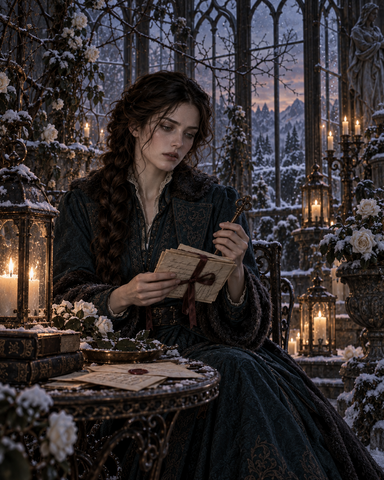
The Road That Wasn't There
By the time Liora Vale understood that the road was not on her map, the snow had already erased the one behind her.
She stopped the car in the middle of the white lane and stared through the windshield while the wipers shoved wet snow aside in two irritated arcs. The mountains had disappeared. So had the pines. There was only the narrow road, two dark ruts running forward beneath an arch of black branches, and her own headlights whitening the storm.
Her dashboard clock said 4:17 p.m. The light outside had the bruised, premature darkness of winter in the north. Her phone had shown no signal for the past forty minutes, but the downloaded survey map was still open on the passenger seat, its blue route ending three kilometers behind her at a broken bridge.
There was no road here.
Liora checked again, because checking was what she did when old buildings lied to her.
The paper version from the regional archive lay beneath her field notebook. She unfolded it across the steering wheel, smoothing the creases with the side of her hand. The map was from 1953, old enough to include forestry tracks modern navigation had forgotten. She traced the river, the bridge, the cluster of abandoned cottages marked near Saint Orra’s chapel.
Nothing.
No spur north. No mountain road. No house.
A gust struck the car broadside. Snow hissed across the glass.
‘Nonsense,’ Liora told the map.
The map remained professionally unhelpful.
She had been meant to spend the night at the village of Renfall and begin her survey of the Asterly estate at sunrise. Instead, a fallen lorry had blocked the main pass, the detour had ended at a washed-out bridge, and an elderly man at the last fuel station had pointed toward the mountains when she asked whether there was another way around.
‘There is an old road,’ he had said.
Then he had looked past her shoulder, toward the white hills, and added, ‘Though it does not always go where people think.’
At the time she had assumed he meant weather.
Liora folded the map. The sensible choice was to turn around.
She shifted into reverse.
The rear camera showed nothing but white.
She twisted in her seat. The road behind the car was not merely covered. It was gone.
A bank of snow rose where the lane had been, smooth and unbroken between the trees. No tire tracks. No red smear of taillights. No shallow ditch where she had passed five minutes earlier. The pines stood shoulder to shoulder, their lower branches knitted together with snow.
For several seconds, Liora did not move.
She had spent eight years working in old houses. She had crawled beneath Georgian floorboards where builders had sealed shoes into walls for luck. She had cataloged children’s names scratched into the backs of medieval choir stalls and once found a human tooth wrapped in silk beneath a stair newel in Brittany. Old buildings collected superstitions the way stone collected damp. If one listened too eagerly, every settling beam became a warning.
Liora did not listen eagerly.
But she knew, with the cold certainty of a person trained to observe small changes, that the trees behind her had moved.
She faced forward.
‘Fine,’ she said. ‘Forward, then.’
Her breath fogged the glass.
The fuel gauge sat just under half. The temperature had dropped to minus nine. Ahead, the road continued into the storm with the confidence of something that expected to be followed.
She drove.
The lane climbed for perhaps twenty minutes. It might have been longer. The bends repeated in a way that made time difficult to judge: black fir, stone wall, broken milestone, black fir again. Twice she passed a carved post topped by a weathered stone bird. The second time, she slowed.
There was a split in its left wing.
The same split.
Liora kept going.
At 4:53, the snow thinned abruptly.
Before the trees opened, Liora checked the odometer.
The car had traveled fourteen kilometers since the bridge.
By her map, the valley ahead should have been solid mountain.
She wrote the mileage in her field notebook because writing a measurement made it feel less like fear.
14.2 KM ON UNMAPPED ROAD.
Then, beneath it:
DO NOT TRUST RETURN ROUTE.
It was the first note she made about Morven.
Later there would be hundreds.
The car rolled out beneath an avenue of ancient yews, and the world opened.
Morven stood at the far end of the valley.
At first Liora thought it was a ruin, because no inhabited place could reasonably be that dark. The palace stretched across the slope in a series of steep roofs and towers, its stone nearly black against the snow. Rows of windows reflected the last gray light. Some were tall and narrow, some round, some divided into dozens of little panes. Chimneys rose without smoke. A glass winter garden clung to the eastern wing like a frozen lung.
The building was enormous, but its scale was less unsettling than its posture. It did not sit in the valley. It seemed to have lowered itself there.
Waiting.
The road crossed a bridge over a stream filmed with ice and ended at iron gates.
They were open.
Liora stopped before them.
Her headlights reached a pair of stone pillars. Letters had been cut into the lintel between them, softened by snow.
MORVEN.
She had heard the name before.
Not in a guidebook. Not recently.
The recognition moved at the back of her mind like a figure glimpsed at the end of a corridor. Something from university, perhaps. A lecture on adaptive architecture. A case history about a manor whose floor plan had changed between surveys. There were documented examples of ensouled houses, though most scholars preferred less dramatic terminology: mnemonic structures, responsive dwellings, inheritance anomalies.
Houses that remembered too much.
Houses that sometimes answered back.
Most had been dismantled.
Liora reached for her phone. Still no signal.
There was no village visible, no neighboring farm, no light anywhere in the valley. Her heater was beginning to struggle.
‘One night,’ she whispered.
The gates creaked wider.
Liora looked at them for a long moment.
Then she drove through.
The front doors opened before she could knock.
That should have been the moment she turned around.
Years later, when she tried to remember the exact sequence of choices that had taken her inside Morven, she could never decide which had been the first true mistake. Following the impossible road. Passing the gates. Leaving the car when the engine died at the foot of the steps.
Or believing, even for one second, that a door opened for the same reason a person opened one.
The entrance hall was warmer than the storm.
Not warm enough to be comfortable, but warm enough that Liora’s frozen fingers began to ache as she stepped over the threshold. She carried her backpack, survey case, and the heavy flashlight she kept in the car. Snow melted from her boots onto black-and-white marble.
‘Hello?’
Her voice climbed three stories and vanished beneath a ceiling painted with constellations.
No answer.
The doors remained open behind her.
That helped.
A little.
She took in the hall automatically. Late eighteenth-century core, later nineteenth-century interventions. Limestone columns. Walnut paneling darkened by age. Electrical sconces installed sometime in the early twentieth century, though none were lit. Candle brackets everywhere, each holding a fresh white taper.
Fresh.
Liora walked to the nearest one.
No dust on the wax.
She touched the wick.
Cold.
‘If someone lives here, I need a telephone,’ she called. ‘Or a room until the storm passes. I can pay.’
Silence.
On a console table beneath the stairs, a silver tray held a folded card.
LIORA VALE, it said.
Her gloved hand stopped halfway toward it.
The letters had been written in black ink. Not printed. The downstrokes were thick, the upstrokes fine. A pointed steel nib. The ink was almost dry.
Liora did not touch the card.
The reasonable explanations lined themselves up and failed one by one.
The regional trust knew her name, obviously, but no one had known she would take this road. She had not known. The fuel station attendant might have called ahead, except there was no signal and he had never asked her name. Someone could have read her license plate and guessed the rest, if that someone had access to a database and a sense of theater so deranged it deserved funding.
She backed toward the door.
Outside, the storm had thickened.
Her car sat below the steps, already half veiled in snow.
The entrance doors swung shut.
Liora lunged.
The two leaves met without a slam. There was only a soft, final click.
She seized the handle and pulled.
Nothing.
She braced one foot against the marble and pulled harder.
The handle did not move.
‘No,’ she said. ‘Absolutely not.’
Somewhere behind her, a candle lit.
Then another.
Then another.
Flame traveled around the hall in a slow circle, each wick kindling without touch. Light moved across gilt frames, carved banisters, the blank dark mouths of corridors.
Liora released the door.
Her own face looked back at her from an enormous mirror above the fireplace opposite the stairs.
Pale. Snow-wet hair pulled loose from its knot. Gray eyes too wide.
Behind her reflection, the entrance hall stretched away.
And a man was standing in it.
Liora turned so quickly her shoulder struck the door.
No one.
The hall was empty.
She looked back at the mirror.
He was still there.
Tall. Dark-haired. Dressed in a black shirt with the collar open as if he had been interrupted halfway through removing a tie. He stood near the foot of the staircase, perhaps fifteen feet behind her in the reflected room.
Only there was no one near the staircase in the real one.
His face was sharp with alarm.
Not menace.
Alarm.
For her.
He lifted one hand toward the glass.
His lips moved.
At first Liora heard nothing.
Then the mirror misted from the inside.
A sound came through it, faint as a voice carried beneath ice.
‘You should not be here,’ the man said.
Liora did not breathe.
He came closer, though no footsteps sounded.
‘You have to leave,’ he repeated. ‘Before it closes.’
Liora put two fingers against the mirror.
The glass was colder than the stone around it.
‘Who are you?’
The man glanced over his shoulder. In the reflection, a corridor opened behind him where Liora’s real wall should have been. Its lamps burned blue-white, and frost feathered the floorboards.
‘Someone who did not leave in time.’
Not an answer, but not the one a host would give.
Liora shifted sideways.
Her reflection moved with her. The man’s did not. He belonged to a second geometry laid precisely over the first.
‘Are you in this house?’
His expression tightened.
‘That depends on what you mean by in.’
A hinge groaned somewhere above them.
The man looked up sharply.
‘Questions later. Door now.’
For the first time, Liora heard something under his urgency besides fear.
Experience.
Whatever was happening to her had happened before.
The candles guttered.
Every door leading out of the entrance hall swung open at once.
The man looked toward them.
Fear changed his face.
‘Now,’ he said.
Liora seized the front-door handle again. It refused to move.
‘I am trying.’
The man struck the glass with the heel of his hand. The sound arrived a heartbeat late, no louder than a knock from another room.
‘Not that door. The west passage. Third arch. There used to be a servants’ exit.′
Liora ran.
The west passage yawned beyond a carved screen. She reached the first arch as a shudder passed through the floor. Dust trembled from the ceiling. Somewhere deep inside Morven, wood groaned with the long, articulate complaint of a ship turning in heavy water.
First arch.
Second.
The corridor stretched.
It had been perhaps fifteen meters long when she saw it from the hall. Now it ran into darkness beyond her flashlight beam.
‘Third,’ she muttered, passing a doorway that had not been visible before.
The third arch contained a narrow stair descending toward a square of gray light.
Liora took the steps two at a time.
The air grew colder. The smell of snow sharpened. At the bottom was a plain wooden door fitted with an iron latch.
She lifted it.
The door opened.
Wind struck her face.
Beyond lay a kitchen yard buried in snow and, thirty meters away, the outer wall. A postern gate stood open.
Relief hit so hard her knees softened.
Liora stepped outside.
One foot in the snow.
Then another.
The door slammed behind her.
She looked toward the open gate.
Something red moved in the snow between her and it.
A ribbon.
Narrow, silk, impossibly bright against the white. It lay half buried, one end fluttering though the wind had gone still.
Liora bent to pick it up.
The instant her fingers touched the fabric, a woman’s voice spoke beside her ear.
‘Don’t let it dress you.’
Liora spun.
No one.
The ribbon was warm in her hand.
For a moment Liora simply listened to the snow. No road noise. No engine from the valley. Not even birds. The silence had the padded density of a room after a door has been closed, except she was standing under open sky. Morven had not merely hidden the way out. It had made the world beyond the wall feel conceptually distant.
From inside the palace came three violent knocks.
Then Adrian’s voice, distorted by wood and distance.
‘Liora!’
He knew her name.
Before she could decide whether that frightened her more than the invisible woman, the open postern gate at the edge of the yard swung shut.
Snow surged upward along the wall like white water.
The gap disappeared.
Liora ran to it anyway.
She clawed snow from the stones until her gloves were soaked through. There was no gate. No seam. Only an unbroken wall older than the mortar between its blocks.
Behind her, the kitchen door opened.
Warm light fell across the snow.
Liora turned.
Adrian was not standing there.
No one was.
But in the small window set into the door, his reflection watched her from the other side of the glass.
His expression was grim.
‘It has closed,’ he said.
Liora stared at him.
‘What has?’
He looked past her, toward the vanished gate, then back to her face.
‘The choice.’
The kitchen door pulled itself wider.
Behind Adrian’s reflection, though the real room beyond the threshold appeared empty, candles bloomed one by one down a corridor she could not see.
The palace had not merely let her in.
It had decided to keep her.