
Once Upon a Morning Hunt
Part 1: The ways of old
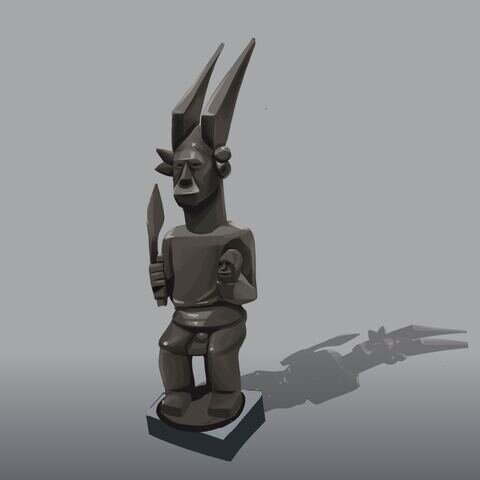
Words From The Great Ape Men – Artefact #6870
Time
In the beginning, they were three – the Great Trinity
Father, mother, and seed
The father, we called Amadioha
Knower of all things
Past, present and future
The great mind of creation
And bearer of divine seed
The seed we call chi – divine energy
Know this, and join us
The mother, we called Eke
The spirit womb of the universe
For no seed alone can grow
Without fertile soil to nurture
She is the bringer of motion, the birther of life
Know this, and join us
The divine seed, chi
Continues to live in us, through us, and with us
The soul that outlives the body
For energy can never die
But can only be transmuted
From one form, to another
From one life, to another
Know this, and join us
The fool sees lightning from the sky and calls it Amadioha’s wrath
They do not understand symbology
So they think Amadioha a mere being
A man in the sky
They see the python and call it Eke
Observing the sacred rituals that forbids the killing
And other such rites they follow blindly to appear virtuous
They think they fool others
But really, they fool themselves
They speak of chi
Erecting shrines and offering sacrifice
Like the chi is of flesh that it needs to feast of goats
With eyes wide open, they still roam in darkness
Know this, and know you
Chapter 1 (Once Upon A Morning Hunt)
‘Shhh.’
The man hissed and the boy was quiet. Between the croaks of toads in a swampy marsh, a twig could be heard snapping – or moving.
‘Can you smell it?’ the man asked his son.
The young boy sniffed at the cool air, turning his head left and then right.
‘You follow the sound, listen. You follow the breeze, sniff.’
Another twig napped – moved. It was left of where they hid leaning behind a large tree trunk with arrows nested in taunt strings.
‘It smells like anu ofia.’ the boy said.
‘Yes, it smells like bushmeat stew. It just needs to be cooked first.’ the man flashed a smile in the morning that still dawned.
The rainy season was making way for the dry now, leaving the swamp rising only a few inches past the ankles. It was not ideal for a hunt, even less so when stealth was a priority – but the boy had to learn. He had to learn to be able to do this at all times; in the rain, at night, and even in his dreams. After all, he was the first son of a D’nta. Becoming a master hunter was as much in his future as his own shadow was now by his side.
The animal’s head finally moved in the darkness as it stood on its forelegs as if to scan the area like a meerkat would.
‘Now!’ A shouted whisper.
The boy fired, hitting close enough in the direction of his aim, but too far to make a kill or injure his game. The arrow struck the ground near the creature and immediately, it moved to escape. First with a perked ear in the direction of the shot, and then a return to its four legs on the ground. The man released his arrow. A clean shot on target somewhere on the head. He had aimed for the eyes, but standing about fifteen paces away under a sky still shy of light, any connection at all was a testament to his ability.
There was only a whimper, fast and low. And then a thud, as the creature hit the swamp.
‘When Ala holds the rain from us, this will not be possible. You will have to hit it on first strike. Do you understand why?’
The boy shook his head. His father smiled, leaning out of the tree they had taken cover with.
‘The water holds the hunter, the water holds the hunted. We are gifted an extra breath of time to act as the prey digs its tiny legs out of the sunken sand.’
‘Just like we are doing now?’ the boy asked as they dragged their feet closer to their prize, dragging it out the wet sand with each step.
‘Yes, just like we are doing now.’
The bush was still mostly quiet, save the toads that wouldn’t stop croaking. Leopards did not roam so early or this far out of the forest, but snakes, one could never be too sure. Both kept their ears open for the sound of a rattle.
When they were close enough, the boy got to work retrieving the arrow. This part he had already mastered on one too many hunting trips. First a little tug to loosen the exit, and then a hard yank, twisting for some ease to pull out. He dipped the tip in the water and then cleaned it with a rag no bigger than the size of his palm. Just before he gave it back, he dried what wetness was left on the weapon rubbing it over his cover cloth. This was a bronze infused arrow tip, casted by the great hands of the Ogbi-Ukwu uzu men. It was made more so for hunting than for battle because it was worth too much to be left in a body. Iron which wasn’t so difficult to cast was much better for war.
‘When will I be able to get my own bronze arrows.’ he asked his father.
‘You haven’t even crawled, yet, you speak of running.’
The boy said nothing.
‘When you kill a leopard with a spear or sword and earn the title of Ogbu’agu, you will be gifted with bronze weapons in honor of your bravery and skill, and you will then be welcome to the council of mighty men. For now, be grateful for the iron tips you have. Many fathers teach their sons only with wooden tips.’
Feeling somewhat defeated, the boy handed the arrow back to his father with a slouched shoulder. Pulling his iron tip out of the soft ground required no skill. He wiped it only because he needed it dry to protect it against rust and decay.
The boy proceeded to place the dead animal in their cane woven basket after tying its legs together for easy bundling. When it was secure, he slung it over his back and tied on the carry strings to keep it there. It was now time to head back home.
‘You should have seen me approaching my seventh rain, I barely slept most nights, waiting on the Ekpe society’s call from the elders of the fraternity. I waited so edgarly it felt like I was dreaming about it every night when I managed to sleep.’
‘But nna’m - my father, I am…’ The boy paused, afraid to admit that he was afraid. The rite of passage into manhood was a custom he could not avoid, unless of course he wished not to be recognised as a man in Eke kingdom. Perhaps in his next life, he will come back as a woman. He did not need to speak though. Where his words betrayed him with silence, his voice cracked and then died in a frightened whimper - much like the animal they had just killed.
‘It is okay to fear nwa’m - my child.’ he rubbed the boy’s tight curls as if to comfort him. ‘When you face the tests of manhood, you will find that it is as much a test of wisdom as it is a test of bravery. You have been born of my seed, channelled through the womb of a powerful woman blessed abundantly by Ala. There is more in you than you can see, but you must allow yourself to grow. How else do you think the sprout becomes a tree?’
‘You make it sound all so easy. I have been practising for how long now, and I can’t even hit this bushmeat on marshy ground, this one that is even slow to run. You must be ashamed of me.’
The father laughed a small laugh.
‘Anyi, you have trained since your seventh rain, and so have I. I have seen thirty five rains since then, and you have seen just six. Yet, you look at my eyes with the arrow and you hope to see what I see, to know what I know.’
The boy sighed, perhaps his father was right and he had to resign from his haste.
‘A time will come when you will go back to your state before you ever picked up a bow. Your body will understand the hunt so well that even blinded, your ears will be enough. Even deaf, your mind will be enough. It is just like you cried through your first breaths and now you breathe without knowing.’
The boy’s eyes widened at the prospect.
‘How is that even possible!’
’Do you not eat pounded yam in the dark? Finding your bowl and then your mouth.’
‘Yes, but my mouth is on my head, a part of my body. The bow is not, nor is the prey.’
The man shook his head.
‘You are much too young for certain wisdom, but know it now that there is no separation between you, the bow, the arrow, the distance between you and the prey, or even the prey itself.’
The boy knew not to probe anymore. Perhaps one day, these mysteries the elders were quick to speak of will be revealed to him too – how can there be distance yet no separation? Maybe that was what it meant to become an elder, to have these strange truths revealed to you. Soon, they were out of the marsh and on the dirt road. Other hunters were there too, most with bows and arrows, some with guns, the thundering weapon of the pig-skinned men.
‘Would you ever use a gun in hunting?’ The boy asked.
‘Perhaps when I am old and lazy with the white of my eyes leaking with milk. I only hope I never live to see the day these ones too will be called Ogbu’agu because they can shoot at a leopard and extract the teeth and claws.’ He fingered the single tooth he wore as a pendant. They greeted the men they walked past, and the women too. The women did not hunt, but they carried fishing nets, farm tools, firewood, and water pots. The dirt road eventually led them back to the town.
Walk paths worn from tramples cut the grey clay ground, bending around hut-clustered compounds in different directions. Sometimes it was hard to know where one man’s obi stopped and where the other started. Other times, it was clear with short bamboo fences separating each man’s land. In Eke Kingdom, a man’s obi was his palace; and to beautify the homes, wives competed fiercely with ornamentation. Now the darkness had given way to the light, though the sun was not yet out to be seen. They could make out the hand painted walls; geometric patterns the elders swore to be sacred, and symbols denoting many meanings - the tortoise for wisdom and cunning, the snake for intuition, the leopard for strength, the elephant for knowledge and truth. Each woman’s work had her style in it, but generally they spoke the same language. A language the boy understood in the way that a boy could.
Greetings rang from the obis where men sat outside, some already gathering their uttaba herbal snuff for a morning sniff. A few held bamboo cups to hide their kai-kai drink, but most chumped on chewsticks and just went about their morning chores.
‘Ogbu’agu! Otutu oma.’ Leopard killer, good morning.
‘Onye nke chi ya folu efo. Amadi na edu gi dube’m.’
The boy’s father greeted them back, raising his bow to show his recognition. When the greeting came from his elders, he was quick to remind them that the prestige of his title held nothing in the face of the greying of their crowns.
‘I don’t understand the greeting, onye nke chi ya folu efo. Are there people that are alive in the morning, yet the morning does not rise in them.’
The man sighed. ‘You ask too many questions.’
‘Yes, and you said that the child that asks will become the man that knows, onye ajuju adahi efu uzo.’
‘You clearly inherited your mother’s head. But as for your question, I fear such sayings are not yet for you to know. These are the things you will come to learn in your years of Ekpe. Perhaps I can tell you why it is called Ekpe.’
They made way for a goat herder driving his livestock into the pen, and then avoided a palm wine tapper with his climbing ropes and tapping pot.
‘Is it called Ekpe because it is the python-speak for the left hand, aka ekpe?’ The boy asked.
‘Congratulations, you know what the word translates to, but do you know what it means?’
The boy was silent.
‘Perhaps I really have to start teaching you these things. The pig-men and their ways are eroding our language very fast. You know, I hear that in some territories where they have dominated, our children no longer know how to read akala left by the first men on the rocks of their own sacred grounds. They can now only read pig-men symbols. Alphabet they call it. I even hear rumours that some of these rocks have been destroyed, sacred trees cut down.’ he spat on the ground in disapproval, ‘alu!’
The boy was not sure why these things were important. Language, inscriptions on stones left by the First Men - the great ancestors, sacred trees, and other such things his father cared so much about. Were languages not just words? Were rocks and trees not just things of the earth?
‘It is called Ekpe, or as you say, left hand, because since you were a baby, you have been practising with your right hand, your natural hand. The ancestors believe that on your fourteenth rain, you must start to learn the use of your left hand. It is only after then that you may become a human being, a full human being - nmadu.’
The boy squinted as if to process the new found information with his eyes.
‘But then, why don’t they just make us sculpt wood, clay and stone, with our left hand? Surely, that must be better than whatever it is that happens in the bush they take us to. And are you saying you can use your left hand just as well as your right?’
The man smiled.
‘You see my son, when we speak of the left hand here, we do not speak of the hand at all.’
‘Hmmm,’ the boy stopped at the front of their obi.
‘Then what do we speak of?’ His eyes widened with curiosity.
The man placed his bow down and then unfasten his sword from the sheath that held it on his waist. Now wearing only his goatskin skirt, he felt much lighter.
‘We speak of the mind, of the soul. We speak of mnuo, and of chi.’







