
Chapter 1 : The beginning
The room was dimly lit, with only the crackling fire in the hearth casting shadows on the walls. The group of young listeners sat in a semicircle, their eager faces turned toward the old man standing before them.
"Good evening, everyone," the man began, his voice deep and commanding.
"Good evening, teacher," the group replied in unison, their voices a mix of respect and anticipation.
"Are you ready for tonight’s story?" the man asked, a hint of a smile tugging at the corners of his mouth.
"Yes!" they chorused, excitement bubbling in the room.
He cleared his throat, leaning on the wooden staff in his hand. "Tonight’s story," he began, "is about the last great war between the elves and humanity—a war that nearly destroyed half of the world. But, more importantly, it’s about how that war ended."
The group gasped, eyes widening with surprise.
The old man chuckled softly. "Now, now," he said, raising a hand, "let’s not jump to conclusions. It all began with a simple thing—a man falling in love with an elf."
One of the younger listeners piped up, curiosity in his voice. "Teacher, do elves really exist?"
"They did," the man replied, his voice tinged with sadness. "But, unfortunately, they are no more. The story of their disappearance is a tragic one."
He paused, letting the weight of his words sink in before continuing.
“In the human kingdom, religion plays a significant role in shaping society. The most prominent faith is that of the Lords of Fire, a fervent group who revere the fierce power of flames and the divine beings said to control them. This religion, often called the Emberfaith, teaches that fire is both a creator and destroyer, symbolizing the dual nature of life itself. Meanwhile, the elves hold a deep, spiritual connection to the land, worshiping a goddess they call Nature. To them, she is the embodiment of all that is green, colorful, and beautiful in the world, responsible for the flourishing of life and the harmony of the natural order.
Beyond these two dominant beliefs, there are smaller sects scattered throughout the lands. Some humans worship the Sun, viewing it as the ultimate source of life and the bringer of death. Others pay homage to the God of Death, a mysterious figure who governs the passage between life and the afterlife. In the more prosperous regions, the God of Gold is venerated by those who seek wealth and fortune, believing that this deity controls the flow of riches and prosperity. These various religions, each with their own doctrines and rituals, contribute to the rich tapestry of beliefs that define the world, with more to be revealed as the story unfolds.
Back then, in what we now call the ‘Peace Age,’ humanity and the elves forged a fragile truce. They agreed to live side by side, but under strict conditions."
The listeners leaned in closer, hanging on his every word.
"First, magic was forbidden. Anyone who dared to break this rule would be judged and executed without mercy. Magic, you see, was considered too dangerous—it always led to bloodshed.
"Second, humans were to cease their destruction of the elves’ sacred lands. They were forbidden from harvesting wood from the elven forests and had to seek resources elsewhere. Breaking this rule would also bring severe punishment.
"Finally, the third rule: humans and elves were banned from interacting with each other in any way. No contact was allowed, and any who disobeyed this command would face dire consequences.
"And so, despite occasional skirmishes along the borders, humanity and the elves lived in a tense peace."
The old man’s voice grew softer, more contemplative, as he continued. "But peace is a fragile thing, easily shattered. And it was on one fateful day that an old farmer named Kain woke to the sound of a crying baby."
The group listened intently, the firelight reflecting in their wide eyes.
"Kain was a formidable warrior, his presence commanding respect. He had a broad, rugged face framed by a long, gray beard that reached down to his chest. His physique was muscular and robust, reminiscent of a seasoned bodybuilder, and his hair, also gray, was tied back into a ponytail. He often wore dark robes that draped around him, adding to his imposing appearance. He was a solitary man, living far from the nearest village. Concerned, he followed the sound and found a strange sight—a baby with sharp ears, like those of the elves, lying wounded on his doorstep. The child’s legs were bleeding, and he was crying in pain."
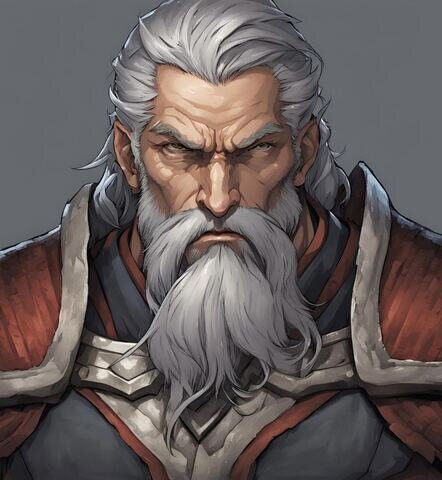
The old man’s voice took on a tender tone as he recounted Kane’s actions. "Kain, despite his years of solitude, felt his heart stir with compassion. ‘How did you get here?’ he asked the infant softly. ‘You’re bleeding, little one”
"He took the baby inside his farmhouse and, drawing on the knowledge he’d learned long ago, healed the child’s wounds with a simple spell—a forbidden act, but one he deemed necessary."
The group listened, captivated by the unfolding tale.
"Kain raised the child as his own, naming him William. It wasn’t easy at first—Kain had never had a son, and the boy was, after all, an elf. But over time, they formed a bond that only deepened with each passing year."
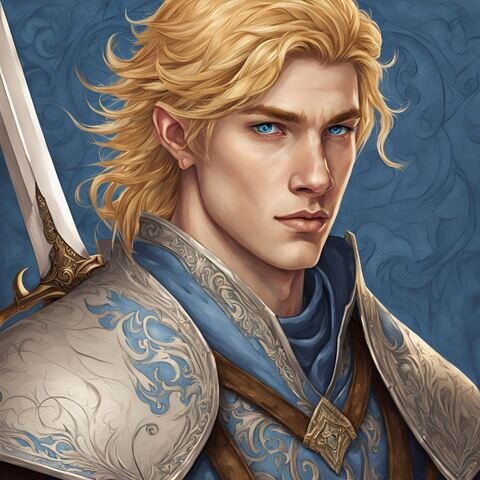
The man’s voice grew more serious. "Kain taught William many things—how to fend off wild animals, how to work the land. But he never spoke of his past, no matter how often William asked. The old man would simply fall silent or change the subject. And so, William learned to accept this, though the questions never left his mind."
He paused, letting the silence fill the room before continuing. "Every afternoon, after a day of tending the farm, Kain and William would practice the way of the Sword, a skill passed down from a warrior. And then, one day, as the sun was setting, Kain asked William to sit with him in the backyard."
The old man’s eyes seemed to glaze over as if he was seeing the scene unfold before him. "The sunset was breathtaking—orange light slicing through the sky, casting a warm glow over the green fields. William had never felt such peace."
The group remained silent, enraptured by the imagery.







