
Forbidden Wilds
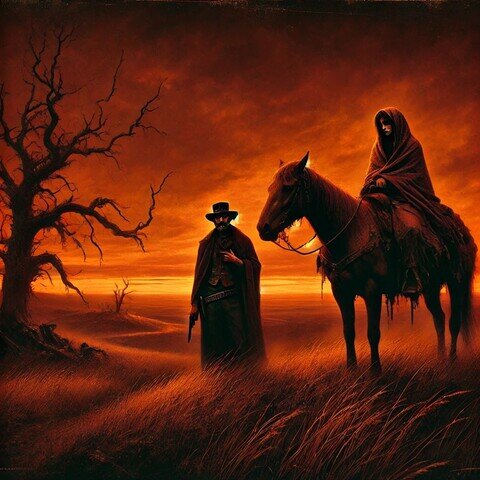 The prairie stretched endlessly beneath a sky bathed in molten amber, the sun bleeding into the horizon, painting the edges of the world in streaks of gold and gray.
Dust writhed like restless serpents, swirling around the steady beat of Abraham’s horse hooves. The emptiness stretched infinitely, the sound of his journey an echo swallowed by the vast silence of the prairie. Each breath he drew tasted of the land’s dryness, carrying a faint bitterness of earth and exhaustion, as though the prairie itself sought to sap him of every ounce of strength. The pale light of dawn had long since given way to molten skies, and the relentless hours pressed heavily against his shoulders, carving deep furrows of exhaustion into his weathered face. Each ache in his bones was a silent tally in a ledger of debts owed to this ruthless land, a place that demanded everything and gave nothing but scars in return. Time slipped away irretrievably, its weight dragging behind him like a shadow he could never outrun.
Two nights ago, a violent storm had raged across the plains, tearing through Abraham’s pastures with the savage intensity of a living thing. The fences, once sturdy, now lay shattered, their jagged remnants jutting from the ground like broken bones. His cattle had vanished into the chaos, scattered like fallen leaves caught in a whirlwind. The storm hadn’t just taken fences and cattle; it had stolen the land’s quiet dignity, leaving behind a scarred emptiness that seemed to whisper its discontent. Every shadow stretched too long, every breeze carried a note of something lost, and in the stillness, Abraham felt a faint, unshakable sense that the storm had awakened something better left undisturbed. Abraham had spent the following morning repairing what he could, but there was something in the air now, an intangible weight, as though the storm had awakened something buried deep beneath the prairie’s surface. The fences, once sturdy, now lay shattered, their jagged remnants jutting from the ground like broken bones. His cattle had vanished into the chaos, scattered like fallen leaves caught in a whirlwind. As dusk crept in, Abraham exhaled a sigh, low and weary, his breath stolen by the chilling wind. This land, which he had once cherished as his sanctuary, now loomed like a silent adversary—vast, unyielding, and cruel in its refusal to reward the sweat and toil poured into its ungrateful soil.
“Damn it,” Abraham muttered under his breath, his voice swallowed by the empty expanse. He tugged sharply on the reins, scanning the barren horizon, his scowl deepening. The dry wind, a constant companion, whistled through the open prairie. Normally, its ceaseless hum brought a strange kind of solace, but tonight, it grated on his nerves. Just as he was ready to give up, to let the cattle find their own way back, a faint cry sliced through the wind. It wasn’t the lowing of cattle or the whistle of wind; it was something else—faint and trembling, yet strangely persistent. Abraham froze in the saddle, his hand instinctively brushing the revolver at his hip. His pulse quickened as he turned toward the sound.
Leaning forward, Abraham’s fingers brushed against the cool steel of his revolver, the touch a reassurance in this unforgiving expanse. His horse shifted uneasily beneath him, its ears twitching and nostrils flaring as though catching an unfamiliar scent. “Steady,” Abraham murmured, his tone calm but weighted with an edge of uncertainty. He urged the horse forward, following the ghostly cry that seemed to linger unnaturally in the wind.
As they ascended a low hill, Abraham’s sharp eyes swept across the desolate horizon. The sound was no longer a distant whisper; it was closer now, a fractured echo threading through the dry wind. His horse snorted, its ears pinned back, hooves shifting nervously. Then he saw it—a lone figure crouched beneath the skeletal branches of a dying tree, its twisted silhouette clawing at the reddened sky as if pleading for salvation. The figure’s form was obscured by the fractured twilight, trembling like a mirage caught between the failing light and the creeping shadows. For a moment, Abraham thought it was a trick of the wind, but the faint cry came again, threading through the air like a ghost’s whisper, and the figure shuddered in response. The tree’s silhouette clawed at the sky like a desperate hand, and beneath it, the figure trembled in the fractured twilight, a fragile specter caught between the encroaching night and the lingering remnants of day.
The figure was little more than a shadow, its outline flickering in the dim, fractured light. The tree itself seemed barely alive, its gnarled branches clawing desperately at the reddening sky. Abraham’s grip on the reins tightened as unease settled in his chest. He approached cautiously, the muffled clop of his horse’s hooves blending with the thickening wind. As he drew closer, the shadowy figure began to take shape—a frail woman wrapped in tattered clothes, her hair a wild tangle streaked with dirt and what looked like dried blood.
Her face, streaked with grime and framed by tangled hair that fell like a tattered veil, seemed to shimmer between fragility and defiance. It was a beauty that felt misplaced, like something plucked from a dream and dropped into the harsh reality of this barren land, smudged and worn but still faintly luminous. Her arms hung limply at her sides, her fingers twitching slightly, as if caught in some invisible struggle. The tattered edges of her clothing clung to her frame, fluttering weakly in the wind, revealing flashes of pale skin streaked with dirt and bruises. Her hair, a tangled mess streaked with dried blood, fell across her face like a veil, shielding her expression but not the sharp rise and fall of her shallow breaths. Abraham’s horse snorted nervously, its ears flattening against its skull, and he tightened his grip on the reins, his unease deepening. But it wasn’t just her features that made Abraham pause; it was the way she sat, her frail form wilting beneath the weight of something unseen, as though she belonged to a different world entirely, one far darker and lonelier than this unforgiving prairie. Her presence here felt wrong, like a tear in the fabric of reality itself.
Abraham dismounted, his boots crunching against the dry earth. His left hand lingered near the revolver at his side, the weight of the weapon grounding him in a situation that felt increasingly surreal. “What are you doing out here alone?” he asked, his voice low and gruff—a tone born from years of survival, not gentleness. He studied her closely: trembling hands, empty but raw with scrapes; bare feet, battered and caked with dirt. She didn’t look like a threat—not in the obvious way—but in this land, even the harmless could be deceiving. Even the wind could lie.
“I… ran,” she said, her voice cracking, the word itself fractured like splintered wood. “My husband… he hurt me. I couldn’t…” Her words trailed off, crumbling into silence as she wrapped her arms tightly around herself, a shield against some haunting memory. Her head dipped low, her hair falling in a tangled curtain that hid her face but not the faint bruises along her neck—faded but vivid enough to tell their story. Abraham narrowed his eyes. Her trembling form reminded him of soldiers broken by war, or women haunted by shadows that didn’t belong to them.
Yet there was something more—a coldness that didn’t belong to the shattered or the afraid. It lingered in the edges of her gaze, like a shadow curling inward. Abraham’s eyes lingered on her hands, noting the raw scrapes on her knuckles, the faint crimson stains under her nails. “Were you running from him, or toward something else?” he asked, his voice sharp, testing.
For a brief moment, her gaze flicked up to meet his, and something unspoken passed between them—a flicker of defiance, a whisper of secrets she wasn’t ready to share. “Both,” she murmured finally, her voice so soft it barely reached him.
“You’re miles from anywhere,” Abraham said, his disbelief laced with suspicion. “How’d you make it this far?” His tone wasn’t unkind, but it carried the weight of a question he couldn’t shake. This land didn’t spare fools or the unprepared, and yet here she was—frail, trembling, but alive. His gaze drifted to her hands—raw scrapes marked her knuckles, and faint stains, the color of earth or something darker, clung beneath her nails. “This place doesn’t let go easy,” he muttered, almost to himself.
Her head lifted with agonizing slowness, as if the act itself weighed more than her body could bear. Each motion was deliberate, strained, and her neck trembled under the effort, revealing sinews pulled tight beneath her bruised skin. Her eyes, shadowed and hollow, rose to meet his. They were impossibly dark, pools of sorrow so vast they seemed to hold the weight of forgotten centuries. Abraham felt his breath hitch, an involuntary reaction to the eerie depth of her gaze—there was no fear in those eyes, only a haunting acceptance that sent a chill coursing through him. Her eyes met his, dark and fathomless, brimming with a sorrow that seemed to transcend the boundaries of any single lifetime. There was something otherworldly in that gaze—something that made Abraham’s chest tighten with an unspoken unease. “I don’t know,” she whispered, her voice barely audible over the wind. “I just… kept walking. I couldn’t stop.” The last word hung in the air, fragile and trembling, as if it might shatter under its own weight. Her gaze flickered to the horizon, where the dying light met the encroaching shadows, haunted by what lay behind her—and perhaps, what still waited ahead.
Abraham exhaled, his fingers relaxing on the revolver but not enough to let his guard drop entirely. “What’s your name?” he asked, his voice steady but cautious. The question hung in the air, her silence stretching too long. Finally, she whispered, “Anisa.” The name slipped from her lips like a reluctant confession, weighted and foreign. “Anisa,” she repeated, the name lingering on her tongue as though it didn’t quite belong to her. Her voice carried a strange cadence, soft yet clipped, each syllable weighted with a foreignness that made Abraham’s brow furrow. The name hung in the air between them, unnervingly familiar yet entirely out of place, like a melody he couldn’t recall but had heard in his dreams.
Abraham’s gaze lingered on the woman’s trembling form. Despite her frailty, something about her unnerved him, like she carried a storm within her that hadn’t yet broken loose. But he couldn’t leave her here—not in this wasteland where the night swallowed everything. He exhaled heavily, his voice low and firm as he said, “You can’t stay out here. The nights don’t show mercy, even less so for someone like you.”
She didn’t respond immediately, her dark eyes flicking to the horizon as though weighing an unseen choice. “I’ll take you to town,” he continued, his tone leaving no room for argument. “It’s not much, but it’s better than freezing to death out here.”
For a moment, it seemed she might refuse. Her hands tightened around herself, and her lips parted as if to say something, but then she nodded slowly. “Thank you,” she whispered, the words fragile, yet carrying a weight that felt misplaced for such a simple gesture.
Abraham helped her onto the horse, his hands firm but deliberate, as though afraid she might break beneath his touch. Her grip on the saddle was tight, her knuckles pale against the worn leather. He walked beside the horse, leading it toward the faint glow of the town in the distance.
The prairie stretched around them, vast and silent, the shadows of the dying day creeping ever closer. The wind had stilled, but the quiet felt heavier, as if the land itself was holding its breath. Abraham cast a glance over his shoulder, his grip tightening on the reins.
Behind them, the horizon dissolved into darkness, an abyss that writhed at the edges of his vision like a living thing. It pulsed faintly, as if breathing, and Abraham had to force himself to look away, the eerie motion lingering in the corner of his eye like a shadow that refused to stay still.
“Where are you from?” he asked, his voice breaking through the heavy silence like a blade.
For a moment, she didn’t answer, her gaze fixed on the horizon where shadows twisted and deepened. “Does it matter?” she said at last, her voice quiet but sharp, each word cutting through the air. “Places don’t keep you safe. People don’t either.”
The answer unsettled him. He looked up at her, catching the faint curve of her lips—a smile that wasn’t a smile at all, but something colder.
The horse snorted, its ears flicking back nervously, muscles twitching beneath its slick coat as though sensing a danger beyond Abraham’s understanding. It stepped hesitantly, its hooves dragging against the dry earth, leaving faint scratches that seemed almost deliberate, as if it sought to mark the way back. “Steady,” Abraham murmured, his free hand brushing the animal’s neck.
“You should let it go,” she said suddenly, her voice barely above a whisper.
“What?” he asked, his brow furrowing.
“The horse,” she replied, her tone distant, almost detached. “It doesn’t want to go where we’re headed.”
Abraham stopped, turning to look at her fully. Her gaze wasn’t on him but fixed ahead, toward the faint lights of the town. The wind stirred again, carrying with it a chill that made the hair on the back of his neck rise.
As they moved closer to the town, the prairie seemed to close in around them. The stars above were scattered but dim, their light muted by a haze that had crept over the land. Abraham’s hand hovered near the revolver at his hip, a reflex he couldn’t shake.
“Do you hear that?” she asked suddenly, her voice cutting through the silence.
He paused, listening, but all he could hear was the soft crunch of hooves on dry grass and the faint whistle of the wind. “There’s nothing,” he said, his tone sharper than intended.
She tilted her head slightly, her eyes narrowing. “That’s what you think.”
Her words lingered, and for a moment, he felt as though the prairie itself was watching them, its silence no longer passive but predatory.
As Abraham led her toward the faint glow of the town’s lights, Anisa shifted in the saddle, her head turning sharply over her shoulder. Her dark eyes searched the horizon, now swallowed by shadow.
“They will know me soon,” she murmured, her voice fragile yet edged with something sharper. Her lips twitched as though she fought to keep more words locked away. Abraham stiffened, the unease coiling tighter in his chest. When he glanced back at the horizon, the darkness seemed to shift and ripple, its edges alive, whispering secrets the wind refused to carry.







