
Chapter 1: “I’ll be back soon, my angel.”
*sorry,english is not my first language
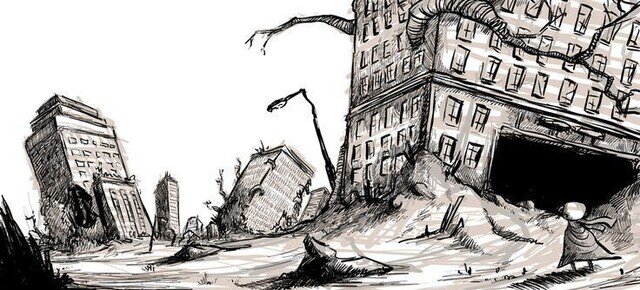
The streets of Saint Petersburg were deserted, wrapped in a thick blanket of snow that seemed to absorb all life and warmth. Night had fallen, silent and vast, enveloping the world in a profound embrace. The darkness, like a sea of ink, covered the empty streets, erasing familiar contours and leaving behind an almost sacred void. The stars, distant and cold, seemed to watch from afar, silent witnesses to this moment frozen in time. The wind, soft yet biting, whispered through the alleys, carrying with it the last remnants of the day. Night had come, and the entire universe seemed to hold its breath. Buildings, worn down by time and frost, stood like solitary colossi, bearing witness to a forgotten past. Broken windows revealed frozen shadows, and every gust of wind carried unseen torments.
Amid this almost unreal scene, a child walked alone. He had no name. He had never been given one. At five years old, he already bore on his frail shoulders the weight of a life marked by absence, cold, and neglect. His small, tattered shoes sank into the snow, but he did not complain. He had moved beyond pain, beyond discomfort. All he felt now was emptiness. The child was thin, almost translucent under the moonlight, his fragile body blending into the vastness of the night.
His skin, an almost ethereal white, seemed to dissolve into the surrounding darkness, like a fragile apparition in the frozen silence. His blonde hair floated around his delicate face, catching the pale moonlight. Yet what struck most were his eyes. One was blue, as clear as the spring skies he had not seen in years, and the other was a deep, vibrant green, like a fragment of lost hope. Just days ago, people had mocked his eyes, calling him a demon. His heterochromatic eyes seemed to gaze at different worlds—one luminous and the other dark—creating a sensation of confusion and estrangement, as if the child perceived a reality invisible to others. Yet behind this strange gaze lay a fragile gentleness, an incomprehension that made him even more vulnerable, like a being trapped in a dimension where he did not belong.
In the frozen night, he wandered aimlessly, the stars above watching him with a distant, indifferent gaze. The city around him was dead, frozen in the vast silence of winter. The wind howled through the deserted streets, but he felt nothing, as if all of it were alien to him. His steps were heavy, directionless, as if he were moving in a dream, lost in a world that had become but a shadow of what he once knew. He did not even know why he kept walking, his mind adrift in a sea of confusion, where only cold and solitude seemed to exist. Winter had transformed the city into a kingdom of silence, where even the biting wind seemed to have stolen away all traces of life and human warmth. Like a spell cast over this place, only echoes of a past existence remained—a mirage frozen in time.
Yet he remembered, barely weeks ago, walking joyfully with his parents through the bustling city market. The vivid colors of the stalls, the air perfumed with sweetness and warm bread, the human warmth, the laughter escaping from mouths like promises of a bright future.
Then, that day, he had seen something in the sky—a dazzling light that, at first, filled him with wonder. Fireworks! He had seen them before, those bursts of color lighting up the night. But this time, there was no music, no joyful laughter. No, this firework was too bright, too loud. It burst with an immense sound, as if the entire earth were breaking apart. Suddenly, people were no longer smiling. They were screaming, running in all directions like frantic ants. He didn’t understand. He thought people would clap, as they did during every celebration, but everything had turned into a nightmare. The light in the sky was no longer beautiful—it hurt his eyes—and the noise... the noise made him tremble.
The child had stood frozen, staring at the now-empty sky, not understanding why people were running, why everything had changed. He kept walking, aimlessly, his legs heavy as if the very earth sought to stop him. He didn’t even know why he kept going. To him, it was just fireworks. But all around him, everything seemed to have collapsed. The world he knew was now just a shadow.
The scent of burnt wood and damp stones surrounded him. His chapped lips murmured the last words of his mother, words he repeated to himself like a prayer:
“I’ll be back soon, my angel.”
Those words echoed within him with every gust of wind, with every distant creak. But he knew, deep in his mind, that she would never return. He didn’t understand why. He didn’t understand why she had left without him, why she had left behind this broken promise.
Time had lost all meaning. Had he wandered a day, two, a week? The relentless snow seemed to erase all traces, covering the streets and memories with a white shroud. He felt neither hunger nor thirst nor even cold. It was as if his young body had abandoned all sensation, becoming nothing but a vessel, a lost breath in the vastness of winter.
Then he heard it. Heavy footsteps behind him echoed in the empty street. He stopped abruptly, straining to listen. He turned his head but saw nothing. Just silence, suffocating and omnipresent. Slowly, a silhouette emerged from the mist.
It was a man, tall and dark, his black coat billowing gently in the wind. His leather gloves and thick scarf hid most of his face, but his eyes, bright and piercing, cut through the darkness. He walked slowly, confidently, as if he knew nothing could halt his path.
“Are you cold, little one?”
The voice was deep, enveloping, laced with unexpected gentleness, contrasting with the cold in which the child wandered. The child instinctively stepped back, but his legs, too weak, froze in place. He shrank slightly, his heart pounding faster.
The man stopped just in front of him, leaning slightly to gaze into the child’s eyes.
“Can I help you?″
The words were simple, yet strangely comforting. The child, exhausted by solitude and pain, felt a new warmth invade his body, like a flickering flame in the midst of the cold.
“My mother will come back,” he murmured in a trembling voice. “She said she would come back soon.” He spoke as if to convince himself, to hide the truth he already knew.
The man gave a faint smile—not a happy one, but something melancholic, almost painful, as though a distant memory had stirred within him. He extended his gloved hand toward the child, his long, cold fingers suspended in the air. The child hesitated, staring at the hand with an almost frightened intensity, as if he feared it might vanish before he could grasp it. Then, after a long moment of uncertainty, he took it. The warmth of the doctor’s hand seeped into his frozen fingers, slowly penetrating under his skin, offering him a long-awaited source of heat.
“Pleased to meet you. I am Doctor Izak Sokolov. You’re safe now.”
The child didn’t respond immediately, lost in the warmth of that simple touch, in the unfamiliar sensation of protection. He looked up, searching the man’s face for a glimmer of sincerity, proof that perhaps this moment wasn’t just another cruel trick of fate. But before he could react further, Sokolov slowly removed his chapka and placed it on Amos’s head. The hat was far too large for him, falling almost to his eyes, but the softness of the gesture—almost paternal—had an unexpected effect on the boy. For the first time in days, warmth spread through him, and a slight smile, timid and uncertain, appeared on his lips. It was a small smile, but it was there, like a fragile star piercing the darkness.
Even though the chapka was too big, its weight gave him a sense of intimacy, of safety—a shield against the coldness of the world.
He felt almost... protected.
The doctor gently guided the child through the deserted streets. The city, with its shadows and its past, seemed to fade away, leaving only the man and the child, solitary in this frozen universe. After what felt like an eternity, they arrived before a large wrought-iron gate, black and imposing.
The doctor knocked three times. A metallic creak echoed, and a figure appeared in the darkness of the entryway.
“Ah, another little one?” said a deep, neutral voice.
Without replying, Sokolov nodded. He led the child inside, into a large, dark, and icy hall. The air was heavy, laden with the smell of dust and cold wax. Faint, almost extinguished whispers echoed—children’s voices, weak and far away.
The doctor turned to the child, his face half-lit by the pale light of the hanging lamps.
“You don’t have a name?” he asked.
The child shook his head. Sokolov smile,like he knew it.
“In that case,” Sokolov said with a strange smile, “you’ll be called Amos.”
Amos. The name echoed in the boy’s mind, strange and familiar at the same time. He had never had a name, never an identity. The word felt like a gift, a burden, and a mystery. He felt his heart beat anew.
Sokolov, satisfied, placed a hand on the blond boy’s shoulder.
“Come. It’s time to discover your new home.”
They delved into the orphanage’s depths. The hallways seemed to stretch endlessly, their bare walls, as hard as stone, reflecting the cold and emptiness of the place. At every dark corner, Amos passed children with hollow eyes, frozen in a dull stupor, as if their spirits had been extinguished, swallowed by the oppressive silence of the place. Only faint whispers and the wind rattling the walls filled the heavy silence.
When they reached a small room, Sokolov stopped abruptly, his eyes fixed on the door.
“This is where you’ll live. We will be your family.”
Family. The word echoed in his mind like a distant, bittersweet refrain—a broken promise, almost foreign, that he couldn’t fully grasp. The word, which should have signified warmth, comfort, and belonging, evoked only a sense of emptiness. Slowly, he sat on the bed, his body heavy, as if the weight of the world had just been placed on his frail shoulders. His eyes, vacant and lost, wandered around the cold, bare room, searching for a sign, something that could soothe the growing anguish within him. The white, empty walls seemed to close in on him, amplifying the loneliness weighing on his heart.
He felt like a child abandoned, left in a dark corner, forgotten, while everything around him appeared frozen, lifeless.
A whisper of sadness, as light as a winter breeze, crossed his mind, and his heavy, disordered thoughts drifted toward his mother—toward that distant memory of a warm world where he was nothing more than a little boy, loved and protected.
“Mom will come back soon, she promised...” he murmured in a fragile, almost inaudible voice. He clung to this idea like a lifeline.
“She’ll come and get me, and we’ll go to the marketplace like before. This is just a nightmare.”
He repeated these words, convincing himself that all of this was just a bad dream he would eventually wake from. His eyes slowly closed, his breathing became slower, as the weight of sleep enveloped him, carrying him into a world of darkness where torments faded but where anxiety lingered.
In the shadows, barely perceptible, Sokolov watched him. A strange smile, both tender and cruel, stretched across his lips, as if all of this were already part of a plan only he understood—a plan he had woven with cold, relentless precision. His eyes glinted with an elusive light, a gleam that held no promise of good. He knew the child’s spirit was slowly breaking under the weight of time and abandonment, and he savored this invisible but certain victory. The silence in the room seemed to echo his thoughts, heavy, suffocating, as if the outside world had become nothing more than a distant illusion.







