
Clear Canvas
The weather had turned soft that morning—mist curling along the edges of the fields, the kind of light that made everything look like a post card. Back in Porthcawl Pass, mornings like this meant quiet: the sea breathing against the cliffs, the kettle warming slowly, the world not asking for much.
But here, at St. Ambrose, the day was already loud. The makeshift gallery in the library was crammed—too many students and parents packed between aisles. Sunlight streamed through tall windows, catching on brushed gold frames and scuffed sneakers, warming the dust that floated in the air like memory.
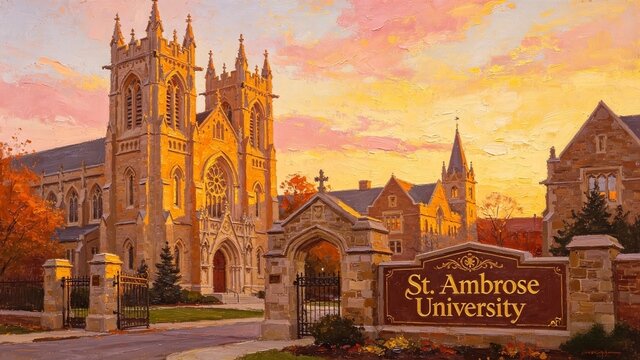


Porthcrawl Pass rarely buzzed like this, and when it did, it buzzed small. Intimate. The kind of excitement that felt borrowed.
Inside, the air held the familiar scent of old books and just-dried acrylic—the ghost of turpentine still clinging to the corners of displayed canvases. Soft jazz trickled from a hidden Bluetooth speaker on the front desk, barely audible beneath waves of polite conversation and strategically timed gasps.
“Very expressive,” someone whispered near a charcoal piece of an owl.
“I love the… tension?” another offered near a watercolor of melting fruit.
Near the center aisle, Ms. Ryker stood like the only one not pressed in by the crowd—tall, iron-straight posture, silver bangles that clinked with every movement. Her black linen blouse flared slightly when she crossed her arms.
“Mind the spacing on that tripod,” she said to a student crouching by a digital display. “If someone trips, I’ll have to feign sympathy, and I’m tired.”
That earned a few chuckles—and a muttered “classic Ryker” from behind a cardboard installation.
Just as Mr. Aldren, the level coordinator, swept in like a gust of too much cologne. His clipboard was as immaculate as his tie.
“Miss Ryker! Impressive turnout,” he boomed. “You’ve created quite the experience.”
She raised one eyebrow. “They created the experience, Aldren. I merely curated the chaos.”
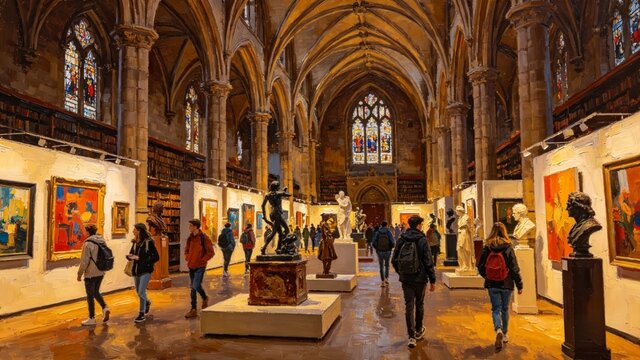
Thomas Sun walked quietly along the edges.
His sketchbook tucked under one arm like a secret. He wasn’t here to be seen—he was here to see.
Outside, Oliver King stood on the library steps, squinting at a tailor’s receipt in his hand. He’d arrived in town barely a week ago. His uncles sent him today to get fitted for a school uniform. But the sound of voices and the shimmer of frames through the window had pulled him off course.
He stepped inside, quietly.
Thomas stood near the back, barely touching the wall but still making himself part of the architecture. He wasn’t there for the charity cause pinned to the corkboard near the entrance. He came for what wasn’t said—for the brushstrokes, the spaces between color, the shapes of longing that only art seemed to hold without flinching.
In one hand, he held a thin black pen. In the other, Thomas’s sketchbook—its spine softened by years of use, pages layered with ghosts of unfinished ideas. Lines spilled across the paper the way they always did—not precise, but alive. His sketches never asked permission. A shape here, a shadow there, a silhouette he didn’t quite recognize yet kept chasing, redrawing as if it might reveal itself with time.
Thomas muttered to himself as he worked. Not words, exactly—more like fragments of thought trying to escape before they hardened into something explainable. A few students glanced his way, brows lifting like punctuation marks in conversations he was never invited into. He didn’t mind.
Then the jolt came—an actual bump against his shoulder. The pen skidded, the sketchbook slipped, and pages fluttered to the floor. For a heartbeat, the room seemed to pause with him, his work exposed in fragments no longer contained by his hands.
“Ah—terribly sorry,” Oliver said, his accent crisp, unmistakably British, though it wavered slightly—as if he wasn’t sure how loud to be in a room like this. “Didn’t spot you there. Here, let me help.”
Thomas looked up, blinking against the low gallery lights. The boy standing before him was tall, maybe his age or a year older, a camera slung too loosely around his neck, eyes darting across the room like they couldn’t decide where to rest.
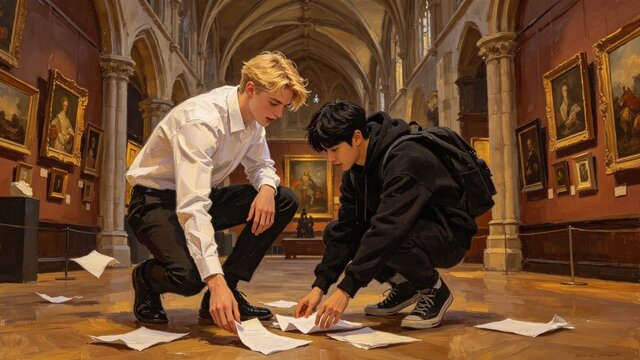
“Don’t worry, this happens all the time,” Thomas said, gathering the scattered pages back into his sketchbook.
Oliver crouched to help, offering a dry chuckle. “Well, that’s a relief. Thought I was the only one blundering about like a lost tourist.”
There was a pause. Not the awkward kind—more like a breath the world had forgotten to let out. Then Oliver laughed softly, like a leaf giving into the wind.
“I’m Oliver—Oliver King. Just moved in, actually. My uncles insisted I ‘get a lay of the land’ before term begins, though at the moment I’m hopelessly wandering about in search of this blasted tailor’s shop.” His words carried that crisp British cadence, softened by self‑deprecation.
Thomas tilted his head. “So, you’re not from here.”
Oliver’s mouth quirked. “Ah, what gave it away?”
Thomas shrugged. “I thought it was the accent, but there’s something else.”
Oliver leaned back on his heels, camera shifting against his chest. “Something else, you say? Well, that’s ominous. Do enlighten me—what dreadful quality have you spotted already?”
Thomas smirked faintly, stacking his sketchbook against his knee. “You look like you’re searching for something you’re not sure you’ll recognize when you find it.”
Oliver gave a dry laugh. “Touché. And here I thought I was only guilty of poor navigation.”
As they wandered through the library‑turned‑gallery, Oliver noticed Thomas tucking away his sketch from earlier. “Sorry if I ruined your work,” he said.
Thomas shook his head. “Nah. It’s barely anything anyway.”
Oliver tilted his head. “Are you a student here?”
Thomas nodded.
“Oh, splendid. Then you can help me learn the ropes around here.”
Thomas gave a wry smile. “That would be a good idea—except I don’t know much myself. Unless it’s the art studio, I’m useless. And besides, my mum wants me home straight after school.”
Oliver chuckled. “Parents, am I right? My father’s the reason I’m here. He thinks it’s penance.” His voice softened. “But I think it’s freedom.”
Thomas considered that, tapping the edge of his sketchbook. “Sounds like it depends on what you make of it.”
“Yeah,” Oliver said, his eyes settling on Thomas with a quiet invitation. “And who I make it with.”
Thomas looked away first—not in retreat, but reflection.
“Well,” he said, “you’ve already found the weird kid with sketches.”
Oliver’s smile widened. “Lucky me.”
The crowd eventually thinned, leaving behind the aftertaste of mingled cologne, half-finished compliments, and polite exhaustion. Thomas lingered near a wall, pretending to study a surrealist landscape he couldn’t quite understand.
Beside him, Oliver rocked on his heels, fiddling with the lens cap of his camera.
“Oi, listen,” Oliver said—abrupt at first, then softening. “About earlier—me barging into you and smudging your drawing. Bit of a rubbish first impression.”
He cleared his throat. “Let me make it up to you. There’s this little café just round the corner. I spotted it on the way in—smells like yesterday’s bread, but the coffee’s half‑decent. Thought I’d give it a go. You’re welcome to join, if you’re not in a rush.”
He glanced at Thomas, then quickly looked away, the offer hanging in the air like a nervous exhale.
Thomas blinked. “I don’t really—uh…”
“You don’t do pity coffee?” Oliver tilted his head, smile playful.
“No, I just… don’t usually go anywhere. With anyone.”
“Consider me an anthropological anomaly then,” Oliver said. “Come on. I’ll even pay in full American remorse.”
Thomas hesitated. The quiet comfort of heading home alone tugged at him—but so did something else. A boy with a camera and grief behind his jokes. A silence that hadn’t felt heavy.
He tucked his hands into his pockets and sighed. “Alright. But only if we don’t talk about the weather.”
Oliver grinned. “Deal. But I might ask your opinion on croissants.”
The streets still glistened from the morning rain, the low sun catching in shallow puddles and fractured reflections. Oliver walked ahead, his steps light but hesitant, the camera at his side bouncing with each stride. Beside him, Thomas kept his hands buried in his pockets, his voice casual but edged with curiosity.
“So, you’re really enrolling next week?” he asked.
Oliver nodded. “Figured it was time. I’ve been orbiting long enough.”
Thomas smiled at that, welcoming him with a half‑teasing grin. “Well, welcome to the mothership. It’s weird, loud, and occasionally brilliant.”
They passed a mural peeling at the edges, its colors bleeding into brick like memory dissolving into stone. Oliver slowed, tilting his head. “Decay’s just another kind of palette,” he murmured, before raising his camera and snapping a shot.
Thomas watched him, then remembered something from earlier. “Back at the gallery—you said your dad thinks sending you here is penance. Porth Crawl, for you, is penance?”
Oliver lowered the camera, the lens swinging against his chest. For a moment, the light caught him in a way that made Thomas notice things he hadn’t before—the crisp accent, the tailored jacket, the watch that looked far too fine for a student. Regal, almost. Rich.
“I see,” Thomas said quietly.
Oliver’s jaw tightened, then he shook his head. “That’s my father’s view, not mine. He thinks discipline is punishment. I think Porth Crawl Pass is… well, it’s brilliant. The cliffs, the sea air—it feels like freedom to me.”
He turned, eyes catching Thomas’s. “Don’t you think it feels like freedom?”
Thomas held his gaze for a moment, then looked away. “Oh,” Thomas said, spotting the glow of a sign ahead. “I see the café from here. Let’s go.”
Oliver’s smile flickered, half‑relieved, half‑knowing. He fell into step beside him, the camera bouncing lightly against his chest as the street opened toward the café’s door.
Together they stepped inside, the bell above the door chiming like punctuation. The café was warm, nearly empty—a place that seemed built to keep secrets.
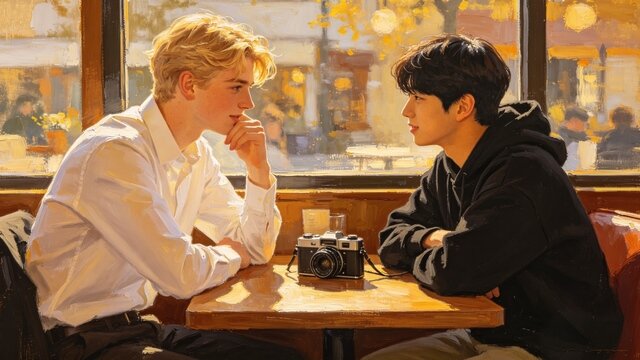
Sunlight dripped in through the window blinds like honey, catching steam rising from mismatched mugs. They sat across from each other in the corner, sipping warmth into their cold fingers.
Oliver spoke first. “So… why do you draw?”
Thomas watched the foam swirl in his cup before answering. “Because it’s the only time I feel like I’m saying something without having to explain.”
Oliver nodded, turning his camera gently in his hands. “I photograph for the same reason, I think. To remember people the way I see them. Not the way they act.”
“I’d ask to see your photos,” Thomas said, “but that feels like reading your diary.”
Oliver smiled, small and real. “Maybe someday.” He hesitated, then added, “You’d probably find them boring anyway. Just faces, corners of rooms, bits of light no one else notices.”
Thomas tilted his head. “That’s not boring. That’s… paying attention.”
Oliver’s grin softened, almost shy. “Well, then maybe you’d understand them better than most.”
For a moment, silence stretched between them—not heavy, but thoughtful. Outside, the street noise blurred into a hum, and inside, the café felt like its own small world.
Thomas tapped his sketchbook against the table. “Maybe one day we’ll trade. A drawing for a photograph.”
Oliver’s eyes lit with quiet amusement. “Deal. Though I warn you, I drive a hard bargain.”
The bell over the café door chimed, and in walked two men—one tall with silvering hair and soft eyes, the other short, dapper, with a gentle smile that crinkled at the corners.
“Spencer, Edmund,” Oliver said, standing a little too fast. “I was just—uh…”
Edmund looked at the boys, then at the half-drunk coffees and said, “Making a friend, I hope?”
“Trying,” Oliver replied, glancing at Thomas.
Spencer gave a knowing smile. “We’ve got to head over to the tailor shop to get your uniforms fitted.
Oliver winced. “Can’t wait.”
Edmund turned to Thomas with a warmth that reminded him of sunlight through linen. “Thanks for keeping him company.”
Thomas just nodded, unsure what to say with adults who didn’t feel like paper cutouts.
Oliver looked back as he followed his uncles to the door. “I’ll see you around?”
Thomas gave a small nod, fingers curling tighter around his cup.
Oliver hesitated, then turned back. “Hey…”
Thomas looked up.
“I just realized—I don’t even know your name.”
A pause.
It would’ve been easy to shrug it off, let the moment pass like background noise. But Oliver wasn’t background noise. And Thomas, for once, didn’t want to vanish into the wallpaper.
He met Oliver’s eyes. “Thomas,” he said, then softer, almost as if offering a secret, “but people I actually like can call me Tom.”
Oliver grinned, the kind that reached all the way into his eyes. “Alright then, Tom. Thanks for the coffee. And the... small talk.”
And with that, he turned and walked out into the afternoon light, leaving the door swinging gently behind him—camera bouncing against his chest, like it had just captured something invisible but true.












The story note is touching
Your writing style flows really nicely. Is this your first story on Inkitt?