
Special One
Excerpt from Chronicles of Stone and Vale: The Founding of Abeurfourth Revised and Annotated Edition by Cecily Arkwright, Municipal Historian (1934) Based on the writings of Elias Montrose (1893)
Published under the seal of the Abeurfourth Genealogical and Heritage Society
“Where the river faltered and the mountains whispered names of old, there was Abeurfourth sown.”
— Edwin Thorne, local chronicler, 1778
Among the valleys winding through the Scottish Highlands lies Abeurfourth – a city of veiled foundation, where time seems to move in step with a memory that refuses oblivion. Five Houses departed the walls of Edinburgh in the twilight of the 17th century, venturing into the mountainous interior. Their names, now carved in stone and wrought iron, were Schultz, Sutton, Gataki, N’Kosi, and Mitarai.
They shared a restless spirit – and a promise.
At first, the new settlement prospered little. The fields were barren, the climate untamable. In old field journals, there are accounts of sleepless nights and disputes among the patriarchs. Some, like Mr Erasmus N’Kosi, noted: “It is not the land that repels us, but something older than it.”
Yet, at some point between 1737 and 1742 – a period still the subject of extensive academic debate – something changed. The town records ceased. Correspondence was interrupted. When the archives resumed, Abeurfourth was no longer the same.
An unnamed tower was raised.
A council without votes was established.
And a new coat of arms was adopted – never voted on, simply accepted.
“The town shed its skin like a serpent in the woods. And no one ever spoke of what they saw in the days of silence.”
— Lavinia Gataki, letter to her brother, 1744
From then on, the city flourished. Within a decade, schools, hospitals, and inns replaced the rudimentary huts. The five founding families maintained their roles – Wisdom to the Schultzes, Justice to the Suttons, Care to the Gatakis, Order to the N’Kosis, and Progress to the Mitarais.
The separation of Abeurfourth and the creation of Prudence, formalised in 1927 for logistical and economic reasons, never erased Abeurfourth’s past. For some, Prudence is the modern face; Abeurfourth, the ancient heart.
But there are those who claim – and I write here only as a humble bearer of oral tradition – that Abeurfourth was never merely a city.
It was chosen. By whom, or what, I dare not say.
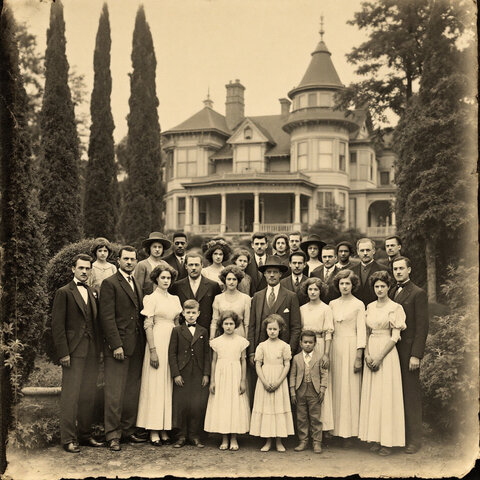
The Five Founding Families of Abeurfourth before the town’s Philanthropic Society, c. 1912.







