Chapter 1
Dim sunlight filtered through the thinning golden leaves of dying trees, splattering ochre blots across the white walls of a stylish, yet ultimately bland and joyless room. A clock ticked steadily, counting off the minutes as they slipped through his fingers. The soft whisper of the air conditioner filled the space with ions and some kind of aromatic nonsense — supposedly designed to calm, but in reality only needling the senses with synthetic irritation.
“I’ve been thinking about our past sessions,” the doctor said, “and I’ve come to the conclusion that things aren’t as bleak as they seem to you. There’s progress.”
Gabriel only shrugged indifferently and shifted in his chair, trying to find a more comfortable position.
The couch the doctor had offered him was pointedly ignored. Gabriel had no desire to lie back and stare at the unevenly painted ceiling. From where he sat, he could at least look out the enormous window — nearly an entire wall of glass — onto a view of Japanese maples: First Emperor, Crimson Queen, all basking in the glow of the Autumn Moon⁽¹⁾.
“In any case,” the doctor continued, undeterred by the silence, “last time we spoke about your work. Has anything changed?”
Gabriel winced, as if the words had hit a nerve, and shook his head.
“No. I still haven’t been able to start.”
Start.
He snorted inwardly and sighed.
He hadn’t turned on his computer in months. He hadn’t even checked his email on his phone. It had to be overflowing by now — angry messages from clients, complaints, threats of lawsuits. But he didn’t care. Without Jerry, none of it meant anything.
“That’s nothing to be ashamed of,” the doctor said quickly. “Still, work could help distract you from the darker thoughts.”
Gabriel laughed.
“No, it couldn’t,” he said bitterly, a crooked smile tugging at his lips as he leaned back and closed his eyes. “You don’t understand. Or maybe you do, but you’re looking at it from the wrong angle. Everything in my life is tied to Jerry. Family, friends, work… all of it soaked in him. All of it shaped by him. Even me.
You know, I’ve covered all the mirrors. In some cultures, after someone dies, people cover mirrors and anything that reflects, so the soul doesn’t get lost in the mirror maze and can find its way to the light.
But I… I got lost in them myself.
I look in the mirror and I see Jerry.
I go to my parents, and they see Jerry.
Even friends — when I run into them by chance — they look at me and see Jerry.
He would’ve handled it. He could’ve coped with all this. But I’m not him. I don’t have that kind of strength. I don’t have as much life in me as he did. I’m just his shadow. I always was.
And no,” he added quickly, heading off the doctor’s next question before it could form, “it wasn’t always like this. When Jerry was alive, I didn’t feel that way.
But now that he’s gone… I’m disappearing too.”
Gabriel fell silent again and turned to look out the window.
A large black bird landed on the branch of a maple tree, shifting its weight before turning its head to face him. For a moment it simply stared, as if locking eyes with him. Then, it seemed — absurdly — to wink, and opened its massive beak.
Gabriel thought he heard its cry, but it was just his imagination.
The bird lingered a moment longer, then blinked its obsidian eyes and, with a heavy beat of its wings, lifted into the air.
“Was there really never anything in your life that belonged to you alone?” the psychologist asked, trying to draw Gabriel back. “There must have been something that was just yours. A dream, a hobby, a crush. Anything.”
“I don’t know,” Gabriel sighed, rubbing his eyes to hide the moisture that had crept in.
He wasn’t one to lie — but this part of his life, he didn’t want to share.
Something just for himself… Gabriel rarely thought about that. From the very beginning — from the womb itself — he had never been alone. He had shared everything with Jerry. And truthfully, he’d never minded.
But once…
He thought it had been autumn, too. Golden leaves, waxy sunsets, the uneven reflections of migrating birds in puddles. The world heavy with dim light, sharp wind, and cold, needling rain. A world wrapped in the milky fog of encroaching sleep.
And in that frozen stillness, among the bleak gray shadows, something appeared — a blotch of color.
So beautiful he couldn’t look away. So bright it hurt his eyes.
But Gabriel stared. Through the prism of tears, with a trembling heart, and a soul caught up in a mad, breathless waltz of love.
It had been strange — all-consuming, intoxicating, alive.
But like autumn itself, it lasted only a moment. A flicker of rust-red flame from a dying candle. A last gasp. A fleeting gleam of sun just before it dipped below the horizon.
And yet he couldn’t remember who had set that blaze inside him. He tried to grasp the memory, but it slipped through his fingers — rotten and crumbling — while his mind conjured up new versions again and again.
“I think I was in love,” Gabriel said at last, after a long silence. “But I don’t remember. I hear laughter — familiar laughter — but I don’t know who it belongs to. Jerry laughed differently.”
He winced as a bolt of pain shot through his temples, and clenched his jaw so hard his teeth ground.
“It’s okay, Gabriel,” the doctor’s voice floated to him through the rushing in his ears. “After trauma, this can happen. Sometimes memory short-circuits. The brain blocks things that cause too much pain. It’s a survival instinct — a defense mechanism.”
“It’s all bullshit!” Gabriel snapped, slamming his fist against the chair’s armrest. “Fairy tales. I just made him up. I knew… I knew I’d end up alone, so I invented someone. I’m afraid of being alone. I… I should probably see a psychiatrist. Imaginary lovers — that’s not your department, is it?”
“Depends on the lover,” the doctor joked gently, smiling. “If the imaginary friend or sweetheart starts urging you toward violence or self-harm, then yes, I’m out of my depth. But that’s not your case, Gabriel. It’s not.
You’re not broken. You’re just lost.
Let’s talk about that — the loneliness.
I know it may feel impossible right now, but you need to get out. Go to a party. A concert. The theater. Anywhere with people. You need to feel that you’re not alone.
And that won’t happen while you’re locked up in these four walls.
Please, just think about it. Take one step. And next session, we’ll talk about how it went.”
“I doubt I’ll manage,” Gabriel said darkly.
“You won’t know until you try. Either way, we’ll work through it.”
Gabriel didn’t argue. He thanked the doctor for his patience and time, said goodbye, and left the office.
It was only just past noon, but the streets were already teeming with people. Everyone hurried somewhere, talking, shouting, laughing. And to Gabriel, the crowd felt foreign. Hostile, even.
Above the city, clouds drifted by — heavy, bloated, like tufts of mercury-drenched cotton. They crawled slowly across the canvas of sky-blue, and whenever they passed in front of the sun, the world around him dimmed, sinking into a dusky gloom. In those moments, it felt to Gabriel like the whole world was slipping into shadow — a deep one, without color, without sound, without feeling. And he liked it that way.
After crossing a few streets, he reached a broad avenue lined with an endless row of shops, restaurants, cafés, and various office buildings. It was even livelier here. Despite the autumn chill, some establishments still kept their outdoor terraces open. People sat in wicker chairs, nursing warm drinks, wrapped in the café-supplied blankets.
Almost every storefront displayed lopsided monster faces — witches, ghosts, creatures with grotesque grins. In front of a small souvenir shop, a whole performance was taking place: singing jack-o’-lanterns with glowing, empty eyes belted out tinny tunes.
The city was preparing for Halloween. In front of nearly every restaurant stood an employee dressed as some kind of monster, handing out flyers and promotional pamphlets to passersby.
One such creature reached for Gabriel, but he ignored it and picked up his pace. He’d gone only a few steps when someone tugged at the hem of his short coat.
Gabriel turned — but saw no one. Then, from somewhere near his knees, came a voice — thin and terribly unpleasant:
“Come join us, mister! You’ll love it! Everyone loves it! It’ll be unforgettable! It’ll be amazing! It’ll be magical! It’ll be enchanting!”
Gabriel frowned, studying the little boy who spun around him like a wind-up toy. The kid looked about seven and was dressed in some strange costume — part jester, part clown, part medieval page out of a fairy tale. His hair stuck out in unkempt, tangled tufts. His face was dirty and tinged with a bluish pallor. Tiny bells tied to his shoes rang out with each step — not in harmony, but in a jagged, grating racket that stabbed at the ears.
“Take an invitation, mister! Take it! Take it! Take it!” the boy shrieked. “An invitation! To the ball! A masquerade ball! You can take off your mask! You can put on a new one! You can be! You can not be! Take it!”
The shrill repetition, the chaotic energy — it all made Gabriel’s head spin. A wave of nausea rose in his throat. He shut his eyes, trying to calm the revolt inside his body.
But the boy kept screeching, kept tugging at Gabriel’s coat, until he finally snatched the flyer from the outstretched hand.
The moment the smooth paper touched his fingers, the child fell silent.
Gabriel cracked open one eye and glanced around — but the boy was no longer near him. Now he was circling a woman, whose young daughter had burst into tears at the sight of the creepy little freak and was begging her mother to hurry and get away.
Unlike the woman, who seemed utterly entranced by the flyer’s content, Gabriel chose to take the girl’s advice. He stuffed the leaflet into his coat pocket and walked off quickly toward home.
But just before turning off the avenue into a side street, something made him glance back. And in that instant, his eyes met the boy’s.
Maybe it was the clouds again — blotting out the sun, deepening the shadows — or maybe it was just his exhausted mind conjuring madness, but for a split second, the boy’s painted clown face looked… old. Wrinkled. And terrifying.
A chill raced down Gabriel’s spine. He tore his gaze away and walked faster.
Twenty minutes later, he was home.
Back in his empty apartment, where all the mirrors were covered, the photos turned face-down, and a basket of rotting fruit still sat on the counter — a card hanging from its handle that read: “Wishing you a swift recovery.”
Gabriel dropped the flyer beside the basket and shuffled to the couch. Still fully dressed, he collapsed onto the cushions and closed his eyes.
Exhaustion crushed him like a slab of stone — heavy, blank, cold as a headstone.
Maybe being dead isn’t so bad, he thought.
But just then, the answering machine gave a sharp beep, and after the brief greeting, his mother’s voice filled the room.
“Gabi, it’s Mom. You haven’t called in a while, so... I was worried. You know, tomorrow’s All Saints’ Day⁽²⁾, and your father and I are going to visit Jerry. Will you come with us? I know you’re still angry with him, but... I think he’d like to see you. I miss you. Dad misses you too. Come home. Or at least call. I... I worry about you, and... we’ll be waiting.”
The message ended.
And silence settled over the room again — the same silence that had filled it before.
It felt good. It felt safe. It was still and soft and calm.
“You hated the silence!” Gabriel suddenly shouted, slamming his fist against the back of the couch. “You damn bastard, you hated the quiet and peace! So why the hell, Jerry?! Why the hell did you trade all that noise for eternal silence?!”
The final words broke from his lips and slid down his cheeks — hot, salty, weeping tears.
Gabriel took a long, shaky breath and turned his face toward the couch back. He closed his eyes, letting helplessness and hollow grief pull him under, until the world blurred and dissolved into the shapeless haze of sleep.
The old park was dark. The dim glow of streetlamps, swaying in the bite of the wind, lit only small patches of ground around each post. The glass globes hung from thick, rusted chains — dull, aged, and trembling.
Gabriel sat on the damp, rotting slats of a wrought-iron bench, watching the fog close in. Its sticky tendrils crept through the trees, wrapping the world in a wet, milky cocoon.
His mind was empty. The thoughts that usually buzzed like a furious swarm of bees had gone silent, leaving him adrift in a hush.
And maybe that’s why the faint crackling of footsteps through fallen leaves sounded deafening.
At first, he thought it was just the wind toying with autumn’s leftovers — but as the sound drew closer, Gabriel turned.
Mirrors don’t show the truth. Mirrors only reflect the illusion of it. But this reflection was different.
It was alive.
It smiled with the grin of death. Its eyes — once warm hazel in life — now burned storm-grey, flashing like lightning from a thunderhead. Its breath carried the chill of the grave… and yet it felt warm.
“Long time no see,” said the mirror, in that same breezy, cheerful voice Gabriel knew too well. “What’s it been, six months?”
“Seven,” Gabriel muttered, turning away from the image.
“Oh, come on! Why the long face again? You’re such a moody little thing,” the voice laughed — the laugh he’d known since before memory.
“I’m only a couple minutes younger. Stop calling me a kid.”
“Well, look at you!” The laughter echoed like shattered glass across the park. “Grown-up all of a sudden. Then why are you sulking like a toddler whose cookie got stolen?”
“I’m not sulking,” Gabriel replied, his face tightening into a grimace.
What a strange conversation.
It felt like it came from another time — another life.
A normal conversation, the kind they could never have again. And yet, somehow, they were having it.
“You are sulking, I know you,” the reflection teased, stretching its arms lazily overhead — like someone shaking off the stiffness of sitting too long.
Jerry always used to do that when he was stuck at something boring.
Gabriel smiled, the memory tugging at the corners of his mouth.
“You’re bored of me again, huh?” he asked softly. “Is that why you left? I wore you out?”
This time, the ghost didn’t laugh.
It just sighed — a deep, hollow sound — and looked at him with empty eyes.
“I miss you, Gabi,” he said.
A tight ache clutched at Gabriel’s chest.
“If you missed me, you’d visit more often,” he said with quiet reproach. “I don’t get it. You could’ve stayed. You didn’t have to go… There was no reason to go to that stupid carnival.
God, that was your worst joke ever. What could be more fun, huh? Dying?”
“Oh, come on, it was fun,” Jerry laughed suddenly. “Everyone thought it was part of the act. That carnival was a blast. And—”
“Stop! Just stop!” Gabriel shouted, tears breaking from his eyes. “It’s not funny! It’s not fucking funny!”
“It is funny,” Jeremy insisted. “What’s not funny is you burying yourself. Wake up, Gabi! Don’t you remember? Life is still good. Have fun. Please...”
Gabriel opened his mouth to argue — but the mirror began to fog.
Thin threads of spider silk laced across his brother’s image, and that pale porcelain skin started to crack.
“No… no, Jerry, don’t go!” Gabriel cried.
But the figure was already fading — unraveling right before his eyes.
“Come… it’ll be unforgettable! It’ll be amazing! It’ll be magical! It’ll—”
“Shut up!”
“—be…”
Jerry’s laughter spilled across the empty park, tangled in the bare branches overhead, echoed through the crows’ harsh cawing — and in the whispering wind, Gabriel heard the ghost of a farewell:
Come.
The room was dark and damp.
Waking up, Gabriel could still hear his brother’s voice — and a strange melody from some unfamiliar waltz. His chest felt hollow. His soul, cold. And in his ears, that shrill, childlike laughter kept ringing, along with those same calls and invitations.
“Damn it,” he muttered, sitting up on the couch.
He raised a hand to wipe the sweat from his forehead — and only then noticed he was gripping the Halloween masquerade invitation tightly in his fingers.
For several minutes, Gabriel just stared at the colorful piece of paper. Then, with a surge of anger, he crumpled it — and was about to throw it away, but for some reason… couldn’t.
“Had fun, did you?! You had a great time, huh?! God, you bastard, Jerry! You heartless, selfish bastard!”
It took Gabriel a while to calm down.
The clock kept ticking — slow, deliberate. Sometimes it seemed to freeze on one number, other times it jumped ahead as if skipping time altogether. Gabriel hardly noticed.
Something uneasy had settled in his chest — something strange and wrong. Doomed.
He was tired of grieving. Tired of being sad. He wanted to laugh — but every smile he forced turned to tears.
And he didn’t know why. Losing a brother was hard enough… but Gabriel felt like he’d lost something more than that.
Grief clawed at his heart — tore at his soul like the talons of some rabid beast, dragging his world into a permanent twilight he could never climb out of.
But there used to be sunlight! he thought. It used to shine — it used to warm me, even in the cold of autumn. It was there! It was!
Gabriel knew he had felt it once — but he couldn’t remember what had sparked that warmth.
Pain shot through his temples — sharp and blinding. Red rings swam before his eyes. He clutched his head in both hands, pressing his palms to his throbbing temples.
Nausea rose in his throat. A bitter taste of bile flooded his tongue, and suddenly, it was hard to breathe.
The apartment walls seemed to close in, inch by inch, crushing his awareness like a vice.
Gabriel couldn’t take it anymore.
He leapt up from the couch and bolted from the apartment — not even bothering to shut the door behind him.
Outside, the air was easier.
Open space meant open lungs, and Gabriel inhaled the cold, rain-heavy air with greedy gulps.
All around him, joy was in full swing.
Children and adults, dressed in Halloween costumes, roamed the streets — knocking on doors, begging for sweets, trying to scare each other silly.
A few of them came up to Gabriel too, but he ignored them all.
Then his gaze caught on a poster — an invitation to the masquerade ball, identical to the one on his flyer.
And something inside him clicked.
Something like a whirlwind spun through his mind — and suddenly, he wanted, needed, to go.
“To be unforgettable,” his lips whispered on their own. His vision blurred for a moment. “To be magnificent...”
He turned away from the poster and made his way toward the taxi stand.
“To be marvelous... to take off the mask... to put on a new one... to be... to not be...”
“Where to, mister?” the taxi driver asked, glancing back at the passenger in the rear seat — a man who looked distant, unsteady, a little off.
“To be unforgettable...” Gabriel murmured, handing the driver the flyer. “To be magnificent...”
The driver simply shrugged at the strange young man muttering in the backseat, and without another word, pulled away from the curb.
Footnote:
⁽¹⁾First Emperor, Crimson Queen, and Autumn Moon are all actual cultivars of Japanese maple trees.
⁽²⁾ All Saints’ Day (November 1st): a Christian day of remembrance for all saints and the dead.
Author’s Note: On the Character of Gabriel Dawnveil
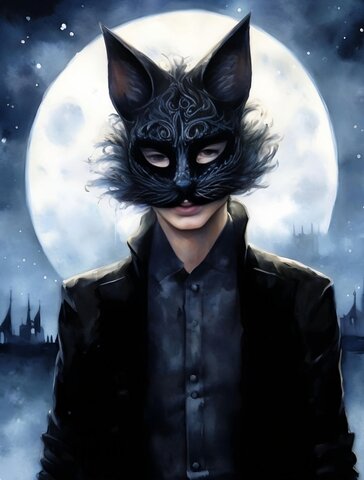


The name Gabriel is derived from the Hebrew Gavri’el, meaning “God is my strength” or “Divine strength.” Gabriel is one of the most prominent archangels in the Christian, Jewish, and Islamic traditions. In Christianity, he is the angel who delivered the message of Jesus Christ’s birth to the Virgin Mary. In Judaism, he appears in the prophetic visions of the Book of Daniel. In Islam, he is known as Jibril, the angel who revealed the Quran to the Prophet Muhammad.
Angel of revelation and prophecy: Gabriel is the bearer of divine messages, a bridge between the celestial and earthly realms, conveying God’s will and knowledge to humankind.
Protector of truth and righteousness: Often associated with purity, justice, and unwavering strength of spirit, Gabriel guides souls along the path of truth.
A symbol of hope and inspiration: He brings comfort and courage, reminding humanity of divine support and inner strength.
Gabriel is traditionally depicted as an angel of light and truth, playing a central role in delivering divine revelations and offering guidance to those on a spiritual journey.
The surname Dawnveil can be interpreted as “veil of dawn” — a poetic image evoking mystery, new beginnings, and the delicate boundary between night and light.







![Fated to My Ex- Best Friend [Moving to Galatea]](https://cdn-gcs.inkitt.com/vertical_storycovers/ipad_49edb1dbf9a28b50b9c4d68d8598359b.jpg)