
Chapter 1


Prologue: The Dream of Forgotten Cycles
On the night of May 10th to 11th, 2025, I dreamed of a series of action-packed adventures unfolding in a world reminiscent of ancient Asia. In the dream, I was living these stories as if reincarnated within them, trapped in a time loop where I had already experienced each tale at least once before. What set this dream apart was my awareness: I remembered the events and decisions from my past lives, their previous cycles. With that memory came the ability to influence outcomes, to bend fate and alter how the stories unfolded. Although I faintly recall that there were at least four distinct narratives, each more thrilling than the last; only the first remains vivid in my memory, preserved because I awoke immediately after reliving it.
Part One: The Village and the Sacred Stone
At the foot of a sacred mountain stood a country village, densely settled, yet shaped by simple living. With the mountain rising behind them, its homes and narrow paths clung to the lower slopes, some even burrowing into the rock itself. To guard the open front, the villagers had built a sturdy wooden palisade, enclosing the community between stone and sky.
Generations of villagers had labored together to search for and free a legendary golden monkey statue hidden within the mountain rock. Their intent was not to claim it, but to enshrine it in a monastery, an offering of care to something timeless and deeply revered. The mine’s entrance, perched high on the mountainside, glinted like a beacon. Unbeknownst to us, its visibility also made it easy prey for distant eyes: a warlord’s scouts had already marked our progress long before we knew we were being watched.
One day, word spread that the golden monkey had finally been found. Day after day, villagers took turns sharpening chisels and delicately picking at seams of ore, ever mindful not to crack the statue’s polished surface. Everyone moved with patience and precision, ensuring that no harm would come to the sacred form emerging from the stone.
Part Two: The Awakening of the Golden Monkey
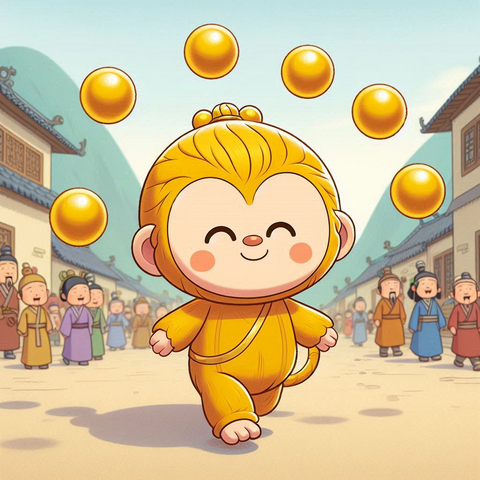
After several days, we were about to fully free the monkey statue, its golden form standing at knee height. I was there, witnessing what was about to unfold, but I already knew, because I had lived it before. Without warning, the statue began to move: slowly, deliberately, gathering momentum as life began to awaken within its form. Then, with a sudden burst, the surrounding rock fractured, releasing several hidden golden spheres in a dazzling eruption. These spheres rose into the air and began to spin in orbit around the golden monkey, as if drawn by an unseen force.
The little monkey danced joyfully, radiating an enigmatic energy. Moved by some unseen rhythm, he turned toward the exit, and we instinctively fell in behind him. His parade began inside the mine itself, along the path leading to the exit. With each step, he leapt with delight, golden spheres floating around him in a celestial choreography. Then, once outside, he continued his joyful descent down the slopes of the mountain, still dancing, as if carried by the music of the world. And all along his path, he gave each person exactly what they needed most: gifts appeared as if by magic, emerging spontaneously, simple and perfect.
The villagers, overwhelmed by this unexpected generosity, felt a deep joy that seemed to wash away the burdens of their daily lives. They did not wish to trouble the monkey; they simply wanted to protect its freedom, happy to welcome it and grateful for the harmony it brought to their village. They cleared the path for the monkey, watching it with awe. For the villagers’ happiness, the monkey continued its parade through the village, scattering gifts along his path, each one perfectly suited to the person who received it, and we all followed, united in an atmosphere of serenity and gratitude.
There was an elderly, lonely woman who had watched the spectacle unfold from afar. Moved by sadness and feeling that the monkey’s gifts would be better spent on others than on her, she returned discreetly to her house. But even from a distance, the monkey noticed her presence. It approached joyfully and suddenly appeared at her window, playing a game of “Peekaboo! I see you! Here’s a gift for you!” And with a playful flourish, the monkey made a complete set of painting equipment appear inside her home: brushes, canvases, and rich, vibrant colors. Long ago, the woman had been a renowned painter, but life’s struggles had forced her to sell all her materials and abandon her passion. As she saw the gift, one tear escaped down her cheek, then another and another, until she was weeping: tears of happiness, of remembrance, and of overwhelming gratitude.
Part Three: The Siege and the Memory of Flames
However, as we made our way back toward the heart of the village, we found the village already under siege. A feared warlord and his invincible army had just arrived and were massed beyond the wooden palisade, beginning to establish their camp. From the crude watchtowers perched along the fence, we could see their banners unfurling and the towering silhouettes of mangonels, traction trebuchets being assembled. Though their arrival sent waves of dread through the town, their commander didn’t strike immediately. Instead, he sent forth an ultimatum: surrender the golden monkey within three days or face complete annihilation. It was clear they needed the time to prepare their engines of war, but the delay also served a darker purpose: letting fear settle into our bones.
Fear rippled through the crowd. We were not warriors; our town’s defense was a stout, but simple wooden fence built on the flat ground below the mountain’s incline, strong looking, yes, yet no match for a seasoned army. Still, no one dared hand over the monkey they’d just set free. Its freedom felt sacred. We knew the warlord didn’t come for peace: he sought to claim the monkey’s mystical power, to bend it to his own ends.
The warlord’s army had never tasted defeat. Heavily armed and disciplined, they towered over our village like a stormfront, unstoppable, implacable, and utterly out of place in our quiet, earthen world.
That night, no torches were lit. The village fell into a heavy silence, broken only by the creak of the wind through the palisade and the murmur of anxious voices behind closed doors. We gathered in the old meeting hall, elders, miners, children perched on laps, everyone listening, not speaking, as if afraid the warlord could hear even our thoughts. Somewhere among us, the golden monkey rested, unmoving yet serene: its expression light, almost amused, as if it had never known fear. There was no dread in its stillness, only joy unbothered by the weight we carried.
That’s when I revealed what I’d known all along: in the previous cycle, when the villagers neither fought nor surrendered, the warlord’s engines pulverized our fence, rained fire into our homes, and slaughtered nearly everyone. Only a handful made it out alive. The monkey was taken: its power twisted to serve a will it never chose.
Now, with memory of that grim future, I stood before the assembly and laid out every detail:
• Their mangonels would target the fence’s foundation until it collapsed.
• Flaming shot would burn our wooden huts from above.
• Our only hope lay in striking first, with total surprise and overwhelming force.
A few still clung to doubt: trusting that perhaps the wall might hold, that the warlord’s threats might waver. But as I described how quickly our cattle pens would be reduced to cinders, how that same fire had once erased us without resistance, their silence shifted. Not to fear, but resolve. In the face of passive death, action became its own kind of hope. With nothing left to lose, we chose to fight. If we were to give our lives, we would do so standing, not waiting.
Under a cloak of twilight, I slipped away to find Oliver and Natalie, two friends from different corners of my life. Oliver already knew me, from days before the story turned. The burden I carried had grown too heavy to shoulder alone, so I told him everything: not just of this siege, but of all the futures I had seen. What had been. What might be. What would break us, and what might still save us. He listened the way he always did in every lifetime: quietly, sharply, as though the world had narrowed to a single voice.
Natalie, though, didn’t recognize me. In this version of the world, we had yet to meet; our bond belonged to a future still waiting its turn. Yet even now, she moved with the calm confidence of someone destined to matter. Her eyes held the same brilliance, the same quiet steadiness. She stepped into the moment with uncanny poise. Her mastery of structural craft seemed out of place for the era, yet utterly hers. Even here, even now, she was already a natural engineer.
Together, we formed three teams:
1. I would serve as strategist, timing the attack and keeping all groups in sync.
2. Oliver became our morale officer, drilling raw recruits in simple formations, building their confidence and unity until they moved as one.
3. Natalie would lead the demolition squad, selecting the fence’s weakest point and setting the charge that would down it in a single, thunderous moment.
Part Four: The Forge of Hearts
Our villagers were unarmed, but not empty-handed. They held hoes, scythes, pitchforks, axes, and pickaxes: the tools of their daily labor, worn smooth by calloused hands. Moved by joy and gratitude, the golden monkey flitted among them, its golden spheres spinning ever faster: each pass sparking a quiet miracle. Every tool was transformed into a weapon that echoed its origin and honored its wielder. A scythe became a crescent blade that swung as effortlessly as grain. A carpenter’s hammer thickened into a mace, weighted just right for the hand that knew its rhythm. A wheat farmer’s pitchfork sharpened into a gleaming tiger fork, its balance so precise it moved like thought. The farmer cupped his hands in a silent salute, but the golden monkey needed no thanks. Happiness was its nature, and giving was simply what it did. It twirled midair with a carefree spin and danced on, golden spheres whirring like laughter.
Each weapon was bespoke, reforged not only in shape, but in spirit. No one needed training. Their new arms moved as if they’d always belonged.
All of this happened unseen by enemy scouts; the wooden wall masked our preparations. Behind its weathered beams, a village was being reborn, not in fear, but in firelight and purpose.
For a long breath, no one spoke. The clang of iron, the hum of the monkey’s spheres, the slow hush of dusk settling over the slopes: these filled the silence better than words. The villagers stood straighter now, not because they were soldiers, but because they no longer feared becoming them. Whatever came next, they would meet it with purpose in their hands and fire in their hearts.
Part Five: The Uprising of Shadows
Then, at my signal, Natalie’s team detonated the charge. They had packed black powder, an alchemical mixture known in whispers as “fire sand”, into sealed clay pots, wedged deep into the fence’s foundation. When ignited, the charge didn’t just burst: it carved thunder from earth, a sound ancient yet new. The wall lurched forward toward the warlord’s ranks, splintered and roaring, and when it struck the earth, the boom cracked across the plain, deep enough to shake the ground beneath our feet. That was our cue.
“Now!” I shouted, already sprinting forward.
Like a tsunami crashing onto unsuspecting shores, our villagers surged through the breach in a wave of unstoppable force. The enemy, caught utterly off guard, scrambled to respond, but their hesitation sealed their fate. Oliver charged beside me, rallying his battalions into tight formation. They moved as one: reflexes sharpened by purpose, bound by trust. Natalie stormed in behind us with her engineers, reinforcing the vanguard and patching gaps with shields and clever defenses born of instinct and grit.
We were no longer planners: Oliver, Natalie, and I had become part of the charge itself. The villagers, united, relentless, surged beside us, not following, but moving as one vast, roaring wave. Each carried the weapon that felt like an extension of their body, their purpose fused with ours. It wasn’t an army. It was a rising.
The army, overwhelmed and unable to recover, staggered, faltered, and finally broke. Their once-invincible ranks crumbled under the weight of our assault, banners torn, formation lost. The battlefield lay strewn with the remnants of a force that had marched with certainty: shattered trebuchets, broken swords, empty helmets staring at the sky. Though they had never fought before, the villagers stood victorious, against all odds, and against every story the world had told them about who they were.
Part Six: The Dawn of a New Cycle
As the smoke thinned and dust curled low across the plain, a strange stillness fell, not peace, exactly, but the silence that follows something irreversible. We moved through the wreckage, searching for survivors, tending to the wounded, gathering arms and armor where we could. We prepared for aftershocks, for grief, for whatever would follow.
The golden monkey, perched atop a splintered beam, watched the aftermath with eyes bright and serene. Its orbs, once whirling with the fervor of battle, now drifted gently in slow, golden spirals. Joy pulsed from it, not pride, not triumph, but the quiet radiance of something that gives because it must. It had not chosen sides. It had not weighed outcomes. It had sensed the villagers’ spirit, their earnestness, their shared breath of hope, and answered in the only way it knew: by being itself. Joyful. Generous. Undemanding.
Around it, the battlefield breathed in silence. No cheers rose, no celebration rang out: only a hush, deep and reverent, as if the world itself had exhaled in relief. In that quiet, I felt the cycle of fate shift, not shattered, but nudged onto a new path. The stories that had once confined us had broken like the enemy’s lines.
And as dawn’s first light kissed the mountain’s edge, I knew: we had not just survived. We had begun again.
But my journey in this world did not end there. More stories waited beyond the village walls. So I left, alone. The path ahead curled into dust and silence, unfamiliar yet somehow known. And when I glanced back, I saw the golden monkey trailing a few steps behind.
It could have stayed. It could have vanished into the mountains, free as wind. But it chose to follow, not for duty or destiny, but simply because it wished to. Perhaps it sensed the good still to come. Perhaps it was drawn to the thread I carried: knowledge of what was, and what might yet be.
After all, this had only been the first of many tales.
© 2026 MED3003. All rights reserved.


















Hello, brilliant author! Your storytelling truly stood out to me. I'd be happy to offer a few creative ideas that could enhance your book’s visibility and engagement across digital platforms and if that sounds helpful to you.