
Chapter 1 : The Power Struggle
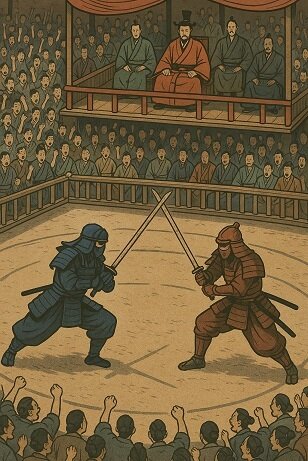
In ancient legends, it is said that during the Kamakura Shogunate era, Japan was divided into seven main regions, each governed by a powerful feudal lord. These feudal lords, also known as Daimyo, were subordinate to the Shogun but would stop at nothing in their quest for more power. While they all controlled vast lands for agriculture, other non-agricultural activities such as weapons manufacturing, mining, trade, navigation, military training, and so on played significant roles in the rise and prosperity of each region under the Daimyo’s command. The names of the Daimyo and the regions they governed were as follows:
1.Minamoto no Masaki – Daimyo of Kanto The Kanto region, the beating heart of the Kamakura Shogunate, was under the rule of the Minamoto clan; a land brimming with glory, armies, and gold. Minamoto no Masaki, with his stern face and piercing gaze, was both a shrewd politician and a ruthless warrior. He had a disciplined army and a treasury filled with gold and wealth, and the other Daimyo always cast wary glances at his power.
2.Takegawa Renji – Daimyo of Kyushu In the south of Japan, the island of Kyushu, with its wild shores and relentless waves, was the domain of a fierce Daimyo. Takegawa Renji, a commander born into the world of war and bloodshed, had made the coastal region a harsh land, yet he kept it under control with an iron fist.
3.Iwaasa Noboharu – Daimyo of Chubu In the heart of central Japan, nestled between towering mountains and fertile plains, Iwaasa Noboharu ruled over Chubu. At first glance, Chubu seemed like a tranquil land, but beneath the surface, it hid mines of gold, silver, and iron. Noboharu, a calculating man with an economic mindset, had built a powerful army from the resources of his mines and fields.
4.Arashi Hideaki – Daimyo of Kansai Kansai, the cultural and religious jewel of Japan, housed the ancient capital of Kyoto. This was the land of temples and artists, but like a sword in its sheath, it was always prepared for battle. Arashi Hideaki, a feudal lord with a pure heart and a firm hand, trained extraordinary warriors who would go to any lengths to defend their land.
5.Fuyoka Tsukima – Daimyo of Tohoku In the cold northern part of Japan, where the wind dances with snow across the plains, Tohoku stretched out. Fuyoka Tsukima, the ruler of this land, focused mainly on livestock, agriculture, and exploiting nature’s resources. Yet beneath this calm exterior, there was a hidden politician; a hand that, when needed, could bring out a deadly blade.
6.Murai Kaito – Daimyo of Shikoku Shikoku, a hidden island in the heart of the seas, was renowned for its trade and tea. Murai Kaito, a man with a mysterious smile and a cunning gaze, had amassed a great fortune through quiet trade. His ships silently but persistently sailed across the shores of Japan, bolstering his financial power.
7.Shinra Kazuhiro – Daimyo of Hokkaido And finally, in the farthest northern point, in a cold and silent land, Shinra Kazuhiro ruled over Hokkaido. A reclusive and enigmatic man, he spent his time hunting, fishing, and managing marine resources. Rarely present in the court, the information that came to him through unknown paths amazed and frightened everyone.
Yet, deep within the dark forests, away from the eyes of the world, men and women lived in the shadows: the ninjas. In exchange for gold, silver, or any valuable item, they would carry out assassination, murder, espionage, and any covert operation without question. The exact location of their main residence was unknown, but some believed it to be in the forests.
A meeting was held in the special guest hall of the Shogun’s palace, between him and the Daimyo of the seven regions. The discussion was about the Emperor’s and Shogun’s guards. Though the Emperor and Shogun had many samurai guards, the retirement of two high-ranking Emperor’s guards due to old age and the rotation of others made the need for two fresh guards urgent.
The Shogun’s chief advisor announced to the Daimyo of each of the seven regions: “According to the Shogun’s orders, each region may nominate two samurai for selection as palace guards within a week after the competition.”
A murmur spread through the hall, and each region nominated two samurai for selection to the Kanto region. However, the competition results showed that both guards were selected from the Kansai region. These two were Sotaro, son of Arashi Hideaki, Daimyo of Kansai, and Ryuki, son of Takahashi Kazuma, special assistant to the Daimyo of Kansai. The two had been close friends since childhood and were highly skilled in swordsmanship. They were also trained in archery and spear handling to further complete their skill sets.
Sotaro’s wife was named Yuko, who was a courageous and beautiful woman, skilled in swordsmanship as well. Ryuki had also married a woman named Mio, who was beautiful, with a big heart and emotional depth. Sotaro’s bravery, combined with Ryuki’s intellect and wit, rapidly elevated their ranks to become senior guards. This made the other Daimyo of the remaining six regions feel threatened. Due to the rising influence of the Kansai region, these two guards might soon become Shogun advisors. As the Daimyo of Kansai were known for their integrity and righteousness, they feared that if the Kansai region gained more power in the Shogunate court, these two guards would expose the corruption and theft of other Daimyo, weakening their regions.
Therefore, they decided to unite and plot the assassination of the head of Kansai and his family—an assassination that would appear to be a mere accident.







