Chapter 1 : The Flight to Freedom (and Regrets)
⚠️ IMPORTANT ⚠️
🎨 ✍️ This novel is currently a work in progress. Content, plot, and translations are subject to change. Thank you for your support!
FOOTBALLER ON THE SPOTLIGHTS
Composed by Violet Crosby
This book is a work of fiction. All names, characters, businesses, places, events, and incidents are either the product of the author's imagination or used in a fictitious manner. Any resemblance to actual persons, living or dead, or actual events is purely coincidental.
Copyright © 2026 Violet Crosby
All rights reserved.
Cover: Violet Crosby
English translation: Violet Crosby
No part of this book may be reproduced, distributed, or transmitted in any form or by any means, electronic or mechanical, including photocopying, recording, or by any information storage and retrieval system, without the prior written permission of the author, except in the case of brief quotations embodied in critical reviews and certain other noncommercial uses permitted by copyright law.
Joshua JC8 Campbell, a rising star in British football, flees the shadow of his famous family for Los Angeles and the L.A. Football Club. There, he crosses paths with Samantha Anderson, the discreet "Hollywood princess" who desperately traded red carpets for a medical coat and anonymity. Their meeting at the children's hospital ignites a spark that Samantha fights to extinguish, fearing the return of the spotlight and media cruelty. As the paparazzi seize their story, Joshua will do everything to win the young woman's heart and free her from her fear of fame. Between the glamour of the field and the secrecy of hospital corridors, can love survive under the glare of the spotlights?
For more information:
www.violetcrosbyauteure.com
⭐⭐⭐⭐⭐
For updates on new releases, giveaways, and other fun stuff, sign up for my newsletter!
Chapter 1 : The Flight to Freedom (and Regret)
✈✈✈


June 2025
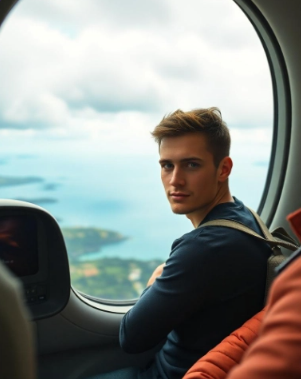
The American Airlines first-class seat was roomier and infinitely better designed than half the London flats I’d rented over the past few years. It was no longer merely a seat; it was a luxurious trap of quilted cream leather, bathed in the dim glow of a cabin that resembled a private lounge drifting above the Atlantic. Everything here had been engineered to numb the passengers’ awareness, to make them forget they were nothing more than bodies sealed inside a metal tube hurtling through the sky at a third of the speed of sound, suspended ten thousand metres above oblivion.
And the worst part was, it worked.
I sank a little deeper into the seat, stretching my long legs beneath the light cashmere blanket. Beyond the window, the ocean was nothing but an endless canvas of black ink, a twelve-hour temporal rift between the chaos of my past and the uncertainty of my future. Twelve hours to stop being a marketable commodity and perhaps become a human being again.
The silence of the cabin felt almost suspicious, almost aggressive. Since the age of sixteen, my life had resembled the heart of a football stadium after a ninetieth-minute winner: a constant cacophony of tactical analysis, screaming headlines, managerial demands and roaring supporters. Everyone, from the Prime Minister to the bloke behind the pub bar, had a firm opinion on the direction Joshua Campbell’s life ought to take. My father managed my career like a military empire; my brothers monitored my statistics like Wall Street brokers. And now, suddenly, there was nothing. Only the soft white murmur of the engines and the crystalline chime of glasses clinking among the upper classes.
So this is what emptiness feels like? Bloody terrifying how good it is.
I slowly swirled the single malt in the bottom of my glass, watching the amber reflections dance against the crystal. It was a rare bottle, given to me by Thomas just before I left.
— “For your grand exile amongst the cowboys,” he’d said with that crooked smile he used in place of tears or punches.
A farewell gift or one last passive-aggressive dart. With the Campbells, the line between love and resentment had always been blurred.
To the rest of the world, I wasn’t a twenty-five-year-old man having an existential crisis. I was JC8. Arsenal’s golden boy. The heir to Britain’s greatest footballing dynasty. The kid supposedly destined to lift the next World Cup before being knighted by the King. A flawless career plan mapped out by other people on a whiteboard before I’d even grown facial hair. In our family, football wasn’t a sport; it was a theocracy. My father, Christopher Campbell, former legendary England captain, was its unquestionable pope. My brothers were the cardinals. They breathed grass, analysed their meals in terms of macronutrients, and slept hooked up to sleep monitors.
Me? I loved the game. I loved the purity of a fifty-yard diagonal pass dropping perfectly into a winger’s stride, the electric thrill of leather rippling the net. But I refused to let my entire existence be reduced to a pair of boots and a sponsorship deal for organic cotton pants. I liked losing afternoons in the dim halls of the Tate Modern, reading American Beat poetry, sitting alone at a café terrace without some tabloid lens pointed at my coffee cup. In England, that sort of sensitivity made me eccentric. Among the Campbells, it made me a genetic anomaly.
— “You think too much, Josh. Poets end up broke. Strikers end up on yachts,” Thomas constantly reminded me.
The whisky burned pleasantly down my throat, but it wasn’t enough to erase the bitter taste of our final family meeting three days earlier. The memory of that execution replayed on a loop behind my eyelids. The great family sitting room in Surrey, lined with framed shirts and silver trophies gleaming like accusations. The smell of expensive coffee and tension so dense it could’ve been sliced open with a scalpel.
— “You’re trampling all over everything I fought for, Joshua!” My father had thundered, his baritone voice rattling the display cabinets.
At twenty-five, that voice still had the power to liquefy me, to drag me instantly back to being a ten-year-old boy ashamed of missing a penalty in a youth match. His pale Arctic-blue eyes weren’t blazing with anger, but with cold disappointment.
Which was far worse.
— “I’m not trampling on anything, Dad,” I’d replied, forcing my heartbeat into the rhythm of a metronome. “I’ve won two FA Cups, I’ve scored in the Champions League, I gave you what you wanted. Now I just want a life that actually feels like mine.”
Oliver had let out a dry laugh, adjusting the cuffs of his cashmere jumper with all the arrogance of a Manchester United player.
— “A life that feels like yours? In Los Angeles? Josh, you’re signing for a retirement league where defenders move in slow motion and the crowd eats popcorn waiting for the half-time show. You’re going there to become some Instagram influencer in football boots.”
— “It’s not about the standard, Oliver. It’s about breathing. I need to breathe without the papers counting my heartbeat per minute the next morning.”
— My father dismissed the argument with a contemptuous flick of the hand.
— “You’re a millionaire, you play for the biggest club in London, and you’re a Campbell. What more freedom could you possibly need?”
The freedom to miscontrol a pass without it becoming a national debate on the BBC, for one.
But what was the point of explaining? They loved the golden cage. They fed off the spotlight. Liam, who’d remained silent until then while methodically destroying an apple with his pocketknife, finally lifted his dark gaze to mine. His verdict came down short and sharp as a studs-up tackle to the throat.
— “You’re running away from competition, Josh. That’s all. You’d rather be king of the blind in a kingdom of weaklings than fight for the Ballon d’Or here.”
That sentence had struck me square in the chest precisely because it awakened the monster I’d spent weeks trying to smother.
What if he was right? What if I was nothing more than a beautifully overpaid coward?
My entire life, I’d been dissected, compared, reduced to charts and statistics.
Is Joshua faster than his father was at the same age? Does he have Thomas’s leadership? Oliver’s vision?
I wasn’t running from football. I was running from the warped mirror they held up to me every single morning.
The only one who hadn’t shouted was my mother. She’d simply wrapped me in her arms, an embrace scented with jasmine and dampened by silent tears. She’d spent thirty years trying to keep peace in a house overflowing with hormones, egos and testosterone. She alone could still see the son behind the number eight shirt.
— “Take care of yourself, my brave boy,” she’d whispered into my ear. “Don’t let them convince you that you owe them your life.”
I’d promised to ring her after every match, send her photographs of Venice Beach, not become too American. But deep down, I secretly hoped California would be exactly that: another planet, somewhere vast enough to absorb the weight of the Campbell name without suffocating beneath it.
— “Another whisky, Joshua?”
The soft voice, touched with a faint Californian accent, broke the thread of my thoughts. I looked up at the flight attendant. She was tall, with impeccably straight chestnut hair and that ultra-professional smile American airlines seemed to manufacture in laboratories. But in her eyes there was that unmistakable flicker of instant recognition.
That makes two. Even ten thousand metres up, the brand follows me.
— “Yes, please,” I replied with my finest public smile. “But go easy on it. I’d rather not land at LAX looking like a washed-up rock star.”
She laughed softly as she poured the amber liquid.
— “Don’t worry. In Los Angeles, people have seen far worse than slightly drunk footballers. First time in the City of Angels?”
— “First time living there, yes. Let’s say I’m testing the climate.”
— “The sunshine’s guaranteed,” she said, handing me a fresh towel. “The rest… well, it’s a city that loves love stories, provided they end in tragedy. Enjoy your flight, Joshua.”
She walked away with the fluid grace of a dancer.
A city that loves tragedy. Brilliant. Exactly what I needed.
To occupy my mind, I switched on the touchscreen in my private suite and scrolled through the film selection. Hollywood filled the screen with its carefully engineered blockbusters. At the top of the new releases, Robert Anderson’s face occupied half the interface. Square jaw, blinding white smile, steel-grey eyes. The undisputed king of global cinema. The British press insisted on comparing him to my father because of his natural authority and the way he ruled his industry. Out of sheer boredom, I played the trailer: digital explosions, razor-sharp one-liners, Anderson saving the world in a tailored suit.
Standard Hollywood fare.
Yet it wasn’t him I was thinking about as I stared at the screen. It was his daughter. Hollywood’s so-called Princess. The tabloids had feasted on her for months after last year’s public implosion. A scandal of staggering brutality: stolen photographs, vicious headlines, and then absolute silence. She had vanished entirely from the face of the earth. No stories, no red carpets, nothing. Public speculation swung wildly between a luxury clinic in Switzerland and secret exile in a Buddhist monastery. Back when I’d read those articles, I’d felt a strange sort of kinship with a girl I’d never met.
Being the child of a living god and having to apologise for existing amongst the ruins of their ambition.
She’d had the courage to cut the cord, even if the cord looked suspiciously like a guillotine.
I switched off the screen, irritated by my own sentimentality, and plugged in my headphones. The opening guitar notes of Arctic Monkeys flooded my headspace. A little piece of Sheffield mud and English rain to carry across the Atlantic with me.
The aircraft passed through turbulence. The metal frame trembled softly, making the whisky sway in my glass. I looked up at the cabin ceiling, my chest suddenly tightening with primitive anxiety.
What if I fail spectacularly?
The British press hadn’t even waited for me to board the plane before crucifying me. Sports pundits, those former players who spend their lives judging others to forget they can no longer run themselves — had been having a field day.
“Campbell chooses the chequebook over history.”“The waste of a generational talent.”
The truth, the one I’d never confess to my agent or my father, was that I was terrified. Not of the ball, not of pressure on the pitch; the grass remained the only place in the world where the rules still felt simple and honest. No, I was afraid of discovering that exile solved nothing. That you always carry your demons in your first-class luggage, and the Los Angeles sunshine would only cast harsher light over the cracks already splitting through me.
I pulled my phone from my pocket, a pointless reflex considering we were somewhere over the middle of the ocean. My lock screen displayed a photograph taken three years earlier, the night we won the FA Cup. The five of us stood shoulder to shoulder on the Wembley pitch, arms full of golden confetti. My father stood in the centre, holding the trophy as though he’d won it himself. Thomas wore his predator’s grin, Oliver posed as if for a fashion magazine, and Liam looked like he wanted to be literally anywhere else. And in the middle there was me. Twenty-two years old, eyes shining with devastating naïveté, still convinced that a trophy could fill the hollow space in my chest.
I locked the phone again and placed it face-down on the tray table. I hated them for suffocating me, but I loved them enough to die for them. That was the great Campbell tragedy: we were a pack. And a wolf that leaves the pack becomes either an outcast or prey.
— “Come on, Joshua,” I muttered to myself as I closed my eyes. Fresh start. New club. The Wings.
The MLS franchise owner had sold me the project with the fervour of a televangelist.
— “You’re not just coming here to play, Joshua. You’re coming here to become the icon of the West Coast. We’re going to build the future of soccer around your name.”
At the time, my ego had swallowed those words whole. Tonight, ten thousand metres above the Atlantic, that promise sounded suspiciously like another pair of handcuffs, only this time encrusted with diamonds. Still, at least this time I’d held out my own wrists. There’s a certain dignity in choosing your own punishment.
Sleep eventually settled over me, heavy and woollen, helped along by the whisky fumes and the steady rocking of the aircraft. The cabin had gone completely dark apart from the soft blue night lights glowing like an aquarium. Before I drifted off entirely, one final thought, ironic and oddly tender, crossed my mind. I genuinely hoped this city would allow me to become anonymous amongst the stars, just another bloke buying groceries in shorts and training in the mornings without causing headlines.
But somewhere in the darkest folds of my mind, an instinct already whispered otherwise. Los Angeles didn’t offer anonymity; it recycled it. And without realising it, as the aircraft began its slow descent towards the American continent, my path was already aligning with that of a girl who had exactly the same reasons as me to hate the rest of the world.
Which, all things considered, had every chance of becoming the most beautiful disaster of our lives.