Chapter 1
“The House on Calle Esperanza”
In the heart of a sleepy town nestled between misty hills and the restless sea, there stood a house on Calle Esperanza. It was old, its paint faded to a weary gray, its windows always shut, as if guarding secrets too fragile for daylight. The townsfolk rarely spoke of it, except in hushed tones and sideways glances. Children dared each other to touch its gate, and the bravest ones swore they heard whispers from within.
But to Elias, the house was not a mystery—it was memory.
He returned after ten years, his suitcase heavy with clothes and heavier still with the weight of unfinished stories. The town hadn’t changed much. The bakery still sold pan de coco at sunrise, the church bell still rang at noon, and the sea still sang its lullaby to the shore. But the house—his grandmother’s house—was quieter than ever.
Elias had inherited it after her passing. He remembered the warmth of her hands, the way she hummed while watering her orchids, and the stories she told about love that lingered like perfume in the air. She used to say, “Some people never leave, even when they’re gone.”
The first night back, Elias lit a candle in the living room. The electricity hadn’t been restored yet, and the flickering flame cast long shadows on the walls. He wandered through the rooms, touching furniture covered in sheets, breathing in the scent of dust and old wood. In the hallway, he found a photograph—faded, curled at the edges—of a girl with a smile like spring rain.
Her name was Lira.
They had been inseparable once. She lived two streets away, played the violin, and believed in ghosts. She used to say the house on Calle Esperanza was alive, that it remembered everything. Elias had laughed then, but now, standing in the silence, he wasn’t so sure.
That night, he dreamed of her.
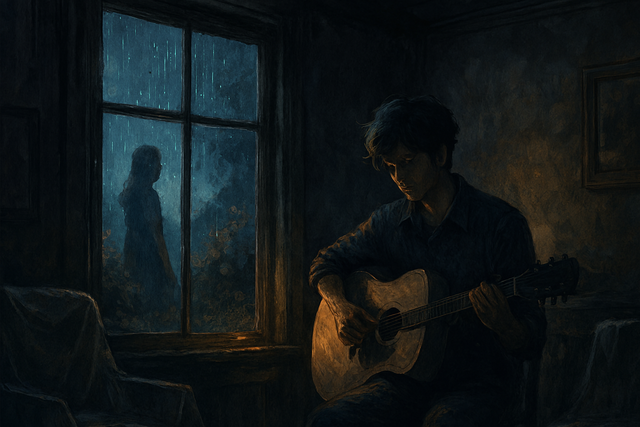
She stood in the garden, her hair swaying with the wind, her eyes searching. She didn’t speak, but her presence was unmistakable. Elias woke with a start, heart pounding, the candle long melted into wax. He stepped outside, drawn to the garden, and there—beneath the moonlight—he saw footprints in the dew.
The days passed, and the house began to stir. The radio turned on by itself, playing melodies he hadn’t heard in years. The scent of orchids filled the air, though none had bloomed. And every night, he dreamed of Lira—sometimes smiling, sometimes crying, always silent.
Elias began writing again. He filled pages with memories, with questions, with fragments of conversations that never happened. He spoke to the house, to the wind, to the shadows. He asked why she left, where she went, and why she kept returning in dreams.
One evening, while sorting through his grandmother’s letters, he found one addressed to Lira. It was never sent. In it, she wrote of Elias’s heartbreak, of the way he stopped playing guitar, of the way he stared at the sea as if waiting for someone to return. She ended with a line: “If you ever come back, tell him you never truly left.”
That night, Elias lit every candle in the house. He played his guitar for the first time in a decade, the notes trembling but true. And as the final chord echoed through the halls, he felt it—a presence, soft and familiar, like a hand brushing his shoulder.
He turned, but no one was there.
Yet the air shimmered with something unseen. A warmth. A whisper. A promise.
Elias stayed in the house on Calle Esperanza. He restored it slowly, room by room, memory by memory. He wrote stories inspired by dreams, by shadows, by love that refused to fade. And sometimes, when the wind was just right, he heard the faint strains of a violin, playing a melody only two hearts could know.