
Chapter One: Red Herring
The sound of the train wheels against the rails was a rhythm of constant, dull displacement, yet Aurelius Leblanc found it impossibly loud. It was the only sound the Great War hadn’t managed to drown out for him. He sat pressed against the worn velvet of the compartment bench, a thick, leather-bound volume of Virgil’s Aeneid resting in his hands. He hadn’t turned a page in ten minutes.
He was eighteen, an age that should have been marked by college pursuits or youthful ambition, not by a spine-deep exhaustion that felt centuries old. His hair, a perpetually messy shade of brown, fell over his high forehead, the notorious streak of pure, shock-white hair on his left fringe catching the weak afternoon light. His green eyes, perpetually wide and watchful, were the same shade as the moss that grew on the waterlogged duckboards of Flanders. A thin, jagged scar tracked from his left cheekbone, disappearing beneath the collar of his stiff, new footman uniform. It was an accessory of the war he couldn’t afford to forget.
Across from him, Samuel Stone was the picture of understated authority. The Head of Staff at Highcliff Manor, he was a man built like a monument, his dark skin a stark contrast to the pale Illinois countryside flashing past the window. He wore a finely tailored suit and held a porcelain cup, sipping coffee with quiet, unhurried grace.
“It’s a peculiar name for a town, isn’t it, Aurelius?” Samuel’s voice was a low, resonant baritone that always sounded like it knew more than it let on.
Aurelius flinched, snapping his attention away from the window where the telegraph poles whipped past like machine gun fire. “Red Herring, sir? Yes. I suppose it suggests misdirection. Or perhaps a good joke.”
Samuel offered a small, knowing smile. “The local legend holds that the name comes from a particularly clever local fox, but I’m inclined to believe Arthur Maxon simply enjoys theatrics. He owns half the valley, including the cliff the manor is named for. Highcliff, perched like a sentinel, watching the misdirections down below.”
Aurelius shifted his gaze to the book, running a thumb over the gold-embossed title. “And the manor itself, Mr. Stone? Is it as imposing as the pictures suggest?”
“It is. A bastion of old American money, built to last. You’ll be comfortable there, Aurelius. The Maxons value efficiency and discretion. They know you served. They respect it. They just ask that the service remains impeccable.”
The word ‘served’ hung in the air, a bell tolling the death knell of his youth. Aurelius tried to focus on Virgil, on the grand, fabricated heroism of a legendary soldier, but the steady rhythm of the train shifted. It wasn’t a train anymore. It was the relentless, driving thump of heavy artillery in the fall of 1917, the mud of Passchendaele clinging to everything.
The coffee cup in Samuel’s hand, so white and pristine, was suddenly covered in a slurry of ochre mud. The rich, earthy smell of the coffee turned to the metallic tang of wet blood and decaying flesh. The compartment was gone. The world contracted to a narrow, waterlogged trench.
A shell whined, a scream that never reached the pitch of silence, and then the air ruptured.
Aurelius’s breath hitched, his knuckles white against the cover of the Aeneid. He didn’t see Samuel; he saw Private Jones, his mouth open in a final, silent plea before a direct hit turned him into nothing but a crimson mist that settled on Aurelius’s already soaked greatcoat. He could feel the fine, gritty viscera coating his teeth, the warm, pulsing spray of life suddenly extinguished. The sound was deafening, a visceral, unending roar that made his eardrums feel like they were going to burst.
“Gas! Gas, everyone!”
He squeezed his eyes shut, plunging himself back into the present, fighting the phantom weight of the respirator on his face.
“Aurelius?” Samuel’s voice, concerned and close, cut through the residual chaos.
Aurelius inhaled sharply, his green eyes darting around the compartment, confirming the reality of the clean velvet seats, the serene landscape, the intact coffee cup. He saw the genuine, careful compassion in Samuel’s expression.
“My apologies, Mr. Stone,” Aurelius managed, his voice sounding thin and unfamiliar. He slid the book onto the seat next to him, his hands trembling slightly. “A moment’s distraction. I believe… I just felt a chill.”
Samuel nodded slowly, his gaze lingering on the white streak in Aurelius’s hair, a visible, stark line of trauma. He didn’t press.
“We’re almost there, son. You’ll see it soon.” Samuel gestured towards the window with his cup.
Aurelius followed the direction, and there, beyond the fields of ripening corn and the small, cluster of smoke-stained houses that must be Red Herring, was the cliff. Highcliff. It rose sharply from the earth, and at its summit sat the manor—a sprawling, limestone behemoth, turreted and shadowed against the setting sun, watching over the small town below. It looked less like a home and more like a fortress, a solid, unmoving thing.
A wave of strange, unexpected relief washed over Aurelius. He was here to serve, to be busy, to bury the lingering horrors of his past in the impeccable demands of the Maxon family. In this towering, silent building, perhaps he could finally find a trench that the chaos couldn’t reach.
The train began its slow, grinding descent into Red Herring station. Aurelius straightened his tie and adjusted the cut of his uniform, the starched collar a welcome pressure against the scar on his neck.
“Ready, Aurelius?” Samuel asked.
Aurelius looked at the immense, cliff-top mansion, then at his reflection in the glass: the scarred face, the haunted eyes. He took a breath that tasted faintly of ozone and fear.
“As I’ll ever be, Mr. Stone.”
He reached for his coat and followed Samuel off the train and into the cool, silent air of Red Herring, Illinois.
The village of Red Herring was exactly as Samuel had described: quiet. It was a cluster of tidy, clapboard houses nestled below a steep, forested rise. The air was clean, carrying the scent of rich, damp earth and the distant musk of the lake. Aurelius, carrying his simple bag and the constant tension in his shoulders, followed Samuel to a waiting black motorcar.
The ascent was dizzying. The car climbed a serpentine, gravel road, and when they finally broke through the dense canopy of oaks, Highcliff Manor loomed against the pale afternoon sky. It was a monolith of gray stone, imposing and severe, yet somehow beautiful in its brutalist isolation. It truly sat on a cliff, the grounds offering a sweeping, terrifying view of the small town below and the vast, unblemished horizon.
Inside, the manor was cavernous, smelling of beeswax, old books, and a faint, metallic trace that Aurelius tried to ignore—the smell of copper and stale air. Samuel guided him through the staff entrance and delivered him to the grand library, where the Maxon family awaited.
Arthur Maxon, a tall man with an air of artistic restlessness, stood by a massive fireplace, examining a Greek bust. His wife, Celia, was seated, a woman of sharp, elegant angles and a gaze that assessed the value of everything it touched. Aurelius straightened his back, a muscle twitching in his scarred cheek.
“Mr. Leblanc, sir, madam,” Samuel announced smoothly. “Your new footman, recently arrived from Canada.”
Arthur Maxon turned, offering a detached, brief smile. “Welcome, Aurelius. Samuel speaks highly of your diligence, if not your history. We require discretion and absolute competence here. You are here to serve, nothing more. Do you understand?”
“Yes, sir,” Aurelius replied, his voice firm, projecting the confidence he was desperate to feel. “Absolute discretion, sir.”
“Excellent,” Celia Maxon said, her voice dry, like rustling silk. “I abhor noise and incompetence, Leblanc. Ensure I encounter neither.”
It was then that Aurelius noticed the third person in the room. She was seated by a bay window, the afternoon light catching her hair—a shimmering cascade of pure, unnatural white. She was sketching in a large pad on her knees, so engrossed she might have been a statue. Her name was Evelyn.
She slowly lifted her head, and Aurelius forgot the stiff posture and the polished floor. Her eyes were exactly as Samuel had described: the clear, deep amber of honey, striking against her snow-white hair and the pale skin of her face. They were the same age, yet she seemed encased in a beautiful, distant antiquity.
Evelyn’s gaze, unlike her parents’, was not assessing, but intensely curious. It rested not on his uniform, but directly on his face, tracing the white streak in his fringe, and settling briefly, almost clinically, on the pale line of his scar.
The air in the library, already heavy, seemed to crackle with an unspoken energy. It was a gaze that saw him, the soldier, rather than the footman. For a terrifying second, Aurelius felt a familiar wave of nausea, an echo of the trenches, and he braced himself for the noise to return.
“Mother, Father,” Evelyn said, her voice a low, melodic contrast to her mother’s crisp tone. “It is rude to make the new footman stand in silence while we examine him.” She closed her sketchbook, the sudden snap of the binding echoing in the large room. “Welcome to Highcliff, Mr. Leblanc. I hope you find the view of Red Herring to your liking.”
Aurelius gave a short, sharp bow, struggling to maintain his professional facade beneath the sheer intensity of her focus. “Thank you, Miss Maxon. The house is… magnificent.”
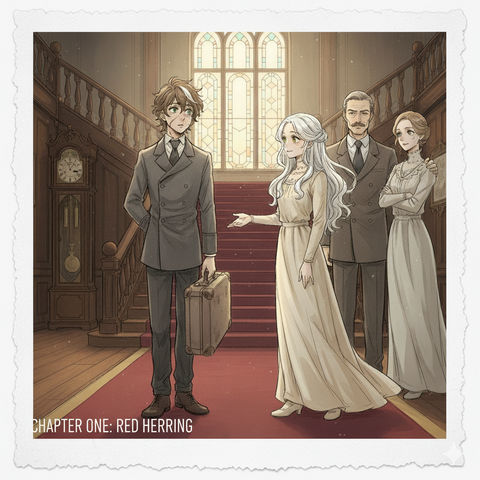
Samuel stepped forward, reclaiming the moment. “Very well. Aurelius, I will show you to your quarters and detail your schedule. Arthur, Celia, Miss Evelyn. We are at your disposal.”
Aurelius followed Samuel, but as he reached the library door, he glanced back. Evelyn was still watching him, her honey eyes holding an unnerving mixture of quiet sympathy and deep, unreadable observation. It was a look that felt more dangerous, more intrusive, than any shellfire. He realized, with a sinking feeling, that escaping the war would be much harder here, under the unsettling, magnificent scrutiny of Highcliff Manor.
The air in Highcliff Manor was too thick, too warm, and above all, too quiet.
Aurelius stood in the doorway of what would be his new quarters, a small, meticulously neat room on the third floor of the staff wing. He still felt the roll of the train, an echo of the troop transports he’d spent endless nights in four years ago. The persistent knot in his shoulders had tightened ever since he stepped into Red Herring, Illinois—a town named, quite ironically, for something misleading, something intentionally distracting.
“Here we are, Leblanc,You’ll share with Ash. He’s on his duties currently, but he’s quiet and keeps to himself. A clean arrangement. You’ll have a few minutes to settle your luggage before changing into your livery. Dinner service begins at seven.”
Aurelius managed a curt nod. His messy brown hair, made famous by the unforgiving white streak slashing across the left side of his fringe, fell over his green eyes. The motion pulled at the small, ragged scar on his cheek, a thin line of raised skin that vanished beneath the starched collar of his civilian coat.
Samuel left, his steps precise and fading instantly on the thick, patterned carpet of the hallway. Aurelius was alone, surrounded by an overwhelming, suffocating silence.
In the trenches, silence was the alarm bell, the moment before the mortars rained down or the raid began. Here, it was merely the absence of sound, but it pressed on his eardrums until they hummed. He dropped his worn canvas bag onto the plain wooden foot of the bed. It made a surprisingly loud thud that sent a spike of adrenaline through him.
A cough from the other side of the room broke his reverie.
“You’re the new lad, then.”
A man, slouched on the second bed, was polishing a pair of black dress shoes. This must be Ash. He was slight, with dull brown hair and an air of permanent indifference.
“Aurelius Leblanc,” Aurelius supplied, extending a hand out of habit.
Ash barely paused his work, offering a quick, grease-stained shake. “Ash. Don’t worry about the polish, Stone will expect you to get your own kit. Everything is ironed in the wardrobe. Don’t be late.”
That was the extent of the welcome. Aurelius appreciated it. Simple. Predictable.
A faint ticking sound drew him back to the present. It was an ornate clock on the mantelpiece across the room. Tick. Tick. Tick. Steady. Unhurried. Aurelius shut his eyes, trying to force his breathing back into the rhythm of a normal, peacetime life.
The battle of the mud, the screams, the rain that never stopped—they were miles away, across an ocean, and deep beneath the earth. He was safe now. He was a footman in a quiet mansion on a cliff overlooking a strange new town. He was Aurelius Leblanc, and he was here to work.







