Prologue – The Shadow of Charing Cross
The last day of August bathed London in a soft, golden light, as if even the sun were trying to pretend that the world truly was returning to normal after the war. The air still held the weight of the past months, yet in the middle of bustling Diagon Alley stood a place that had remained unshaken by every storm for generations. The Leaky Cauldron, shabby and forever crowded, smelled of the same smoke, the same old wood, and the same butterbeer that had accompanied young witches and wizards throughout their adolescence.
Harry sat at one of the side tables — a table that had witnessed more evenings full of nerves and hope than most. He wrapped his hands around the mug as if trying to warm himself with something more than just a hot drink. He still carried within him that last day at Hogwarts — tormented by the restless portraits, the screams of spells, the echo of fallen friends.
Ron and Hermione sat across from him, absorbed in conversation with a lightness Harry hadn’t seen in them for many months. Ron, slouched casually against the chair, shook a tankard full of butterbeer, his red hair glowing in the candlelight. Hermione — more serious, though relaxed — held a newspaper with the latest issue of the Daily Prophet, a self-writing quill tucked in as a bookmark.
Part of Harry felt grateful that their laughter no longer sounded like an echo of a better time, but truly belonged to this moment. Another part of him still trembled at the sight of that newspaper — the Daily Prophet was no longer a chronicle of fearmongering but almost an official reconstruction bulletin. The last pages were filled with notices of missing valuable items (not only magical), auctions of artefacts confiscated by Aurors, and constant lists of thanks to St Mungo’s healers, whose shifts still stretched endlessly. Even Tom, pouring drinks behind the bar, cast nervous glances at the headline resting on Hermione’s lap:
“New Head of the Department of Magical Law Enforcement: Will the Wizarding World Forgive Old Sins?”
Harry felt exhausted by the very idea of politics, but Hermione, a relentless priestess of law, was already scribbling something in the margins.
“And you’re saying McGonagall really wants us to go back?” Ron asked, raising his brows as if he still couldn’t believe he’d have to hit the books again. “After everything? After… all that?”
Hermione shot him a stern but warm look.
“It’s not about what she wants. It’s just… Hogwarts is coming back to life. They need older students — people who know the school and who…” Her gaze darkened. “Who survived all of this. Besides, Professor McGonagall says finishing our education is our right. And especially your responsibility if you want to work at the Ministry.”
Ron groaned theatrically, but a glint of brightness lit his eyes — something Harry hadn’t seen since Fred’s death. They all needed this — normalcy, even if it came in the form of year-end exams.
Ginny approached their table, carrying steaming plates. She smiled softly, as if capturing this moment was something precious — and it was. Her red hair fell smoothly over her shoulders, and her eyes shone with the same calm Harry had always found comfort in.
“Tom said that if you start complaining again, you can clear the plates yourselves,” she said, setting the food down. “Apparently it’s a new rule. Applies especially to one Ronald Weasley.”
“Cruel,” Ron muttered, but grabbed his fork instantly. “Do I have any rights at all?”
“Only the ones I grant you,” Hermione replied without lifting her gaze. Ron snorted and wrapped an arm around her shoulders.
Harry watched them, a true, honest smile slowly forming on his face. After so many months of fear and gloom, the sight of their tenderness soothed him like a warm compress. He felt that his whole life had unfolded in the flash of a stunning spell — victorious, yet scorching everything soft and innocent in him. It was the quiet curse of every survivor: the constant awareness that the power that saved him had also destroyed so many others. Magic, the most wondrous force in the world, had revealed itself as the most potent form of violence. Now, sitting safely in the Leaky Cauldron, he was trying to learn how to reclaim it — to use it to kindle light, not repel deadly curses.
Ginny sat beside him and placed a hand on his knee. Her presence was quiet but steady — like something that had finally found its rightful place after a long storm.
“How do you feel?” she asked softly.
Harry shrugged.
“Better. I think… really better. I don’t remember the last time an evening felt ordinary. And that’s what I wanted, right? Normalcy.”
Ginny smiled gently.
“The world wants that too. It has to grow back somehow. We all do.”
In the corner of the room, a few wizards were reading the newest Ministry announcements pinned to a crooked board: reconstruction regulations for Hogwarts, support programs for families of the fallen, notices about the pursuit of Voldemort’s last supporters. Even now, months after his downfall, the name “Voldemort” sent a ripple through the crowd. Fear didn’t fade easily.
Even Tom, older than the dragons guarding Gringotts, spoke much more quietly that evening.
But something else lingered in the air — a note of cautious hope, like the first shoots pushing through scorched earth.
“You think Hogwarts will look the same?” Ron asked suddenly, squinting as if he could already see the castle’s silhouette.
Harry closed his eyes for a moment, imagining the Great Hall without the gaping holes in the ceiling, the Astronomy Tower without burn marks, the grounds he could walk without bracing for battle. Memories struck him in a wave — Lupin, Tonks, Fred, Colin, so many faces he would never see again.
“No,” he said at last, opening his eyes. “It won’t be the same. And maybe… it shouldn’t be.”
Hermione nodded.
“Professor McGonagall told me some parts were left untouched. As memorials. The spot where Fred died…” She paused, fighting to keep her voice steady. Ron’s breath hitched. “And others. But the Great Hall and parts of the walls are being rebuilt. And most of the staff is already back.”
“Flitwick?” Ron asked.
“Yes. I wrote to him. And Professor Sprout apparently has some new… elf-gardeners, or whatever they’re called. After the war, a lot of strange plants started popping up everywhere and they’re hard to control.”
“Sounds like Hogwarts,” Harry muttered with a brief laugh.
A comfortable silence settled over them — the kind that brings the realization that tomorrow something important begins: a simple school year.
Suddenly, the sharp crack of Apparition sounded outside, followed by laughter. Someone burst through the door, waving a newspaper.
“The list of students returning for seventh year is out!” the boy shouted. “McGonagall announced it officially! They say it’s going to be the most unusual year in Hogwarts history!”
Tom hurried over to quiet him, but it was too late — the news spread through the room in seconds. Everyone began whispering about who was returning, what classes would look like, whether N.E.W.T.s would take place or if the Ministry planned a new format.
Ginny looked at Harry with a smile that said everything.
“It’s going to be okay,” she whispered.
And for the first time in a long while, Harry believed she might be right.
Outside, Diagon Alley slowly fell silent. Tomorrow, the Hogwarts Express would depart — for the first time since the Battle of Hogwarts. Tomorrow they would all return to the place that had been their home — changed, wounded, but standing. And Harry felt that no matter what the new year brought, he would do everything to help that home truly come back to life.
That night, the Leaky Cauldron stood like a sentinel between the old world and the new. And the four young people whispering plans at their table were, once again — if only a little — the friends they had once been.
Everything was only just beginning.
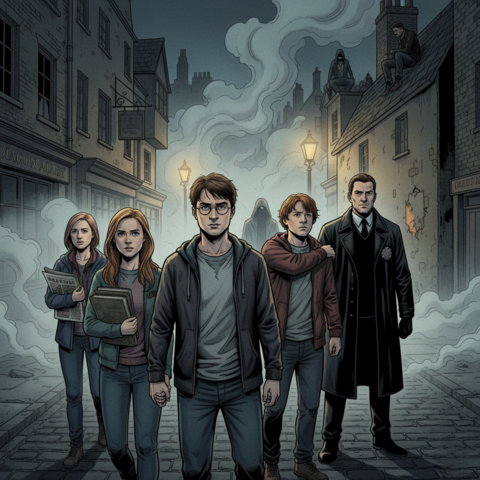
Night over London was dense, darker than it had any right to be at the end of summer. Fog drifted low, brushing the cobblestones of Charing Cross Road like a lazy, milky ghost. The streetlamps cast a pale, watered-down glow that barely pierced the veil of moisture. The Leaky Cauldron looked as it always did—scratched, shabby, its enchanted sign tapping softly in the breeze—but tonight someone was watching its entrance with unusual care.
Beneath the shadow of one of the lamps stood a hooded figure, seemingly just a vagrant or a bar patron who had stepped outside for air. But under the dirty cloak she hid a wand clenched in her pocket, and an eye that never stopped sliding toward the tavern door.
Across the street, melting into the darkness behind a bus stop, stood a second silhouette—taller, broader, equally motionless. Only the glint of a metal pin on his collar gave him away. It was the emblem of the Auror Headquarters, redesigned after the war: a shield with three stars, symbolizing courage, vigilance, and loyalty.
They waited.
They watched.
They guarded four young people who were just finishing dinner inside.
A thin, taut conversation lingered in the air, barely audible.
“Think they’ll come out early tonight?” the hooded witch muttered from the left side of the street, not shifting her gaze from the door.
“It’s Potter. Of course not,” the man opposite replied, his tone heavy with the weariness known to every auror since the war’s end. “And we’ll stand here as long as it takes, until the new minister decides the world is absolutely safe.”
The witch snorted.
“The world won’t be safe for a long time.”
“I know. That’s why we’re here.”
On the roof of the bookstore next door perched a third figure, almost invisible—only the faint flutter of a cloak revealed her presence. The three of them formed a discreet but tight circle of protection around the pub.
After the war, the Ministry of Magic looked nothing like it had before. Officials who supported Voldemort had either fled or were waiting in cells for trial. The new minister—Kingsley Shacklebolt—had spent weeks trying to rebuild trust in the government. One thing he knew for certain: as long as even one of the Dark Lord’s followers remained at large, Harry Potter and his friends were the most valuable targets in the world.
Rumors about Death Eaters hiding in Norway and Albania spread daily. Almost certainly someone had slipped across borders. The Ministry tried to keep this secret. With mixed success.
The front door of the Leaky Cauldron creaked open.
All three watchers reacted at once.
Four figures stepped into the street.
Harry first—hair messier than usual, glasses fogged from the warm interior. Behind him Ron, fumbling with his jacket, Hermione with a stack of books under her arm, and finally Ginny, who stepped up beside Harry and, before anyone could say a word, slipped her hand into his.
A simple gesture.
And yet so vulnerable.
“Cold,” Ron muttered, rubbing his hands. “I thought late August would be… I don’t know, warmer.”
“This is London, Ron,” Hermione reminded him, rolling her eyes. “The weather here has its own rules. Literally, according to Magical Meteorologies of the World.”
“Sure, Hermione, probably some ancient spell is involved,” Ron said with mock seriousness. “Or maybe it’s your inhuman knowledge of absolutely everything.”
Hermione snorted.
Ginny squeezed Harry’s hand, and he glanced at her out of the corner of his eye.
The street was empty. Too empty.
“Do you feel that?” Ginny whispered.
Harry nodded.
Since the war, his instincts had sharpened to a painful degree. Every draft, every shadow, every murmur set him on edge. Now—just like in Godric’s Hollow, in the forest, on the grounds of Hogwarts—he felt eyes on him.
Ron stopped as well, scanning the street with a frown.
“Is someone following us?” he asked bluntly.
Hermione narrowed her eyebrows.
“They shouldn’t be. The Ministry said the area was secure.”
“That means there’s a mess,” Ron concluded. “Standard procedure.”
Harry took a step forward, lifting his head toward the fog. He wanted to say: Come out. He was already opening his mouth when a man emerged from the darkness.
He didn’t look like an attacker. He wore a long black auror coat, a silver pin, and a face Harry recognized from Shacklebolt’s office—one of the younger aurors, trained right after the war.
“Mr. Potter,” he said, inclining his head. “Mr. Weasley. Miss Granger. Miss Weasley. Forgive us… our presence. It’s a routine precaution.”
The other two figures stepped out behind him.
“Routine?” Harry asked sharply. “Since when do aurors stand outside pubs to guard students?”
The auror swallowed.
“Since you are not ordinary students anymore. Minister Shacklebolt believes that after recent intel… we must protect you more closely than before.”
Hermione exhaled heavily.
“What intel?”
The auror hesitated.
“Several supporters… managed to escape. Likely using contacts on the continent. The trail ends in Austria, but we can’t rule out that someone is trying to reach England.” He paused. “Rumors of revenge against so-called ‘symbols of the new order’ are appearing more often.”
“Symbols?” Ron echoed. “Harry, that means you.”
Harry pressed his lips together.
“Not just me,” he said. “Anyone who fought on the right side.”
The auror nodded.
“The Ministry doesn’t want to take chances. That’s why discreet protection has been assigned. Always at a safe distance.”
The last few months, since the fall of He-Who-Must-Not-Be-Named, hadn’t brought relief but a new, bitter role—Harry Potter: Personal Symbol of the New Order. The weight of that label felt almost physical. He felt like a living museum piece, a walking exhibit meant to prove the war was over. But he knew perfectly well that evil had never been just one man. Evil was a mindset that survived. He longed to be simply Harry again, who had to take boring but safe N.E.W.T.s, not a human shield for the entire world. It angered him that aurors were standing here, watching him like a treasure to lock away in Gringotts, instead of hunting down the last remnants.
Ginny huffed.
“Discreet? You snorted like a herd of hippogriffs when we came out.”
The aurors exchanged glances.
“We’re still learning the new system,” the man said. “After the war everything is… different. Procedures, rules, responsibilities. You are the most important witnesses. And heroes. If… anything happened to you…”
“Yeah, I know,” Harry muttered. “The world would go mad. I’ve heard that one before.”
Hermione gave Harry a worried look.
“Harry… you’re tired, aren’t you?”
He didn’t deny it.
Seeing this, the auror stepped a little closer—without aggression. More out of a sense of duty touched with concern.
“Tomorrow you return to Hogwarts. The train will be secured. There will be aurors on the platform. And at the castle… discreet supervision as well.”
Ron let out a long groan.
“So even at school we won’t get peace.”
“It’s only temporary,” the auror assured him. “Once we catch the last of them… or at least learn where they’re hiding, you’ll finally be able to breathe freely.”
For a moment silence fell, broken only by distant mugglish traffic and the soft hiss of fog sliding over the pavement. In that silence Harry caught another sound—a faint mechanical click from the direction of the rooftop auror. It was the snap of a magical recorder, one of the devices Shacklebolt had introduced to capture all potentially sensitive conversations in protected zones. Officially they were meant to gather evidence against surviving Death Eaters, but Harry knew they were also recording them. It irritated him; even if the motive was noble, he felt spied on, as if the Ministry still didn’t fully trust anyone—not even the people who saved it.
Harry stepped forward, meeting the auror’s eyes.
“Tell me one thing. Do you honestly think someone would dare come here? That someone is planning to attack us?”
The auror hesitated only a second—but it was enough.
“The Ministry… wouldn’t say so without reason,” he replied quietly.
A sharp glint flashed in Harry’s eyes—brief shards of memory from the Forbidden Forest, the tents, the shattered halls of Hogwarts.
“Fine,” he said at last. “But if we’re supposed to start new lives, you have to let us live them. We want to go back to school. To studying. To normality.”
“Normality will return,” the auror promised. “But safety comes first.”
Harry nodded. Ginny rested her head against his shoulder, Ron shifted impatiently, Hermione hugged her books tighter, as if knowledge could put the world back in order.
The fog thickened, swallowing the street in shadow. The aurors slipped back into position—discreetly, though still visible to trained eyes.
Harry looked at his friends.
“Let’s go,” he said. “We’ve got a long day tomorrow.”
They headed toward the entrance to Diagon Alley, surrounded by silence, mist, and unseen watchful eyes. In the post-Voldemort world, the line between freedom and protection was still thin as thread. And they all felt that even if the war was over, its remnants would follow them for a long time, like the London fog—reluctant to disappear.
As they neared the entrance to Diagon Alley, Harry paused. The magical barrier between worlds felt thinner, more porous, as though years of stress and dark curses had worn it down. On the other side, in the dim alley where the old telephone booth entrance to the Ministry once stood, there remained an imperfectly concealed scar from the explosion that happened at the start of the war. Despite the aurors’ Reparo spells, the stone was a different color—grayer, scorched—a quiet reminder that magical destruction is rarely undone completely. It meant no return would be whole; there would always be scars—on the walls, and in memory.