
Chapter 1
March 17, 1758
Williamsburg, Virginia
The wind over Williamsburg carried the scent of damp earth and early spring blossoms, as the bells of Bruton Parish tolled the hour after sunrise. The town still shook off winter’s chill, yet inside the Governor’s Palace, firelight glowed warmly against carved wooden walls and fine imported tapestries.
Lady Martha Wright lay beneath a quilted coverlet of French embroidery, every stitch a memory of the country she had once called home. She was not born of Virginia, nor of England, but of Champagne, eldest daughter to Marquis Étienne de Rochefort, whose title and vineyards rolled across the hills east of Paris like rows of sleeping soldiers.
Her marriage to Edward Wright, the governor of the colony of Virginia, had been the sort of union whispered about in both drawing rooms and taverns French nobility wed to a man of English birth ruling a restless colony. Yet Martha had chosen Edward freely, believing that love, not pedigree, would build a truer future.
Now, that future was making its way into the world.
The midwife an Irishwoman named Mrs. O’Malley worked with quiet authority, commanding even the most anxious servants to stillness. Martha gripped the sheets, her breaths sharp and deep, her blonde hair damp against her temples.
“You’re close, my lady,” Mrs. O’Malley said, voice steady as the sea.
Edward paced the corridor outside, his footsteps echoing against the grand hall, where portraits of British monarchs stared down in solemn judgment. He had faced debates, threats, even the tensions of war, but nothing so unnerving as his wife’s muffled cries through the heavy door.
Hours passed slow as honey, heavy as stone.
Then at last, a sharp, vigorous cry pierced the quiet. The midwife smiled.
“A strong little lady, indeed.”
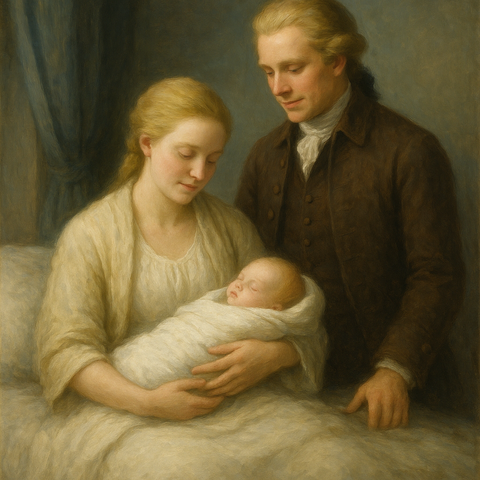
Martha closed her eyes, tears threading down her cheeks, as the newborn was placed in her arms. The baby’s skin was warm, her small face flushed with life. Wisps of blonde hair crowned her head like gold in the dim light. Her eyes, when they opened, were a deep violet-blue the rare Rochefort eyes her grandfather had always said marked the true heirs of his line.
“A daughter,” Martha whispered. “Ma petite Charlotte.”
Edward slipped into the room at last, his breath catching at the sight. He approached his wife and child slowly, reverently, as if fearful he might disturb a miracle. Martha lifted their daughter for him to see.
“Her name is Charlotte Louise Rochefort Wright,” she said, infusing every syllable with pride.
Edward bowed his head and pressed his lips to his daughter’s forehead, his voice breaking softly.
“Welcome, Charlotte the first light of our future.”
News swept through Williamsburg before evening. Tavern patrons toasted her health; churchmen offered blessings; noble families whispered possibilities. Slaves in the palace kitchens sang low lullabies in languages long forbidden, hoping the child might grow into a better world than the one they served.
That night, under Virginia’s star-strewn sky, the governor’s infant daughter slept peacefully in a cradle carved from walnut and lined in French lace.
She was the child of two worlds France by blood, Virginia by birth and one day, she might have to choose between them.
But for now, she slept, tiny and perfect, unaware of the tides of revolution already stirring outside her nursery window.


1758–1765
The Governor’s Palace in Williamsburg could be grand, yet lonely for a child. Its halls echoed with polished footsteps, its chandeliers dripped with crystal, and its gardens were trimmed to the inch. But Charlotte Louise Rochefort Wright, with her sun-gold curls and curious violet-blue eyes, did not grow up to be a child of stillness.
By the time she could toddle, she had no fear of courtly carpets or echoing colonnades. She chased dust motes in the sunbeams that slanted through tall windows, left sticky fingerprints on polished mantels, and talked to portraits as if they were guests.
Her mother, Lady Martha, encouraged her curiosity. She taught her to speak both English and French, reciting verses softly at night:
"Dors, ma petite lumière”
Sleep, my little light
Her father, Governor Edward Wright, allowed her to perch on his lap as he worked, her small hand patting his waistcoat while he reviewed documents from London.
She learned to bow, to curtsy, to recite her letters, and to laugh without fear.
But not everyone in the Palace lived such a life.
Charlotte’s greatest companions were not noble-born. They were the children of the enslaved workers who kept the Palace running like a silent machine cooking, polishing, mending, carrying, tending.
Charlotte loved to slip away from the formal rooms and sit in the warm bustle of the kitchen, where simmering pots filled the air with herbs and steam. There, she found two children who would shape her earliest understanding of friendship.
Nora, older by three years, quick-witted and protective, stirred soups too heavy for her small arms but always smiled at the little girl who followed her like a shadow.
Daniel, nimble and quiet, carved animals from scrap wood. When Charlotte admired a tiny wooden bird, he gave it to her without hesitation.
“A bird ought to fly,” he murmured. “Better in your hands than mine.”
Charlotte did not understand the weight of his words. To her, they were playmates. To them, she was the governor’s daughter untouchable, and yet strangely kind.
Martha watched Charlotte’s affection for them and felt both warmth and fear. She knew the world did not treat all children equally. Some were born to inheritance, others to chains.
She did not stop the friendships, but she taught Charlotte gently:
“Honor people for their hearts, not their circumstances. But remember freedom is not gifted to everyone in this land, as it is in France.”
Charlotte listened, without yet comprehending.
When Charlotte was five, the Palace gardens filled with French voices. Her grandfather, Marquis Étienne de Rochefort, arrived from across the Atlantic, accompanied by two finely dressed aunts and the ever-present aroma of French lavender.
He was astonished by the colony its wealth, its raw earth, and its contradictions. African men and women labored in fields as horses plowed behind them; tobacco fortunes were built by hands that did not own them.
At dinner, the Marquis declared in elegant disapproval:
“Slavery, in such numbers, is a stain on any civilized land. France is not innocent, but at least we do not make plantations our crown.”
The Virginia aristocrats present stiffened, but Governor Wright merely raised an eyebrow.
Later that night, the Marquis sat with little Charlotte, who played with her wooden bird by the fire. He lifted her onto his lap and brushed a curl from her forehead.
“You are born of two worlds,” he said softly.
“You must someday choose the best parts of each.”
She nodded solemnly, as if she understood even though she did not.
He gave her a small golden medallion of Notre-Dame de Paris.
“For protection,” he said. “And to remember where your soul began.”
Charlotte kept it close, though she could not yet imagine how it might guide her. For now, she played with Nora and Daniel, learned French lullabies, tugged at her father’s sleeves, and filled the Palace with a child’s laughter.
She did not know Virginia was changing. She did not know her friendships challenged social order. She did not know history was approaching like distant thunder. All she knew was that she belonged to everyone and to no one.
1763–1765
By age seven, Charlotte’s education became more serious. A French tutor, Monsieur Delacroix, arrived at the Palace to instruct her in language, geography, philosophy, and the classics. He was a kindly man with pince-nez spectacles always sliding down his nose and the faint scent of tobacco leaves on his coat. Delacroix encouraged her to question everything.
“Understanding begins when you stop accepting the world as ordinary,” he told her. “You must ask why things are as they are.”
Charlotte did. She asked why Daniel was not allowed to learn to read. Why Nora was scolded for talking to her in the garden. Why some families were owned like fields and tools. Her parents met her questions differently. Martha, with her French upbringing, answered gently and honestly:
“This land is powerful, but not yet fair.”
Edward Wright, who depended on the unspoken machine of enslaved labor to maintain the governor’s household, answered more cautiously:
“This is the custom of Virginia, Charlotte. You must understand the world before you can hope to change it.”
That phrase before you can hope to change it stuck to her heart like evening dew. Charlotte still sought Nora and Daniel in the kitchens and gardens. They had become like siblings to her. But the older they grew, the more they were trained into their roles.
Nora began working full time in the Governor’s laundry rooms, her hands red and cracked from hours of rinsing and wringing cloth.
Daniel was taken to the Palace stables, trained under strict supervision to care for the governor’s horses. He grew taller, quieter. His wooden carvings became rare treasures of memory.
One afternoon, Charlotte found him brushing down a gelding. She brought him a book of birds and tried to give it to him.
“Please,” she whispered. “You love animals. You should have this.”
Daniel looked at the book longingly then closed her hands back over it.
“I’m not allowed to read, Charlotte. And you’ll make trouble if anyone sees.”
She felt something inside her twist painfully. Not anger but helplessness. She wished she could break the rule simply by refusing to obey it. But she was a child, trapped by expectations just as they were. When she told Monsieur Delacroix, he sighed.
“Then you must grow strong enough one day to change what seems unchangeable.”
Charlotte made a promise to herself. Quiet, firm, unknowable to anyone else: She would not forget Nora or Daniel.
January 1, 1765
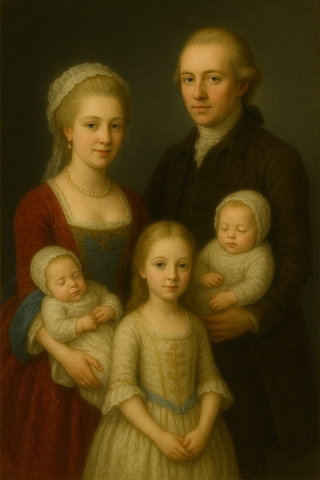
The Palace rejoiced when Martha Wright gave birth to twin girls, healthy and vibrant, their cries echoing into the crisp winter air. They were named: Anne Marie Wright dark-eyed, stubborn even as an infant Marguerite Élisabeth Wright soft-featured, calm from the start
Charlotte loved them instantly. She thought their tiny hands looked like rose petals. Nora, carrying fresh linens to the nursery, paused silently to smile, though she knew the twins’ lives would be as different from hers as the moon is from the sea.
Daniel, allowed only a brief glimpse from the doorway, whispered softly:
“They look like you, Charlotte.”
She squeezed his hand before he was ushered away. Life was changing and not all in ways they could touch.
That spring, the Wright family was invited to tea at the Coleman estate, just outside Williamsburg. The Coleman family, rich with both English titles and Virginia land, owned tobacco plantations stretching to the horizon. Charlotte wore pale blue silk.
Her mother wore a gown of shimmering gold brocade, embroidered with tiny fleurs-de-lis a bold nod to her French heritage.
They were greeted by Mary Coleman, Duchess of Richmond, dignified and elegant, and her son William Coleman, age fifteen, already polite, tall, and clearly amused by Charlotte’s timid curtsey.
Charlotte was not yet seven. The idea of courtship, marriage, or title meant little to her. But William bowed to her with warm eyes and whispered:
“When we are older, I’ll show you how to ride the fastest horse in Virginia.”
She giggled not because of the promise, but because his hair refused to stay tied back, and a stubborn blond curl bounced in front of his face.
Over tea, Martha and the Duchess discussed an arrangement a union between old French nobility and rising colonial aristocracy. A future Duke of Richmond and the daughter of the governor. It was politics, economics, status. But when Charlotte peeked at William again, he smiled kindly, and she smiled back. It was, oddly, happy.
Charlotte’s life now stretched in two directions: toward a noble future she barely understood, and back toward friendships trapped by chains she wished she could break. She was growing. Virginia was changing. And the storm of revolution was drawing closer with every year.