
Chapter 1 – The Last Night in Paris
The night before she left for Saturn, Dr. Elise Moreau walked along the Seine until her lungs ached from the cold.
Paris in winter had always felt like a city between worlds: pale bridges, slow water, light smeared across the surface like oil paint. She passed a café whose windows glowed amber against the dark, and for a moment she imagined stepping inside—ordering a noisette, pretending she was just another woman whose greatest journey was the metro ride home.
Instead, she kept walking.
Above the rooftops the sky was clear, and somewhere beyond the pinpricks of distant planes and satellites, Saturn waited: a pale orb, circled by rings so broad they could cradle a thousand Europes.
Her wrist-com vibrated.
“Still wandering?” The voice was warm, accented Italian. Luca Rossi.
Elise smiled despite herself. “Observing the native atmosphere.”
“You’re three hours from final transport,” he said. “Command will riot if the lead xenogeologist is late.”
“The French invented riots,” she murmured. “We handle them.”
He chuckled. “Meet me on Pont Neuf? One last terrestrial cliché before we go?”
She hesitated, then turned toward the bridge.
Luca was waiting at the center, hands in the pockets of his navy wool coat, curls escaping his beanie in untidy spirals. The soft glow of the streetlamps turned his breath into silver mist.
“You look like a postcard,” Elise said.
“You look like you’re already trying to leave,” he replied, studying her. “Did you at least say goodbye to your apartment?”
“Plants watered, books offended I won’t be reading them.”
“And your mother?”
Elise exhaled. “We said everything. And nothing.”
He didn’t push. Luca had grown up in Naples; he understood messy families, understood the way Europe could be crowded with history and still leave you feeling alone.
They leaned against the stone parapet, side by side, watching the boats pass beneath.
“I keep thinking,” Luca said quietly, “that when we reach Saturn… there will be a sound. Not recorded vibrations or plasma waves, but something like… an organ, in a cathedral.”
Elise smiled. “You and your metaphors.”
“You can’t tell me a planet dressed in rings isn’t dramatic. It’s basically Baroque.”
“Then Titan is what?” she asked. “A foggy English seaside town?”
“Obvious,” he said. “Titan is Copenhagen in November. Mist, melancholy, architecture that looks better in the rain.”
She laughed, and the sound surprised her. “You’re ridiculous.”
“And you’re nervous,” he replied.
She stiffened. “What makes you think I’m nervous?”
“You’ve checked your wrist-com every thirty seconds since you got here. And you keep looking upstream, like you’re hoping the river will carry you somewhere else.”
Elise gazed at the water. “We are going somewhere else.”
“Yes,” he said, “but not everyone gets to come back.”
The words hung, heavy, between them. The mission was ambitious even for the European Space Alliance. A three-year expedition to Saturn’s system: orbital mapping, Titan surface bases, Enceladus plume sampling… and the real mystery, the one buried in classified annexes—anomalous geometric signatures in the rings themselves.
No one said “alien.” The ESA was too proper for that. They called it “non-natural resonance.”
“You know why I signed up,” she said.
Luca nodded. “Because the last time, they didn’t listen.”
Her throat tightened. Five years ago, on Europa, her warnings about subsurface pressure zones had been ignored. The resulting icequake killed two scientists and ended the mission prematurely. In the official reports it was a miscalculation, a natural disaster.
In her private nightmares, it was her incompetence.
“I need to prove—” she began.
“That you were right,” Luca finished, softly. “Or that you’re not the sum of one catastrophe.”
She didn’t answer.
Instead she lifted her gaze to the constellations. Orion hung askew above the rooftops, his belt tilted like he was walking uphill.
“Do you ever think we’re still a little medieval?” she asked. “Europe, I mean. Cathedrals, parliaments, old ghosts.”
“We’re taking those ghosts with us,” Luca said. “We’re building them new cities in the sky.”
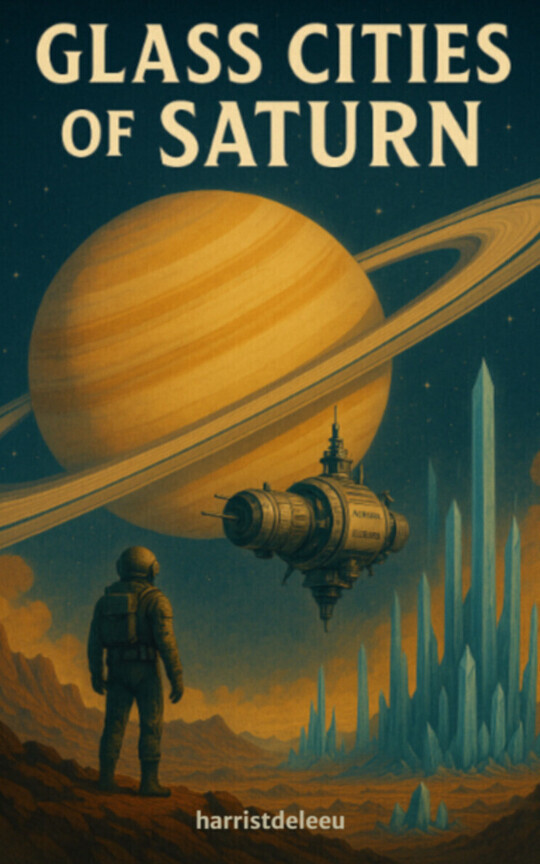
“Glass cities,” she murmured.
He nodded. “Glass cities of Saturn. With good coffee, if I have anything to say about it.”
Her wrist-com chimed.
TRANSPORT TO KOUROU SPACEPORT IN 45 MINUTES. CREW OF AURORA EUROPA, CONFIRM BOARDING.
“That’s us,” Luca said lightly.
“That’s us,” she echoed.
For a heartbeat, neither moved.
Then Luca held out a hand. Not a formal handshake, but something human, simple.
“To Saturn?” he asked.
Elise took his hand. His palm was warm.
“To Saturn,” she said.
The city hummed around them, ancient and indifferent, as they turned away from the river and walked toward the future.