
The Place that remain
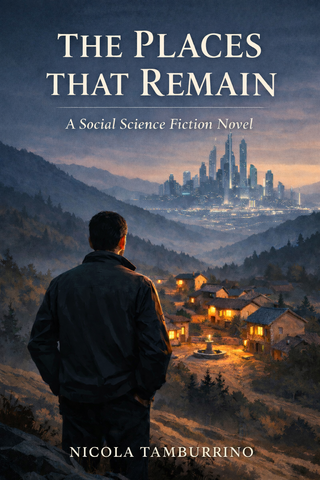
In the near future, humanity has moved beyond Earth.Colonies orbit in space, new planets are being settled, and major cities have become perfectly optimized hubs of connections, data, and global flows.
But not all places have followed this race.
On Earth, there are still territories considered no longer relevant: marginal communities, sparsely populated, far from decision-making and economic centers. They are not evacuated or destroyed. They simply stop being seen.Progress does not erase them—it leaves them behind.
To govern this new phase, the Register of Human Continuity has been created: a global archive tasked with determining which places, cultures, and communities deserve to be preserved in humanity’s official memory, and which can be forgotten without apparent consequences.
The protagonist is a Continuity Archivist. His job is to visit marginal territories, collect data, compile reports, and assign scores of usefulness and sustainability. His decisions are neither violent nor spectacular, but they are final: they determine whether a place will continue to have access to resources, infrastructure, and a future, or whether it will be slowly erased from History.
He is a man accustomed to emotional distance, convinced that his work is necessary, rational, and just. He has learned not to see people, but numbers. Not relationships, but statistics.
During a routine assignment, he is sent to a remote territory already classified as at risk of exclusion. A few families, minimal services, no strategic importance. A case that seems already closed.
And yet, as he remains in that place, something begins to fracture.
That community preserves a form of life that no longer exists elsewhere: slow relationships, shared memory, a kind of knowledge that cannot be transferred or digitized. There is no rebellion, no request for salvation. Only people who continue to live, fully aware that they no longer matter to the advancing world.
For the first time, the Archivist faces a choice the system does not account for:to faithfully record what he sees and condemn the place to oblivion, or to alter the data, slow the process, and assume a personal responsibility that could cost him his job, his identity, his future.
The Places That Remain is a work of social and human science fiction, in which progress is not judged for what it creates, but for what it chooses to forget. A story about the silent power of administrative decisions, the value of memory, and what makes a place worthy of existing—even when no one is watching anymore.
Chapter 1 – The List
The name of the place was no longer spoken by anyone.
It appeared on a neutral screen, at the bottom of a list scrolling slowly, as if even the system hesitated to display it: an alphanumeric code, a geographic coordinate, a sustainability percentage below the minimum threshold.
The Archivist read it without stopping.
He was used to it.
Every morning, at the same hour, he accessed the Register of Human Continuity and reviewed his assignments: territories, districts, settlements. Some as large as cities, others little more than isolated points on a map. All of them identical, once reduced to data.
The procedure did not allow for emotions.It required accuracy.
The system demanded efficiency, not involvement. And over the years, he had learned to provide it effortlessly: compiling, verifying, comparing. Always comparing. A place was never evaluated on its own, but only in relation to another—more accessible, more productive, more adaptable.
The one at the bottom of the list was none of those.
The percentage blinked yellow, then red. A silent, almost polite warning. The Register suggested a final verification mission, the last one before definitive classification.
The Archivist confirmed.
He did not think about the name, because it was unnecessary. He did not think about the people, because they had not yet entered the report. He thought only about the time required: three days, perhaps four. Then the place would re-enter the global statistical flow, as always happened.
He closed the screen.
Outside the window, the orbital city continued to move without friction. The upper levels reflected a constant, artificial light, calibrated not to strain the eyes. Everything had been optimized: climate, sound, even sleep cycles.
Here, nothing remained by chance.
He put on his regulation jacket, thin and light, without identifying marks. Archivists were not meant to be recognizable. They were meant to pass through, observe, and leave.
In the corridor, he encountered a colleague. They exchanged a brief, almost automatic nod. No questions. No curiosity. Each carried a different list, and there was no reason to discuss them.
Transport to the Earth’s surface was smooth. The Archivist watched the planet draw closer with the same detachment he reserved for graphs. From above, everything still appeared intact—compact, coherent.
He knew it was not.
He landed in a transition zone, one of the last operational hubs. From there on, the journey would be less linear: secondary vehicles, non-optimized routes, uncertain schedules. Every descent into a marginal territory felt like progress taking a step backward.
It was not unpleasant. Just unfamiliar.
The ground vehicle left him on a road that no longer appeared on updated maps. The asphalt was intact, but without recent signage. No directions, no maintenance markers. As if the place had stopped being reached before it had even been forgotten.
He walked for a few minutes.
The silence was not total, but different. There were no network signals, no constant background noise. Only intermittent sounds: a light wind, a distant footstep, something that might have been an animal—or a door not fully closed.
He saw the first houses.
They were not abandoned. This struck him more than he was willing to admit. The windows were clean, some open. There were curtains, plants, objects left outside, as if someone were about to return at any moment.
A man noticed him from afar. He did not approach immediately. He observed him, the way one observes something not entirely recognizable. Then he nodded—simple, without suspicion.
The Archivist returned the gesture.
He did not say who he was. There was no need. In places like this, they always knew. Not from direct experience, but from a kind of knowledge passed on without words. Sooner or later, someone came to measure what remained.
He stopped in the central square, if it could be called that. An open space, without monuments or official symbols. Just a bench, a functioning fountain, a tree grown without guidance.
He activated the recording device.
The system began collecting environmental, demographic, and structural data. Everything flowed normally. The parameters confirmed what the list had already suggested.
And yet, something did not fit.
It was not a measurable anomaly. No error in the data. It was a minimal, irritating sensation—like a word out of place in an otherwise correct text.
The Archivist looked around.
People were not hiding. They continued doing what they were doing: talking, fixing things, waiting. No one asked for explanations. No one seemed eager to prove they were necessary.
Perhaps that was what disturbed the system.
For the first time in a very long while, the Archivist hesitated before writing the first sentence of the report.
And that hesitation—small and invisible—was not provided for by any procedure.







