
THE LEGEND OF THE LENTON POND
These stories are inspired by tales that hover between legend and reality. The names of some characters and places are the product of the author’s imagination.
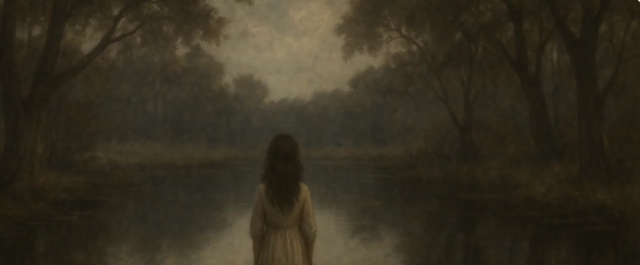


THE LEGEND OF THE LENTON POND
The fire burns weakly that evening. A thin amber flame flickers along the edge of the log, and its reflection does the same against the windowpanes in my study.
Outside, the rain traces long, uncertain paths on the glass, as if the sky itself cannot decide whether to wash away the memory or mourn it. On the desk, in front of me, lies a water-stained map of a small US state, Delaware. A fragment of land between greater powers, which rarely demands attention. Yet I have learned that it is small places that hold the most deafening silences. They are the ones where guilt lingers longest and where the dead are not disturbed too much.
I turn the map toward the light. Along the southern curve, a silvery shape glitters faintly. A pond almost obscured by the faded ink of ancient survey lines. Lenton Pond.
The name itself evokes something unfinished. A strip of calm water, surrounded by trees and marshes. It is located east of the old canal that once carried barges from Calpeak to Delaware Bay. In the years when America is still undecided about itself, neither free nor enslaved, neither innocent nor sensible, these territories give rise to their silent forms of cruelty.
A land made up of small farms and ridiculous acts of mercy, where church bells toll not only for the righteous and the devout, but also for those who condemn.
The story I am about to tell begins right there. Before the advent of the railroad, before conflicts separated brothers, there is the story of a fifteen-year-old girl who kept in her silence more grace than the world had ever given her in her life.
Her name—just mentioned—is Eliza Trolins. She lived, worked, and died near that pond, or to be precise, she disappeared into it. What follows is not only a tragedy, but the slow decay of the conscience of those who remain. They bury their shame beneath their harvests, and hide it behind their sermons. And time—an obedient servant—helps them forget.
Yet water remembers: it does not reflect what lies above, but what lies beneath.
Tonight, as the rain beats against these tall windows, I will bring that memory back to the surface. Listen carefully, because I am not telling ghost stories, but rather stories that the living refuse to remember.
Delaware in the mid-19th century, appears to be a territory caught between two truths. It is neither north nor south, a land that has not yet decided what mercy means. Slavery lurks in the shadows of barns. Freedom is spoken of alongside obedience.
The land is barren, summers are plagued by insects and silence, and people quickly learn that survival requires resilience rather than kindness.
In those sultry years, when the air seems to cry out for rain, a cart travels along a dirt road toward a small farm surrounded by willow trees and ponds.
In the back, there is a fifteen-year-old girl named Eliza Trolins, forced by contract to work for a family she has never met. Her parents died the previous winter, their names recorded along with those of hundreds of other people who fell victim to fever and poverty.
People consider her lucky because she is a well-mannered, pretty, well-dressed young woman with a job. But often the term lucky is used as a veil to hide malice.
The road bends past a patch of half-grown wheat, where crows scatter like shreds of black cloth. In the distance, Lenton Pond glistens through the mist, its surface remaining still even under the wind’s whispers. Eliza finds it bizarre that water can appear so placid, as if it is listening rather than reflecting.
The carriage creaks and the girl wraps herself in her shawl, not because of the cold, but because of the uneasiness that seems to hang in the air.
His new home is small but tidy. A square house with white-painted boards. The windows are shut despite the heat. Beyond, a portion of the garden stretches out in perfect lines, and the soil appears dark and heavy.
Eliza descends and then stands still for a moment, unsure whether she has arrived in a safe place or another kind of prison.
From the porch comes a faint sound of movement, the presence of an attentive and vigilant woman, and, somewhere inside the house, the shadow of a male figure passing in front of a window.
That first day passes in a whirlwind of work. The pace of country life leaves no room for hesitation. Water is drawn, floors are cleaned, bread is baked in the oven, whose smoke attacks the beams.
The fifteen-year-old moves calmly, her hands remembering the gestures her mother once taught her, her mind wandering elsewhere, trapped between pain and numb determination. Every task becomes an anchor against her thoughts. For her, work is a way to feel nothing.
As the light begins to fade, the young woman finds herself at the edge of the property, where the trees open up onto the vast expanse of Lenton Pond. The air smells of peat and rotting leaves. A heron stands still in the shallow water, so motionless that it seems sculpted by the twilight.
Beyond the water, the pine trees stretch inland, their reflections blending with the surface, making the world appear double. The expanse of the pond is perfectly smooth, yet it gives the strange illusion of depth.
As if something were waiting for her there, Eliza kneels down and touches the surface with her finger. The water is warm, almost human, and circles spread outwards, disturbing the reflected clouds. For a moment, the young girl sees her distorted reflection, not her real face but a glimpse of how fear and exhaustion have aged her, despite her fifteen years. The ripples quickly erase that image, leaving Eliza unsure if she really saw anything.
The house behind her is immersed in silence, while smoke rises from the chimney in a straight column. Somewhere inside, daily life continues in hushed tones: the creaking of a chair, the closing of a door. But even from where she stands, Eliza can feel the weight that hangs over those walls, a weight that does not come from poverty but from unspoken resentment. That unease grips her, haunting her even in the open air. And as dusk deepens, the frogs begin their hoarse chorus.
The heron takes flight and its wings brush the surface like a whispered warning.
The fifteen-year-old stays there until the last glimmer of light fades, then returns to the farm. Behind her, the water becomes still again, as if no presence had disturbed it.
That night, the girl cannot sleep. Her room is hot and the air is still. From the wide-open window come the faint sounds of the pond: the lapping of small waves against the reeds, the distant rustling of trees.
Somewhere in that dark setting, something moves. It is not the wind or an animal, but the vague sensation of something turning over in its sleep.
Eliza stays awake until dawn, listening. To convince herself, she repeats that it was just water flowing in the night. However, deep down, she senses that something has noticed her and will not leave her alone.
Morning dawns on the Homan farm, casting a pale silver hue. Mist hangs low over the meadows, veiling the fences. Eliza rises before the rooster crows and slips outside, her bare feet sinking into the cool grass. The world seems kind for a moment, until the sound of the door behind her reminds her that kindness in these parts is a borrowed gift.
The landlady, Ruth Homan, lives each day as a soul determined to escape her pain. Years of hardship have scarred the sweetness of her face, leaving harshness where there should be affection. She is a woman of few words, yet her silence fills every room, and she is accustomed to measuring the worth of those under her roof.
Her existence revolves around the perfect organization of household chores, baking bread, doing laundry, and prayer time. She demands that the young woman follow the same strict routine. Eliza obeys. To wrong Ruth is to wrong the air itself.
Her husband, Nathaniel Homan, is another type of calm individual. He is a tall man, his shoulders hunched from working in the fields, his eyes light-colored and inscrutable. He works from dawn to dusk, his hands darkened by sweat and dirt, returning home every evening so exhausted that he looks older than his age. His silence does not stem from resentment, but from distance, as if his mind were wandering elsewhere, leaving only the shell of a man to finish the day’s tasks.
The fifteen-year-old senses his mood from the sound of his boots on the floor. If the sound is steady, it means he is calm, but if it is heavy, it means danger.
Inside the house, order reigns thanks to Ruth. The laundry is folded with military precision, the jars are lined up like soldiers on the pantry shelves, and the Bible is open on the table, even though no one reads it aloud.
Nevertheless, that almost maniacal order vibrates with a sense of unease, an energy as fragile as an overly taut string.
The woman scrutinizes every glance from her husband, every laugh from her son, every movement from the young woman, and finds nothing sinful in what she observes. However, the absence of sin does not reassure her. She gives the impression of wanting to find a flaw in the same way that others seek the light.
Eliza works for hours, aware that she is being watched. She fetches water, mends seams, and sweeps the same section of floor until it shines. The work keeps her physically busy, but her mind wanders to the pond. Every afternoon she sees it among the trees, a mirror sparkling between the trunks, drawing her in with a placid obstinacy, promising her something undefined... perhaps freedom or oblivion.
Sometimes she imagines her reflection there, waiting for her, living the life she could have had if the fever had spared her parents. Other times she fears that what awaits her beneath the surface has no reflection at all.
Summer becomes more sultry. The heat is so oppressive that even the insects move sluggishly and the fields are filled with ripe wheat. Thomas Homan, the couple’s young son, becomes increasingly restless at home, and Eliza often takes him out into the shade while Ruth is cooking or busy sewing.
The boy’s laughter is the only innocent sound that farm seems capable of producing. Yet even that sound changes the atmosphere between the couple for the worse. Ruth looks up from her work, narrowing her eyes not out of anger but out of something darker, a kind of loneliness that turns into suspicion.
On that farm, guilt is contagious. It spreads like dust, settling on everything.
Nathaniel avoids his wife’s gaze, and Ruth avoids her own reflection; the young woman, trapped between them, feels the slow erosion of her identity resulting from living as a kind of surface onto which others project their fears.
At night, when she returns to her modest bed, Eliza gazes at the wooden beams towering above her and listens to the house breathe. Alongside the chirping of crickets and the mooing of cattle, she hears the lighter rhythm of two people who are losing faith in each other: the sound of the bed creaking, muffled sobs, heavy breathing that could also be a prayer.
Every noise reminds her that peace cannot dwell where shame has taken root. Outside, the pond glistens faintly in the moonlight. It has begun to appear in her dreams—sometimes calm, sometimes mysterious and turbulent. In those dreams, she never enters the water, yet she always wakes up with wet hands as if she had.
With the arrival of harvest season, the tension inside the house becomes palpable. The land has yielded a poor harvest, tempers are running high, and Ruth’s body seems to shrink under the weight of suspicion. She performs her household duties like a ghost, repeating the gestures of the living. Her husband has become harsher in his words and less courteous in his manner.
Little Thomas, sensing what the adults stubbornly refuse to say, follows the fifteen-year-old everywhere, as if her mere presence could prevent the house from falling apart.
No one knows exactly—and no one will ever know—when the final collapse began. It was not caused by a single event, but rather by the gradual erosion of balance.
Shame—once a private feeling—has become collective, and at the center of it all is that young maid, so quiet, obedient, and utterly vulnerable.
Meanwhile, beyond the barn and fields, Lenton Pond waits patiently and cautiously, reflecting the clouds with uncanny precision. Those who live nearby claim that the water never rests, that it retains daylight long after the sun has gone down. Eliza begins to regard it as the only authentic thing she knows, vast, immobile, and overflowing with secrets it does not bother to hide.
When the first autumn storm begins to gather on the horizon, she senses its weight long before the rain arrives. The wind whispers through the reeds with a sound like breathing, and the young woman knows—though she cannot explain why—that something in that house is about to reach breaking point.
That year, the storm arrives earlier than expected, driven inland by a wind that smells of salt and iron. For three days, the air trembles with distant thunder and every living creature seems to hold its breath. The Homan’s land, parched by the summer heat, greedily drinks up the rain until the earth turns into a black swamp. Inside the farmhouse, that same water finds cracks in the roof, dripping slowly onto the table, where the Bible still lies open on the same page, never read.
The arrival of the storm does not cause the breakup, it only reveals what has been cracked for some time. That house has become a container of suspicion; the walls are steeped in it and the air is saturated with it. Ruth’s silence now resembles contempt, while her husband’s distance resembles bitterness. Their son has also become taciturn, sensing the tension that, like a tremendous electric shock, runs through every word, every glance. And at the center of it all is Eliza, whose existence becomes unbearable precisely because she is blameless.
The rain lashes against the shutters and the wind whips across the roof.
The day fades too quickly, and toward evening the lanterns cast an amber glow that transforms every movement into a silhouette. Inside the house, the air smells of wet wool and something more pungent: the unpleasant sensation of an unspoken accusation. Unlike anger, shame does not explode; it seeps in slowly and imperceptibly until it overwhelms everything.
That night, things come to a head. No one can say exactly what happened. Years later, neighbors will talk about a nasty argument, harsh words, a door slamming, and the crying of a frightened child. Others, however, will insist that no noise was heard, only absence. And absence can be more powerful than any scream.
Eliza runs away into the storm before the moon has fully risen. She takes nothing with her, neither a coat nor a lantern, only the burden of fear and the instinct to escape it.
The rain soaks her in no time, sticking her dress to her skin. The road disappears beneath her feet, and the world is reduced to the hiss of the rain and the beating of her heart.
Lightning tears through the clouds and for a moment the girl sees her surroundings: the barn, the twisted trees and, beyond, the faint glimmer of the water in Lenton Pond. At that moment, it represents both a shelter and an abyss.
The wind pushes her back as if trying to make her turn around, but she continues running. The ground is slippery, the reeds whip her legs, and the air is filled with sounds.
With every step she takes, she thinks she hears other footsteps behind her, but when she turns around, she sees only darkness. The storm blurs the contours of the world, transforming trees into moving figures and shadows into increasingly distinct faces.
In front of Eliza, the water sparkles slightly, reflecting the lightning, and its tranquility seems unnatural, too calm amid the chaos, as if the storm itself avoids disturbing it.
The girl reaches the edge and hesitates. Behind her, the fields are swallowed up by darkness. In front of her, the pond stretches out wide and shallow, and in that moment of suspension, she realizes that the line between escape and surrender has disappeared.
The fifteen-year-old takes a step forward, perhaps to hide, or perhaps just to end it all and disappear long enough to no longer be seen. The surface breaks. The rain washes away the circles almost instantly as the storm rages on, oblivious.
When dawn breaks, the clouds clear, revealing a cleansed world. The fields glisten with water, the fences sparkle with dew, and the pond reflects the new light with apparent calm. However, something in that reflection has changed. The heron—which once stood in the shallow waters—does not return. Even the frogs are silent, and the Homan farm awakens in the typical silence that characterizes an absence: an overturned chair, an open door, the unanswered cry of a child.
Nathaniel searches the yard, then the street, his boots sinking into the mud. His wife stands at the window, an unreadable expression on her face, her hands trembling.
They find nothing except footprints leading to the pond and the torn hem of a dress caught on a root. Around noon, the neighbors gather, drawn as much by curiosity as by anguish. They converse in low voices to prevent the words that everyone already knows from becoming audible.
The men begin to dredge the shallow waters using poles, their reflections broken by every ripple. Meanwhile, the women invoke God, none of them meeting the gaze of the others. The water yields only algae and silence. Towards evening, the search is called off and the pond returns to being smooth and still.
The surface reflects the last glimmer of sunset, intense and metallic. Those who linger believe they see something pale floating just below the surface of the water, probably a piece of fabric... perhaps a light, but it vanishes before anyone can be sure.
The night that arrives is calm and windless. The storm has passed, but its memory remains fixed in the depths of the pond.
Far from the farm, where the reeds whisper to each other, lulled by the darkness, the first story begins to take shape, not among the adults, but among the children, who understand certain things more clearly. They whisper that the pond took the young girl because she had nowhere else to go. They say that water keeps what is given to it, and although no one can prove it, everyone who passes by finds themselves slowing down toward the shore, observing the transparent surface and feeling the unpleasant conviction that something is watching them in return.
The following week, another storm hangs over the land like an incomplete sentence. The air grows heavy and the clouds show no sign of clearing; even the insects seem to buzz softly, as if afraid of disturbing something.
Meanwhile, life on the Homan farm continues with difficulty day after day. Tasks are completed, but without harmony, and every sound—the bucket on the stone, the wind in the cornstalks—seems to echo the same question that no one dares to ask aloud. At first, the neighbors visit every day, bringing bread, dispensing advice, and offering the kind of compassion that hides curiosity behind prayers.
On the third day, visits from neighbors become shorter, and on the seventh day they cease altogether. People quickly learn to avoid pain when it no longer offers entertainment.
The men’s boots leave deep footprints along the shore, where they had dragged their sticks to probe the water in search of the girl. The water sucked away their efforts without leaving a trace.
Ruth Homan’s health is deteriorating. She moves between rooms like someone who has forgotten what each object is for. The dishes remain dirty, the garden unkempt. Her gaze—once attentive and judicious—now appears dull, always fixed on the interior of the house. The neighbors think she is possessed, but they use that term as easily as others use the term “illness.” It is easier to make a diagnosis than to feel pity.
Nathaniel continues to work in the fields, even though the harvest has been ruined. His shoulders are perpetually hunched...the posture of a man who carries both anger and remorse. During the day he avoids the pond, but at sunset he is seen there, standing still on the shore. Once upon a time, a mill worker found his lantern in the mud, still lit, but the owner was nowhere to be seen. The miller placed it upright and then walked home, without ever looking back.
When the first frost touches the reeds, the stories begin. The village children carry them farther than the gossip of adults could ever go.
They claim that the girl’s hair still sways beneath the surface, carried by the current like seaweed; they also assert that she walks on the water every time the moon is at the center of the sky, her face pale and her dress smeared with mud. Others claim to hear a single splash every night, as if something emerges to breathe before sinking back down again.
The pond itself undergoes small changes. The water becomes darker, its reflection too perfect, excessively still. Fishermen begin to avoid it, as their lines get tangled in pale filaments that dissolve in their hands. Birds no longer nest in the trees near the shore, and even the wind seems to shy away from the edges of the water, turning back toward the plots of land rather than crossing it.
In Delaware, the seasons change, but time seems to stand still within that circle of trees. The canal becomes increasingly busy and the towns prosper. Yet the Homan property falls into ruin without anyone stepping in to help.
In 1850, the fences collapsed, and the barn leaned inward like a suffering figure. Travelers used that dwelling as a landmark...the place before the pond, the one that lit the lanterns at odd hours.
Ruth dies one winter night, when ice covers the expanse of water, making it resistant to its weight. Her body is found on a chair next to the fireplace, her eyes wide open as if she is still watching the door.
His son—now grown up and gone—never returns. Nathaniel lives in complete solitude for another decade, with a white beard and gnarled hands from work and guilt. When he finally disappears into thin air, his neighbors declare that the pond has taken him back, and no one bothers to look for him.
The century draws to a close. Meanwhile, beyond the borders of Delaware, empires rise and fall, but Lenton Pond remains unchanged, a mirror untouched by progress. The local people no longer talk about it... forgetting has become a form of respect. However, those who camp nearby tell of dreams filled with water, of waking up with damp clothes despite the night having been dry. More than one traveler swears that, just before dawn, it is possible to glimpse a silhouette beneath the surface, suspended as if awaiting judgment.
The appearance of that mysterious observer slips into silence, because water does not forgive and only remembers. Every reflection represents an act of confession: the world above forced to meet the world below.
As the old century sinks into the new, Eliza Trolins’ story is reduced to a warning for young children. But the pond continues with its testimony.
Even in the height of summer, when the heat and light are relentless and laughter echoes from passing boats, an atmosphere of listening persists and the water appears dormant. Yet it never is. It dreams, slowly and intensely, of a young girl who fled too far away and a world that had abandoned her.
The following decades rendered the landscape around Lenton Pond almost forgotten. Roads were built, bridges appeared where there had previously been fords, and the old canal was enlarged to accommodate boats laden with stone and timber. The Homan farm disappeared under weeds and its last planks were recovered and used as firewood. All that remains is a rectangle of foundations and the faint trace of a path leading to the expanse of water. However, the pond has not changed; it gives the impression of being immune to the passage of time. Its banks blend in with the surrounding vegetation, and its surface absorbs every season.
Delaware enters a period of quiet industrialization. Small towns spring up around mills and railroad stations, and the roads are lined with respectable-looking houses. Men shave every morning and talk about topics that suit the modern times they are living in; nevertheless, they continue to cross themselves every time the fog envelops the area.
The farmers’ children grow up and devote themselves to other things—some become office workers, others shopkeepers—and when they pass by the pond, they don’t linger.
No one feels the need to explain the reason to them.
The legend has taken on the appearance of superstition. Something rural, old-fashioned, that is best not mentioned. But forgetting does not mean erasing, it merely blurs the edges.
Despite progress, the same unease persists, as resistant as silt. Obviously there are reports, even if none are put in writing. A horse that refuses to drink from the pond, rearing up until its hooves cleave the air; fishermen who find their nets torn by something they have never seen before; a farmer’s daughter who claims to have noticed a face under the ice, a face similar to hers but not hers, watching her from the depths. The stories follow one another like a refrain that is too familiar to fade away.
The land near the pond is becoming depleted, the soil is dried out by flooding, and farms are being abandoned one after another.
In the early 1890s, the forest reclaimed what had been cleared. Pine and willow trees bent together, their roots drinking from the same placid water.
Walking in that place means being catapulted back in time, and the silence is not relaxing but full of anticipation. Rumor has it that sometimes, just before dawn, the mist rises, taking on the precise shape of a figure standing on the shore. Those who witness this scene speak not of terror but of sadness... of someone who seems to be searching for something they will never find. On another occasion, after a scorching summer and when the water had fallen to a level never seen before, some young people exploring the shore found a piece of cloth caught on a branch. They claimed that it turned to ash when they touched it.
Meanwhile, the Homan surname disappears from local records. The descendants move north or west, taking with them nothing but a silence they cannot understand.
The pond—deprived of human interest—becomes a refuge for everything that wants to go unnoticed: reeds, frogs, grass, and the lingering remnants of guilt.
In those years, the reverberation of the mysterious Observer could go unnoticed on the surface. A presence that catalogs the remains of a consciousness long since dissolved.
What happens to shame when no one remembers its cause? It does not die, but takes root in its surroundings, changing the light, the sounds, and even the air.
The water in the pond should not be considered haunted in a childish sense, but is simply loyal: it remembers what men have decided to forget.
When the 20th century arrived, bringing with it electricity, cars, and new forms of skepticism, the pond welcomed it with indifference. The state began to register its land, creating parks and nature reserves thanks to the wild nature. They called it conservation, a kind of sanctification through bureaucracy.
Lenton Pond reappears on maps, with its name printed next to symbols identifying picnic areas and fishing piers...an attempt to turn mystery into recreation.
But those who camp there claim otherwise, saying that the water is too cold in summer and that, sometimes, it gives off a faint scent of lilac, even in the middle of winter. Others speak of voices, soft, rhythmic, and without language—delicate moans like the song of the sirens in the Odyssey—that rise from the surface when the fog descends.
The forest rangers dismiss these reports as figments of the imagination, yet when they make their rounds, none of them stay out past sunset.
Meanwhile, the years pile up like wood and memories overlap until history itself becomes opaque. The pond resists with its immobility and autonomy, with its existence neither damned nor benign. It is not ravenous, but waits.
The world around it changes, and every change brings with it a new way of not listening. Only water remembers, and with the passage of time, memory becomes a kind of existence in its own right.
As the century grows old enough to be considered modern, the land surrounding Lenton Pond is reclaimed by experts and commissions. They arrive with briefcases, tape measures, and the conviction that paperwork can tame any wild area. They don’t see a mystery in those placid waters, but rather an ideal place for family fun and organized weekends. The forest is cleared and dirt roads are built, along with pretty wooden signs announcing the new name of the place: LENTON POND STATE PARK.
Beneath those signs, the land remains unchanged. The soil still smells of iron and rotting roots, the air still carries the faint stench of decay, and nature does not protest. It stands by and watches, with its usual patience, as the hand of man returns.
The huts are built where the Homan fields once stretched. Children dash across the grass, laughing heartily, while their parents busy themselves with bonfires, their faces lit up by the orange glow. Meanwhile, the pond absorbs all the noise and then returns it muffled, as if analyzing every echo.
The first ranger station stands not far from the old farm foundations, although few are aware of their history. The past has been carefully buried beneath picnic tables and gravel paths, yet memory cannot be deliberately erased...it only waits to be reawakened.
Before long, the guards begin to notice small anomalies that distinguish this place from others. Boats drift despite there being no wind, slowly turning toward the center of the expanse of water; campers also report hearing footsteps near their tents long after the park has closed for the night.
Once, at dawn, a maintenance worker found a young boy standing with his knees submerged in shallow water, his eyes wide open, motionless, and unaware of how he had got there. The incident was dismissed as a case of fatigue or sleepwalking, or as something of no significance.
In 1930, when the Works Progress Administration undertook improvements to the facilities at Lenton Pond State Park, a team of men working to drain a section of the marsh found some rusty iron nails and a row of stones. They mistook them for the remains of a fence and didn’t think any more about them. Rain hid everything before the end of the day, smoothing the ground once again.
During the middle decades of the century, the pond became a place of habit and repetition. Every summer, families would gather at the same campsites, pitch the same tents, and take photos of the same views. They would smile on the shore of the pond, unaware that each photograph added another layer of mystery to the legend. Decades later, some of those shots will reveal slight distortions: a ripple where there was none before; a faint blur among the trees. Most people attribute this to some defect in the camera.
During the 1960s, Delaware’s gentle tranquility became its calling card. Brochures touted safe forests, clean air, and simple recreation, but they failed to mention that after sunset, rangers avoided the north trail by unspoken agreement. They realized that the sound of water lapping at that spot was not caused by the wind. It was a sound that pulsed irregularly, like labored breathing.
One of the guards—an elderly man who kept his stories to himself until retirement—claims that on certain nights he can see a faint glow beneath the surface, but not phosphorescent algae, rather a light that traces the outline of a shape.
When the park administration was revamped in the 1980s, a new generation of rangers arrived, equipped with radios, regulations, and skepticism. Among them was Anna Darles, young, conscientious, and ready to prove herself. She recorded wildlife, managed the trails, and treated reports from visitors about strange noises with polite indifference.
She is the first to notice a recurring pattern: every complaint, every unusual ripple always leads to the same area, the stretch of shore closest to the old Homan property.
In her spare time, the young ranger begins researching the archives. The park office keeps boxes full of documents and faded maps. One evening, accompanied only by the hum of a neon light, she finds it. A register from 1843, its ink turned brown with age.
Among the neat columns of entries, the girl notices a small note written in smaller letters.
Eliza Trolins, 15 years old, maid in the Homan family, probably drowned. No burial record. No further notes to add.
She reads that note again.
The office sinks into silence, as if the building itself is holding its breath. In that moment, the signs he ignored—footsteps, lights, whispers—go from being a nuisance to becoming evidence.
In reality, the pond is not haunted by imaginary spirits but by omission.
That night, Anna walks alone around the perimeter of the water. The air is still and the expanse is completely calm. The moon has not yet risen and the darkness around the trees seems to fold inwards. The ranger feels neither fear nor courage, only a strange familiarity, as if the scene before her is waiting to repeat itself; Meanwhile, the pond reflects her image with disturbing precision. For a moment, she thinks she sees another indistinct reflection next to hers, as if someone were standing right behind her. Then the wind blows harder, breaking up the image into ripples.
Anna leaves quickly, and the night does not pursue her, but simply closes behind her like water on a stone.
The next morning, the young ranger tells no one what she saw. But from that day on, the legend changes again, giving rise to its next version.
Autumn returns to Delaware with the same deliberate tranquility that has accompanied every summer since the pond was first populated.
The leaves turn brown, the mist descends every evening earlier than expected, and the light on the water takes on the same hue as oxidized brass. For visitors—who arrive on weekends—it is nothing more than a backdrop, a pleasant, melancholic landscape to capture in a photo and recount around the campfire. For Anna Darles, however, it has become an invitation.
After that discovery in the archives, the ranger returns to the office and continues reading, but not the official reports, rather the margins, letters, sermons, and newspaper clippings. Each of them contains a small absence, a reference to a missing girl, a domestic tragedy, and an accident on the canal, but none of them mention the young woman’s name.
Eliza Trolins has been reduced to a space between the lines, to a barely legible note, to a silence where guilt has taken root.
The park brochures depict happy families and numbered trails, but when Anna opens them and compares them with the old topographical maps, she realizes that the curve of the shore remains unchanged after a century and a half. Even progress has bypassed that strip of water.
The first frost arrives early. Campers pack up their gear and leave, leaving behind only the smell of smoke and the faint echo of laughter. When the gates close, Anna remains on duty, continuing to count the wild animals and record maintenance notes. The pond—now cleared of people—regains its ancient language. The wind communicates through the reeds rather than through the tents, and the water returns to its perfect stillness.
The young ranger walks along the shore after sunset, lantern in hand, following the line of the shore as one follows the outline of a wound.
Every night she tells herself that she is there simply to study erosion and record changes. But, little by little, the gap between study and reverence narrows. And it is during one of these walks, with the cold, pungent air smelling of pine and decay, that Anna sees the glow, a pale light just below the surface, steady, and certainly not a reflection.
It hovers where the depth suddenly decreases, where the bottom disappears into darkness. The ranger kneels, clutching the lantern in her hands, and the light grows brighter, as if to answer her.
The water slides down her boots, cold enough to sting her; suddenly, beneath the ripples, a shape begins to take form. Shoulders, hair swaying like thin grass, a face untouched by time. It is not a terrifying face, but an incredibly human one. The eyes look up, not to accuse, but tired of waiting: the eyes of someone who has waited too long to be seen.
The world transforms into the space separating the silhouette underwater and Anna. The sound fades until the young ranger can only hear her own heartbeat. And beneath the surface, another rhythm as slow as the pond itself. Heartbeat or tide? Impossible to tell.
Tell everyone that I was good. Those words surface in his mind, unspoken, but engraved there like the memory of a voice.
Immediately afterwards, the shape beneath the surface shatters, dissolving into thin silver threads that disappear into the current, after which the water returns to being calm without a single ripple. Anna finds herself knee-deep in water, the lantern raised with its light reflected beneath her. The ranger stands up and takes a step back toward the shore, her heart racing, unsure whether she has witnessed a supernatural event or something inevitable.
In the days that follow, she tries to return to her usual duties, considering that experience to be the result of fatigue or suggestion, but the pond does not allow her to minimize it. Every night she dreams about it, sometimes peaceful, sometimes turbulent, but always vivid. In those dreams, Anna feels the same sense of recognition, as if two lives, separated by centuries, had touched for a moment before returning to their respective currents.
Lenton Pond State Park reopens in the spring. New brochures are printed, the trails are renumbered, and the old ranger station becomes a visitor center. Anna Darles leaves a short note in the logbook before moving to another location further north.
Her handwriting is small, neat, and stable.
No other disorders.
Below the phrase, a faint line of ink spreads out, creating a blurred oval that, under the right light, resembles a tear.
Meanwhile, visitors continue to arrive every summer. They fish, swim, and then leave before dark. Sometimes, when the air is still and the sky begins to change color, someone notices a figure at the bottom of the pond. A female presence standing where the reeds bow... a silhouette as blurred as the fog. Every time they call her, she vanishes, leaving behind only the sound of water enveloping a form that never really went away. So the story comes full circle, not with a conclusion, but with perseverance. The pond guards what has been given to it.
Terror, shame, and memory are faithfully reflected in the expanse of water to anyone who observes long enough to identify their own shadow in its depths.
The fire inside my study has dimmed again, its glow flickering against the bookshelves, coloring the edges of the volumes and the dust that covers them like accumulated ash. Outside, the rain has returned, light, steady, and detached. Lenton Pond—a name of little significance for such boundless silence—remains fixed on maps, marked, evaluated, cataloged, but never understood. Eliza is gone, but at the same time, she is not gone.
Nathaniel and Ruth Homan, the century that condemned them, everything has been reduced to stories told in increasingly faint voices. However, the water hosts them not as ghosts, but as tangible memory.
The past does not haunt us, but simply persists, waiting for someone to notice its reflection. Sometimes I wonder what happened to Anna Darles, the young ranger who saw the girl. Whether she carried that encounter as a burden or as proof. She probably learned what most people don’t learn. Truth rarely appears bright. In reality, it is heavy, slow, and patient. Like water, it adapts to every container that tries to hold it, and when that container breaks, it does not escape but remains.
The pond shakes among my thoughts, its surface trembling with the breath of centuries.
I can almost see that fifteen-year-old girl so devoted to her work and silence. Her hands always moving, her gentle gaze that never accuses... a girl who just endures. The world that has forgotten her continues to consider itself good, but it has not understood that some stories need to be concluded while others just need to be remembered.
But this story will not end; it will spread across the land and through the seasons, through the dreams of those who continue to camp beside that water, only to wake up with wet hands, unable to understand why the pond holds them as it has held everything that has been given to it.
And the pond, even though it is far away, returns through memories because it makes itself remembered... and the pond remembers everything and everyone because it always remembers.