The Dentist
The Dentist
In the latter age of the Roman Empire, when auguries still governed law and marble halls listened more closely than men, there arose a rumor spoken only in whispers and extinguished lamps: Julius Caesar had begotten a second son.
The child was born in silence. No thunder answered his coming. No comet marred the sky. Yet when the midwives parted his lips to cleanse him, their hands stilled, and their breath fled them.
For the child bore teeth.
Not the tender promise of them, not the hidden buds of infancy—but full and set, pale as carved bone, already waiting.
The priests argued in murmurs. Some named it Mars’ mark, others a jest of Fortuna. One dared whisper that no soul should arrive already prepared to rend the world.
At length, a single name passed between them like a curse carefully wrapped:
The Dentist.
He was summoned before dawn. An old man, known to every rank yet celebrated by none. His hands were steady. His tools plain. His gaze carried the fatigue of one who had listened to suffering for too many years to be startled by it.
He examined the child long, and when he spoke, his voice did not rise.
“These must be drawn forth,” he said, “for no babe ought to greet the world already armed.”
Caesar stood apart, watching as the teeth were taken, one by one. The infant did not cry. He did not struggle. He only stared—unblinking, as though measuring the room.
The Dentist wrapped the teeth in linen and refused reward.
Instead, he departed the palace and descended beneath Rome, through corridors where the dead had once been stored and forgotten. There lived a soothsayer whose name had never been written, whose eyes were filmed white, yet saw beyond mortal reckonings.
When the linen was opened, the soothsayer smiled.
He revealed his treasury.
Shelves upon shelves of teeth, sorted and sealed—children’s teeth, soldiers’, nobles’. Some ancient and yellowed, others newly drawn, still warm with memory.
“Every tooth remembereth,” the soothsayer murmured, “what it hath bitten, and what it yet desireth to bite.”
The newborn’s teeth were cast among them.
The air thickened.
After long silence, the prophecy was spoken:
The son would turn upon the father.
Blood would seek its own blood.
Rome would endure the wound—but not survive it.
The Dentist felt his hands tremble, though no instrument lay within them.
Caesar must not know. Rome would never suffer such a child to live.
Thus they chose defiance of fate.
That same night, the soothsayer prepared the ancient rite known as The Chant of Fortuna, a working meant not to break destiny, but to bend it softly, as one might guide a river before it swells.
Circles were drawn. Sigils scored deep. Teeth were ground into dust and mingled with wine and ash.
The chant began.
And at its final turning, one word was spoken amiss.
A single syllable—misplaced.
The candles guttered.
Above, in Caesar’s palace, the child began to cry.
Yet it was not the cry of hunger nor fear.
It was heavy.
Layered.
As though more than one throat strove to form sound.
Servants fled as the walls shuddered. The chamber doors bowed inward. Stone wept.
When the room was forced open, there was no child left to behold.
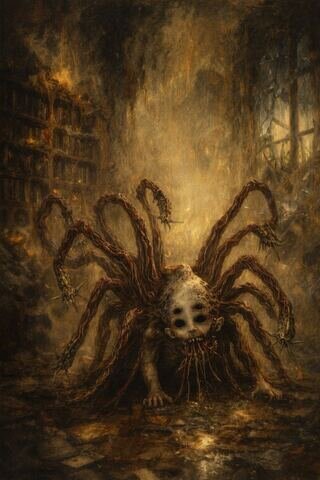
What stood there had no true weight, no substance proper to flesh—yet it moved. Twelve limbs unfolded from it, jointed and alien, scraping air and marble alike. From its center fell a colorless acid that hissed and ate through stone as though through parchment.
Upon it remained a human head.
The mouth stretched wide beyond nature. A long tongue tasted the air. Six eyes opened across the face—ordered, numbered, unblinking. There were no pupils.
Only count.
Caesar himself raised his blade.
It meant nothing.
The thing did not strike. It did not flee. It merely existed, filling the chamber with the certainty that it should not be.
By dawn, the palace wing was sealed.
The Dentist and the soothsayer were found dead where they lay, their mouths burned from within by the same formless acid, as though something had spoken through them once more—and taken payment.
No teeth were recovered.
The child’s chamber was bricked shut. Its doors bound. Its name erased.
Official record spoke of illness. Of loss. Of a son who never lived.
Yet servants swore that in the deep of night, from behind the stone, there rose a sound—
a soft grinding, like teeth pressed together in thought.
And Rome learned, too late, that fate suffereth no correction.
It only changeth the shape of its punishment.







![[Moving to Galatea] What We Never Healed](https://cdn-gcs.inkitt.com/vertical_storycovers/ipad_b00b828931c645f2eccdf3396cb15498.jpg)