
The Command
CRACK
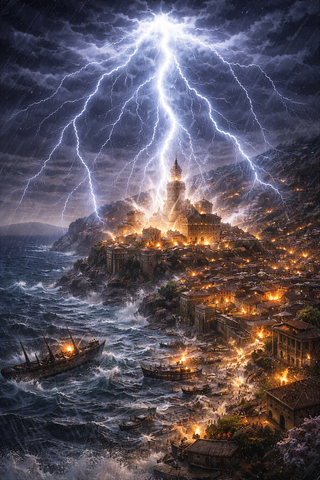


The sea did not calm when the lightning struck.
It rose instead—black water folding over itself, wind shearing the crests into white ruin. Ships clung to the harbour like broken teeth, ropes screaming as waves slammed the stone piers. Above it all, clouds pressed low and bruised, the sky swollen with violence that refused release.
Ares stood at the edge of Olympus and watched it happen.
Not for the first time.
Not with surprise.
Storms had become fashionable lately. Divine displeasure, made theatrical. Poseidon favoured spectacle—loud, wet, relentless. Zeus allowed it. Encouraged it, even. The sea god’s anger had been fermenting for years, but this place—this narrow stretch of coast with its stubborn walls and breathing streets—had become the focal point.
A kingdom that should have drowned by now.
It hadn’t.
Thunder cracked again, closer this time, rattling the marble beneath Ares’ feet. He didn’t move. He never did when the sky tried to remind him who ruled it.
Five years of this.
Five years, and still the city breathed.
Ares stood at the edge of Olympus and watched the coast endure.
Not with awe. With suspicion.
Poseidon’s hand was obvious—every crashing wave, every tide dragged too far inland. The sea god made no attempt at subtlety. But the storm overhead carried Zeus’s signature: thunder too deliberate, lightning placed like punctuation. Even the clouds felt arranged.
And beyond that—
The land itself failed in quieter ways.
Fields inland withered under Demeter’s attention, soil turning stubborn and thin. Crops struggled despite the rain. Apollo’s light scorched instead of warmed, days burning too long, nights arriving sharp and cold. Illness crept through the city in brief, punishing waves—never enough to finish it. Just enough to weaken.
Athena, at least, did not bother with pretence. Trade routes collapsed under her watchful silence. Allies hesitated. Messengers went missing.
Pressure from every angle.
Still, the kingdom stood.
“You’re staring again.”
The voice reached him without echo.
Ares didn’t turn. Below, the sea hurled itself against the cliffs and failed—again—to take them.
“I’m counting.”
Zeus came to stand beside him, calm as carved marble. Gold eyes, immaculate composure—divinity worn like a perfectly tailored cloak.
“Counting what, exactly?”
Ares kept his gaze fixed on the shoreline. “How many Olympians it takes to break one city.”
A pause. A flicker of amusement at the corner of Zeus’s mouth.
“You exaggerate.”
Ares let the storm answer for him: thunder, close and impatient, rattling the marble beneath their feet.
“Poseidon drowns them,” Ares went on, voice dry. “Demeter starves them. Apollo burns and sickens them. Athena isolates them.” His head angled slightly, not quite looking at Zeus. “And you… you allow it.”
Zeus’s smile held. Unoffended. Almost entertained.
“You make it sound coordinated.”
“Isn’t it?”
Lightning split the clouds again. For an instant, the coastline lay bare—walls scarred but intact, towers leaning yet unfallen. The sea surged, shattered stone, then slid back as if yanked away from its prize.
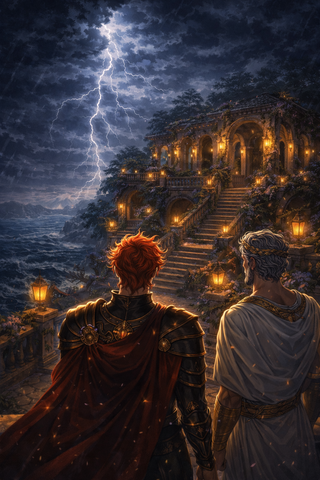
“They’ve adapted,” Zeus remarked. “That isn’t divine.”
“No,” Ares murmured. “It isn’t.”
Down below, fires still burned in courtyards sheltered by stone. Bells rang—warning, not prayer. People moved through the streets with practiced urgency. Not panic. Endurance.
Zeus shifted his weight, as if the conversation bored him. “You’re being sent.”
Ares exhaled through his nose. “To investigate the anomaly.”
“Yes.”
“And Poseidon?” Ares asked. “What does he think he’s punishing?”
Zeus tilted his head, as though browsing memories.
“You know the story.”
“I know rumours. Demigods die all the time.”
“Not like this.”
A wave climbed the cliffs and cracked against the rock face. Spray arced like shattered glass. The water drew back again—unwilling.
Ares’s jaw worked once, slow. “Two of his sons. Killed on that coast.”
Zeus laughed.
Not cruel. Dismissive.
“You think this is grief?” Zeus’s eyes gleamed. “You think Poseidon has spent five years howling at the sea because he loved them?”
Ares watched the water recoil, again, as if it had been denied by something it couldn’t name.
“I assumed losing both sons in one place might irritate him.”
Zeus’s amusement sharpened, then thinned. “Poseidon isn’t sentimental.”
“Then why?”
The laughter died without ceremony. Zeus didn’t answer immediately.
That was the crack.
“They weren’t slain by Olympians,” Zeus finally replied, tone light but precise. “Nor by mortals.” His gaze drifted back to the coast, as if it might look up and speak for itself. “Whatever killed them did not answer to Olympus.”
Ares turned fully now.
“And it happened there.”
“Yes.”
Thunder rolled low and long, as though the sea listened closely.
“Eris,” Zeus added, almost casually. “She rules openly. No disguises. No prayers. No supplication.”
“That alone would offend Apollo,” Ares muttered.
“And Demeter.” Zeus’s mouth curved again. “Athena finds her irritating.”
Ares gave a short, humourless breath. “Of course she does.”
Zeus stepped closer. The air hummed, the way it always did when power pressed near power.
“The point,” Zeus continued, “is that something on that coast survives what should have erased it. Something that did not protect Poseidon’s sons—and yet denies him his revenge.”
Ares looked down at the battered kingdom.
At the lights that refused to go out.
At the city that endured under a sky determined to crush it.
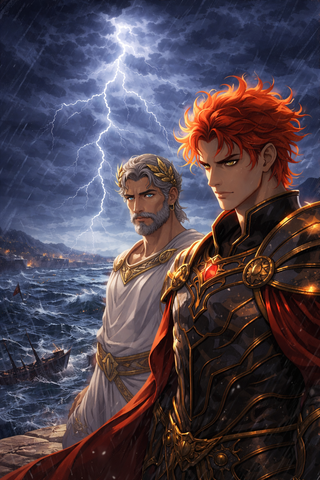
“You want me to see whether the anomaly is with her.”
“Observe,” Zeus corrected. “Report.”
“And if it is?”
Zeus’s serenity returned, smooth and merciless. “Then we decide what to do about it.”
Ares felt it—the tightening in his chest that came before war. Before choice.
He stepped forward.
“I’ll go.”
Below, far from Olympus, Princess Eris of the little kingdom of Erynea stood within her walls as the sea raged against her gates.
The Olympians pressed in from every side.
And still—
The kingdom lived.
For now.









