
The Question That Couldn’t Be Asked
Chapter 1 — The Forbidden Question
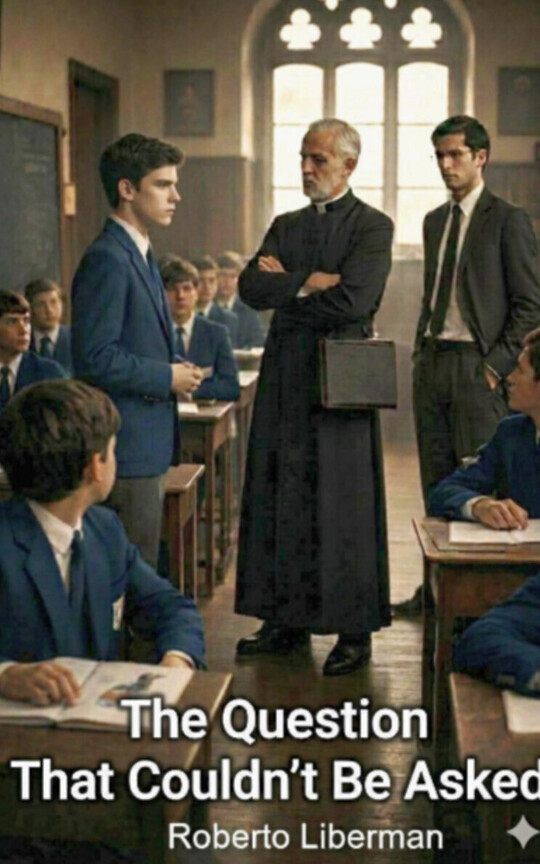
The classroom was unusually quiet that morning—not with the calm of routine, but with expectation. Notebooks lay open on the desks, pencils rested between fingers that hesitated to move, and even the scraping of chairs had stopped earlier than usual. The boys seemed to be waiting for something, though none could have said what.
At the back of the room, beside the window, Father Felipe sat watching. He did not interrupt, did not take notes, did not even shift in his chair. He simply observed with the stillness of someone who turned every word spoken in the room into a matter of record.
Professor Jaime Guzmán placed his papers on the desk and drew a slow breath. He had rehearsed the lecture carefully. Every sentence had been weighed beforehand, stripped of anything that might suggest enthusiasm or invite further questions.
“Today,” he began calmly, “we will discuss Alfred Russel Wallace—the naturalist who, independently of Charles Darwin, arrived at the same theory of evolution.”
A few students looked up.
“Charles Darwin worked in England. Wallace conducted his research in the Indonesian archipelago. They lived on opposite sides of the world, yet both arrived at remarkably similar conclusions about the natural world.”
Some boys copied the title in their notebooks with mechanical discipline. Others listened without writing, as if uncertain which words might later matter.
Guzmán continued cautiously.
“Their observations focused on variation among species—particularly birds found on islands separated by small distances.”
Differences in beaks. Wing shapes. Feeding habits.
The words were safe, descriptive, harmless.
From the back of the room, Father Felipe remained silent.
The lesson progressed with near ceremonial calm until a hand rose. It was Rafael Ernesto Larrain. His gesture was impeccable, unhurried—marked by the ease that came with his illustrious surname and the quiet security of his family’s generous donations. He knew he could ask without consequence.
Guzmán felt a knot tighten in his stomach as he glanced toward the back of the classroom.
Felipe tilted his head slightly. Permission.
“Go ahead, Rafael,” Guzmán said.
“Professor,” the boy began politely, “I was just wondering about these two scientists.”
“Yes?”
“If Darwin and Wallace believed species changed over time… how did they know that if they never actually saw it happen?”
The room grew still.
“And,” Rafael continued, “when we speak about evolution… how much time are we really talking about?”
For a moment, Guzmán considered answering. Then Father Felipe rose.
“An excellent question, Rafael,” he said softly.
The answer no longer belonged to Guzmán. Felipe walked slowly among the desks, his pace deliberate.
“Scientists do not need to have seen an event firsthand to study it. A historian need not have witnessed the fall of Rome, nor need a judge have witnessed every act he must judge. One observes patterns, similarities, variations; from these, hypotheses are formulated.”
He paused by Rafael’s desk.
“But remember this, young Larrain: a hypothesis, however clever, is not truth. It is merely a human attempt to understand a creation that surpasses us.”
He raised a hand, marking an invisible boundary.
“As for time, we speak of vast periods. Beyond a single life, beyond a generation. Scales only God fully knows.”
Rafael nodded, and the room relaxed just enough to breathe—but caution lingered in every mind.
Guzmán returned to his notes, determined to continue.
Then another hand rose—firm, not timid. Fernando Pereira—a scholarship student in a school where surnames carried more weight than grades. He knew he was crossing a threshold.
“Professor,” he said, “is it true Darwin kept his manuscript unpublished for years for fear of the consequences? Of public rejection, of ridicule… and of hurting his deeply religious wife?”
A murmur rippled through the room. Not curiosity—alarm.
Guzmán felt a shiver and opened his mouth—only for Father Felipe to interject, calm but unmistakably sharp:
“Mr. Pereira Pereira, do not expect the same indulgence from me that I might grant some of your more privileged classmates.”
The silence tightened.
“Your double surname,” he continued, “makes your presence in this room seem anomalous to many. Only a few years ago, without a properly registered ecclesiastical marriage certificate, you would not have crossed this threshold, let alone been allowed to hear theories that only Intelligent Design makes comprehensible.”
Fernando straightened, his face burning with shame and rage.
“With all due respect, Father,” he replied, “I am here on the direct recommendation of the Cardinal of Santiago, His Eminence Juan Francisco Errázuriz del Río.”
Felipe took a step forward, his calm glacial.
“An influential recommendation may open doors,” he said, “but it does not entitle you to arrogance or to question what is sacred here.”
Fernando tried to add something about his baptismal certificate.
“That document,” Felipe interrupted, “may not meet this institution’s standards—especially when it comes from parishes where ecclesiastical supervision has been… lax.”
The room fell still. Felipe turned to Guzmán as if nothing had happened.
“You may continue with the lesson, Professor.”
Guzmán obeyed. He resumed speaking. But the class had ended the moment Fernando asked.
It was no longer about Darwin.It was about place.About hierarchy.About making every student understand, even if only dimly, that curiosity was not rewarded here. Prudence was. And, above all, lineage.
Chapter 2 — The Tightrope
Throughout the semester, biology classes at Holy Cross Academy had felt like a tightrope walk. Every word had to be weighed, every gesture restrained. The boundaries were invisible but strict. The curriculum required Darwin, but only as a historical footnote. Evolution could be mentioned, never embraced. The origins of life belonged to Scripture—fixed, unquestionable, sufficient. Any deviation was imprudent; any enthusiasm, suspect.
Professor Jaime Guzmán had understood this from his first day. Entering the classroom felt like speaking softly in a sleeping house—one wrong word could awaken the wrong person. The students sensed it too—a tension they could not name, yet felt pressing down on every gesture, every line they copied. They sketched diagrams, memorized dates and names, but intuited that something remained unsaid, something their teacher kept carefully out of reach.
While describing the Beagle’s voyage or Darwin’s discoveries, Guzmán often felt Father Felipe’s gaze from the back of the room. Not stern, not hostile—worse: evaluative. Biology could describe wings, bones, beaks. It could not suggest a world explained without God’s hand.
The professor adapted. He spoke of variation, not transformation. Guzmán noted differences among island birds as curiosities, never as evidence. Lessons informed without inviting questions. And yet, each measured phrase felt like a betrayal of the science he loved.
One evening, after the students had gone, Guzmán lingered in the empty classroom.
He thought of his years in Europe: libraries in Madrid, debates in Paris, discussions of Darwin, Mendel, DNA—the freedom to question, to err, to disagree. Guzmán had returned to Chile hoping to bring some of that freedom into his classroom. Here, the air felt thick, almost suffocating.
“How much of myself remains in these lessons?” Guzmán wondered. “At what point am I teaching biology, and at what point merely obeying?”
The professor walked to the window. The courtyard below was orderly, polished, harmless—but he knew order was a thin varnish over fear and obedience. Every notebook, every unasked question: evidence of curiosity tamed.
Alone, something stirred inside him. Not rebellion. Not courage. Something smaller, fragile, persistent: a question he did not yet dare voice but knew he eventually would.
Chapter 3 — After the Question
The bell rang with a sharp crack, yet no one moved. At Holy Cross Academy, leaving the classroom was always orderly: immaculate uniforms, measured steps, restrained voices. Rafael Ernesto Larrain was the first to stand, gathering his notes with practiced precision.
As he passed Fernando’s desk, their eyes met for a brief instant. No words, no gesture of solidarity—just a flicker of recognition, enough for Fernando to feel that, for a moment, the barrier of privilege had thinned.
Fernando remained seated a moment longer. His face still burned with shame and anger at the meticulous cruelty with which Father Felipe had exposed him. He collected his notebooks slowly, controlling each movement. Any careless gesture could become the pretext the school needed to humiliate him again.
Outside, the courtyard felt strangely subdued. Groups of students clustered near the columns, speaking in low voices.
“Pereira crossed the line…”
“You don’t ask things like that here.”
No one mentioned the question itself. Only the boldness. Only the violation of an unspoken order everyone had learned to respect.
Fernando leaned against a brick wall and opened his notebook. Inside was a loose sheet with the bird he had drawn earlier. He wasn’t studying; he took refuge in the drawing. The graphite wings obeyed him. The rest of the world did not.
From the second floor, behind the glass, Guzmán watched. He saw Fernando standing alone against the brick wall, while Rafael drifted away with his group and the other students stood under the arcade, their voices low with uneasy curiosity. He felt the urge to go downstairs, to say something—anything—to reassure Fernando that he had been right to ask. But then he saw Father Felipe’s silhouette appear in the opposite corridor, moving with the same glacial calm that seemed to turn every hallway into a place of judgment.
Guzmán stepped back from the window. He closed the curtains with a quick, almost instinctive motion, as if he needed to erase the scene before it could implicate him. In this place, sympathy could be mistaken for defiance, and defiance was never forgiven.
Recess passed without soccer matches, without laughter. The students had learned the lesson: at Holy Cross Academy, some questions did not belong to them. And those who understood this earliest were the ones who endured.
When the second bell rang, Fernando lifted his pencil from the graphite sketch of the bird. His hand trembled as he loosened his grip. He snapped his notebook shut.
He did not seek Guzmán’s gaze; he expected nothing from anyone. He walked back toward the classroom, knowing that, from now on, his curiosity would have to learn how to survive in silence.
Chapter 4 — The Reorientation
The teachers’ lounge was empty, holding only the faint scent of reheated coffee and the echo of footsteps fading down the corridor. Afternoon light filtered through the high windows, catching dust motes drifting lazily in the air.
Professor Guzmán closed the door behind him and set his notes on the table. Beside them lay Fernando’s sketch. Something about it had struck him, and he had kept it. He had hoped for a moment alone—just enough time to steady himself after the morning’s class. Fernando’s question still echoed in his mind, along with the humiliation that had followed. The boys had left shaken; he had left feeling complicit.
He looked down at the sketch.
The bird’s outstretched wings were drawn with precision and patience. The graphite lines were careful, almost reverent—a quiet act of curiosity in a place where curiosity had to disguise itself as obedience.
The door opened again. Father Felipe entered without haste, closing it with the same measured care he brought to every gesture. He removed his gloves and placed them beside the sketch.
“Interesting work,” he said, eyes still on the drawing.
“It’s one of the students’ observation exercises,” Guzmán replied, trying to keep his voice steady.
The priest nodded. “The boy has patience.”
A silence followed—long enough to feel intentional.
“You seemed… hesitant this morning,” Felipe observed.
“The class was becoming restless,” Guzmán answered carefully.
“Yes,” the priest continued, tapping the drawing lightly with one finger, “the boys have been asking more questions lately. Increasingly… uncomfortable ones.”
His gaze remained on the paper.
“Curiosity is not always harmless, Guzmán. In young minds, it grows faster than discipline. And some questions are not born of curiosity, but of provocation. You know what that implies.”
A tightness gathered behind Guzmán’s ribs.
“The lectures on Darwin will continue,” Felipe added as he examined Fernando’s sketch. “We will not retreat. That would make us appear weak.”
Guzmán nodded, though the words landed like a blow.
“But they will be… reoriented.” Felipe fixed his gaze on Fernando’s drawing.
“Toward the beaks of birds. They will draw exactly what Darwin observed on the islands: curvature, length, thickness. With absolute precision: graphite on paper, attention to every detail.”
He paused.
“They will believe they are studying evolution, but they will only be drawing beaks.”
A chill ran through Guzmán. “Reorientation” was a euphemism—curiosity reduced to mechanics. Questions reduced to lines. His classroom, his students, his vocation—all confined to graphite and order.
“And the questions?” Guzmán said quietly.
Felipe’s expression did not change. “Questions are rarely the problem. The problem is what they awaken.”
The priest moved toward the door, slipping his gloves back on.
“Oh, and the Pereira boy…” he added without turning. “You would be wise not to encourage his enthusiasm.”
A pause, hand on the doorknob. “I trust your prudence, Professor.”
As the door clicked shut, the silence returned—heavier than before. Guzmán remained seated, staring at the wings on the page. Each line suggested a question that could never be asked.
Guzmán slowly set the sketch aside and listened to the silence. Somewhere in the building, a door slammed, footsteps echoing faintly down the corridor.
Reaching for the pencil beside the syllabus, Guzmán drew a small, sharp arc in the margin—the unmistakable curve of a beak.
A quiet pact with that forbidden curiosity—and with the boy whose hands had drawn the wings.
Chapter 5 — The Lesson Plan
Later that afternoon, after the last student had left and the echo of footsteps had faded down the corridor, Guzmán sat at his classroom desk. Outside, the sun sank behind the hills, spilling an amber glow across the terrace. Shadows stretched long across the stone walls, as if Holy Cross Academy itself held its breath, waiting to see what the teacher might do after the final lesson.
Fernando Pereira’s sketch lay on the desk. Guzmán studied it again: the curve of the beak, the shadow beneath the wing, the insistence of graphite pressed into paper. At first glance, the drawing was exactly what Father Felipe expected: technical, muted, harmless. But Guzmán could read between the lines. There was something more: the desire to understand, not merely to copy.
He walked to the window. From there he could still picture the brick wall where Fernando had leaned during recess, pencil still in hand, struggling to steady himself after his public humiliation. Everything below appeared orderly, coated in the thin varnish of discipline and silence that covered the school. A single question was enough to put it to the test.
The door opened suddenly. It was the head inspector.
“Professor Guzmán, still here?” he said. “Father Felipe asked me to remind you to submit your plan for the upcoming lessons.”
Guzmán nodded without turning. “I know. It’s ready.”
When the door closed, he leaned over the official syllabus, a list of carefully pruned topics designed to leave no room for dangerous questions. He picked up a pencil. In the margin, he wrote a single word—small but firm:
Observe.
It was a reminder to himself: the questions he could not openly encourage still had a place in his lessons. Teaching would mean balancing what was permitted with what could still be suggested, obedience with the audacity to think.
He switched off the classroom lights. The hum of the fluorescent fixture died, and the room fell still.
Walking down the empty corridor, Guzmán felt the weight of the decision settle over him. Each step was measured, restrained, as if even discretion itself could become a subtle form of courage.
He descended the stairs and stepped into the cold courtyard. There were no heroic acts, no speeches. He would not rebel openly. Just a man walking toward the exit, determined not to stifle the questions his students still dared to ask.
He knew that as long as someone still drew a wing with such care, seeking to understand flight, silence could never be absolute.
Epilogue — What Remains
Years later, far from the stone towers of Holy Cross Academy, Professor Guzmán opened a folder he had kept among his exile papers. The edges were yellowed, and the spine was on the verge of giving way, yet the contents remained intact.
Inside lay that drawing: the bird with the curved beak, traced with almost obsessive precision. He recognized it immediately as Fernando’s work.
Guzmán ran his fingers over the texture of the graphite, the shadow beneath the wing, and the insistence of each line. It was neither a masterpiece nor an act of open defiance. It was a remnant of curiosity that had survived the enforced prudence of those years. It brought back Fernando’s flushed face, Father Felipe’s icy gaze, and that small, silent gesture with the lesson plan—the word written in the margin, a reminder he had left for himself.
He paused to think of his students. Of Rafael, with his measured yet genuine questions; of Fernando, who had learned too early that certain knowledge had to be handled with care. He thought of himself, too—of what he had left unsaid, what he had only hinted at, and what he had never dared to say.
The country had changed since then, but Guzmán knew that some silences never truly disappear—they transform, they adapt, and they find new ways to persist. And alongside them, curiosity endures. That faint, fragile interest had passed from one mind to another, resisting fear and surveillance.
Guzmán looked out the window at a landscape no longer defined by the hills of Santiago. He felt no nostalgia—only a quiet certainty: his time in that classroom had not been in vain. Not for what he had managed to teach, but for what he had refused to let fade.
He closed the folder and held it for a moment between his hands. Then he turned off the light. The room settled into silence. Even hidden in the dark, the graphite seemed alive—as if the spark kindled in that small classroom were breathing, ready to awaken other minds.