
Minimum Friend Protocol. - Ch.01.
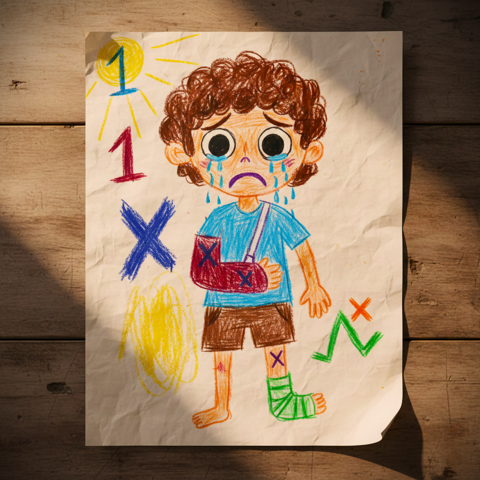


Why does he keep looking at me?
The question ran on a loop while I stood at the curb, sweat cooling into a thin, itchy film under my shirt, my gym bag tugging at one shoulder like it had opinions.
I had finished leg day badly and felt it in my calves, a dull warning that tomorrow would be a negotiation with stairs. The pedestrian light stayed red. The cars did not care about my recovery timeline.
He stood close enough to register without trying, which was already a problem.
Dark hair that refused to behave, falling into his eyes as if gravity had singled him out personally. Round glasses, wire-thin, catching the sun in quick, polite flashes.
A soft mouth that looked like it knew when to keep quiet. A cardigan worn open over a white T-shirt, the kind of outfit that pretended to be incidental while clearly being a decision. He turned forward, checked the road, turned back, checked me, like I was part of the traffic pattern and he was counting lanes.
He looked like he was about to say something, then thought better of it.
I shifted my weight and stared at the signal as if it might speed up under pressure. I did not enjoy being looked at. I enjoyed even less the part of me that wanted to catalogue the looking, file it under something actionable, then pretend it never happened.
He looked again. I shifted my grip on the gym bag like it could keep me busy. The light stayed red.
When it flipped to green, the relief felt administrative.
I stepped off the curb immediately, because standing still had started to feel like consent. He moved with me, close, the side of his sleeve almost brushing my arm. He took the side nearer the cars, which felt chivalrous in a way that annoyed me because I did not ask for it. I told myself to look forward. I told myself to finish crossing.
I remember the sound before I remember the impact. Tires, too fast, too near. The light for the cars was red.
I knew that the way you know a fact while it is already useless. Then there was weight and then there was none, and my body made a decision without consulting me.
The next thing I knew, light pressed against my eyes as if it had hands.
I opened them and regretted it immediately. White everywhere, bright and unforgiving, the ceiling close enough to argue with. My head felt wrapped, heavy, like it had been packaged for shipping. My left arm refused to be part of me. My left leg was suspended and bandaged, held at an angle that suggested someone else had made plans.
“Oh my God,” my mother said, somewhere to my right, already halfway to tears. “He’s awake. He’s awake! Nurse!”
She disappeared before I could orient myself, her voice trailing down the hall like dropped keys. I tried to sit up and discovered I could not. I tried to remember how I had gotten here and found a blank space that felt intentional.
I turned my head and saw the bed beside mine.
There was a guy there. Awake. Brown hair flattened at the back, glasses set slightly crooked now, as if the world had nudged them and never apologized.
His right arm was in a cast. His right leg was elevated, the mirror image of me laid out in medical logic. Two women stood near him, one with her hand at his shoulder, the other talking quietly, her mouth moving with the practiced calm of someone who had been scared earlier and survived it.
A nurse drew the curtain between us with a soft, decisive tug, the sound of privacy being installed. She checked my vitals, asked my name, nodded when I answered correctly, which felt like passing a test I did not remember studying for.
“What happened?” I said. My voice sounded like it had been used recently without my permission.
“You were in a car accident,” she said, calm and efficient. “A car hit you both. You and the gentleman in the bed next to you.”
“Oh,” I said, because my brain was still loading. “Oh. Damn.”
“The doctor will come by later to check on both of you,” she said. “We’re monitoring your concussion. As for him, we’re watching for internal bleeding. Things are contained for now.”
“Am I going to stay here long?” I asked.
“That depends on the doctor,” she said. “We’ll know more soon.”
My mother reappeared like she had been waiting behind the door for her cue. “What did I tell you about crossing the road?”
“Mom,” I said, closing my eyes for half a second to steady myself, “I’m pretty sure the light was green. And I’m pretty sure if it wasn’t my mistake, it wouldn’t have been his either.”
I pointed at the curtain, an accusation by proxy.
From the other side, his voice cut in, polite but firm, like he had already decided how much space he was allowed to take. “Ma’am, I’m sorry to interrupt, but we were crossing at a green light. The driver ran the red.”
“Thank you, stranger,” I said, relief sharpening my gratitude. “See, Mom. I didn’t cross blindly.”
She pursed her lips, which meant she was losing but committed to continuing. “I told you to check anyway. You know how people are. Some people run red lights.”
“Mom,” I said, and tried to keep my tone measured because everything else felt fragile, “I just woke up. I really don’t recall half of what happened. Can you please give me a break?”
There was a pause. The curtain stayed closed. The light kept doing what it did.
Somewhere nearby, machines hummed with the confidence of things that understood their purpose. I lay there, left side broken, head wrapped, thinking about a stranger’s eyes at a crosswalk and how, apparently, they had been the last thing I saw before everything went wrong.
I’m pretty sure I fell asleep for the rest of that day, the kind of sleep that was less resting and more my body hitting “force quit.” I did not check whether the doctor came. I did not even check whether time still worked. I blinked and the hospital did what it does, which was keep existing around you while you tried to catch up.
When I woke the next morning, the curtain between the beds was drawn back.
It felt weirdly intimate, as if someone had filed paperwork overnight and decided we were now allowed to acknowledge each other as real.
The guy from the crosswalk was awake, propped up against his pillows with an e-book reader balanced in his good hand. His glasses were on. His hair still refused to cooperate, like it had survived the accident on spite alone.
I stared for a second too long, because my brain wanted pattern. Same room. Same car. Same red-light runner. Opposite injuries. If we had been a metaphor, it would have been rude.
Trauma bond, I thought, because my mind loved assigning labels to things it could not control, and also because it made the situation feel less random.
I cleared my throat like I had a meeting scheduled. “Good morning.”
He turned his head toward me, unhurried. “Oh. Good morning.”
“What’s your name?” I asked.
“August,” he said.
I nodded. “Pretty name. Nice.”
“Levi,” he said, and nodded back like we were doing an exchange program. “I heard your mom call you yesterday.”
That made my stomach do a small, mean twist, because it implied he had been awake for things I missed. “So you’ve been awake through all of it? Are you alright? I woke up and you were already… up.”
He blinked slowly, like he was sorting through the timeline with the same mild irritation I had. “No, I don’t think so. I woke up at some point, but I wasn’t awake the whole time.”
“Okay,” I said, then felt compelled to keep going, because silence made room for anxiety and I hated giving it real estate. “It’s ridiculous, though. You were the one facing the cars when we crossed—as far as I remember—so it would be really awkward for me to wake up way later than you. You should’ve had the bigger impact.”
August’s mouth lifted, barely. “Yeah. I guess the universe did not consult physics. It’s a good thing we’re both okay.”
“Yeah,” I said. “Exactly. So what are you doing? Reading?”
“Yeah. Killing time.” He glanced down at the screen, then back up. “The doctor dropped by yesterday. He said I can leave in about three days. I think he told your mom when you can leave, too. She’s not here right now. I couldn’t really hear them.”
“That tracks,” I said, because doctors loved talking to whoever looked most awake.
“So you were awake,” I said, half accusing, half jealous, like he had attended a party I slept through.
He gave a soft chuckle. “You didn’t miss much.”
I watched him for another beat, and the memory came back in a sharp, inconvenient flash: him at the curb, turning his head, looking at me, looking away, looking again.
My first instinct was to ask 'why?'
My second instinct was to protect myself from the answer by acting like I did not care.
I chose the second one. It felt safer. It also felt cowardly, which I would unpack later in therapy or never, depending on scheduling.
The room was quiet in that way hospitals loved, the background hum of machines and distant footsteps keeping score. I was just starting to settle into the idea of conversation as a normal thing when the door opened and the temperature in the room changed with a person’s presence.
A tall blond man walked in carrying an absurd bouquet, the kind of bouquet that made a statement before the person holding it even spoke. His hair looked styled in a way that suggested an argument with a mirror had been resolved. He took one look at August and his face cracked open.
“Oh my God, August,” he said, already crossing the room. “What happened?”
He set the bouquet at the edge of August’s bed like it belonged there and then leaned in and kissed him on the lips, quick and familiar and completely unembarrassed.
My body reacted before my brain did. I turned my head away so fast my neck protested, heat creeping up my ears like I’d been caught watching.
It was too early for this kind of information. It was too early for romance, for flowers, for being reminded that other people’s lives continued even in a hospital room that smelled like disinfectant and bad luck.
“What the hell,” I thought, staring very intently at the blank wall like it had an interesting personality.
The blond man sat down beside August, still running on adrenaline. “I didn’t know. I called your mom this morning because you weren’t picking up, and she told me you were in a car accident. How come she didn’t tell me yesterday? I would have come.”
August’s voice stayed calm, like he was talking someone down from a ledge made of feelings. “Daniel, it’s fine. Things happened real quick. Mom was focused on other stuff. She didn’t think to tell you. It’s fine. I’m fine.”
Daniel made a sound that was halfway between disbelief and accusation. Then his gaze flicked, and I felt it land on me, sharp and curious.
I made the choice to look away again, because apparently that was my brand now.
Daniel still spoke, voice cutting through the room. “Were you in a car and it got in an accident, or…?”
August answered before I could. “No. I was crossing the road.”
Daniel’s eyebrows rose. “And a car picked two people up and hit them?”
August exhaled, the tiniest sign of fatigue showing at the edges. “Yeah. It happened that way.”
Daniel stared at him like he was trying to rewrite the story into something that made sense, something that had a villain you could point to and a lesson you could learn.
I lay there with my left side broken and my head wrapped, listening, thinking about how yesterday I had been irritated by a stranger’s gaze at a crosswalk, and now I was stuck in a room with him while his boyfriend showed up with flowers like the world was trying to audition for a drama I did not subscribe to.
And the worst part was, the question from the curb still sat in my chest, stubborn and alive.
Why did he keep looking at me?
It took me exactly ten minutes to turn Daniel and his bouquet into a personal insult.
That was my talent. Give me any neutral event and I could reframe it as a performance review I was failing.


















omg I LOVE when you write rom-coms! I'm so excited for this one. Levi's reaction to the kiss is hilarious, also I know that this won't just be a rom-com, seems like there will be some angst
I love Levi he’s so funny!