What You Sell When You Own Nothing

The knife froze in mid-air, barely a millimeter from the cutting board. From beneath the blade, the juice of a freshly sliced tomato began to seep slowly, very slowly—thick, deep red, reminiscent of blood. It gradually soaked into the wood, leaving dark stains that looked like a new, unhealable scar, reminding me that the marks of guilt remain forever.
The quiet stillness of the kitchen was suddenly pierced by an alien sound—the muffled hum of an engine. Through the cracked window, a sense of unease and heavy air rushed in along with the noise. I lowered my eyes from the knife to see who was there. A black BMW X7 rolled slowly into the yard, like a ticking promise of a threat.
A wave of shivers ran through my body. I knew what this meant. Someone from the agency had arrived.
A tall man wearing a black suit stepped out of the car. His movements were rigid, coldly precise. Without even waiting for the doorbell to ring, I went out into the yard. As the man approached, he held out a black envelope adorned with shimmering silver initials: “A” and “R.”
“A delivery from the agency,” he said dryly.
A moment later, he was back in the car. The engine roared, and the BMW disappeared around the corner as if it had never been there at all.
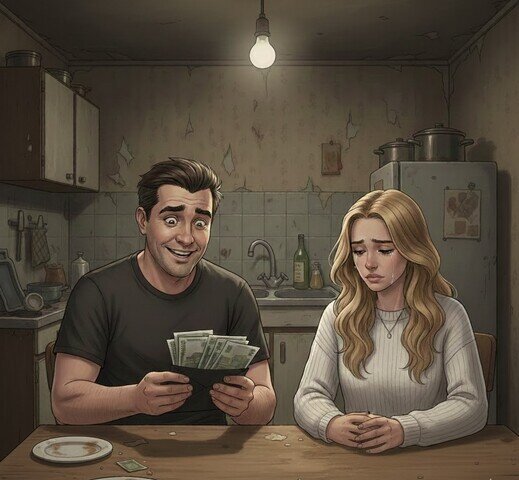
I opened the envelope with trembling fingers, already feeling a familiar chill. It wasn’t just that my hands were shaking; it was the way my eyes widened in disgust rather than surprise at the sight of the envelope stuffed with hundred-euro bills.
This wasn’t the first envelope I had received from the agency. Yet every time I opened one, the trembling would start anew, unstoppable. Each perfectly printed banknote, looking far too clean for such dirty pay, felt like a new scar—a direct reminder of how it had been earned.
“Estela, who was that?” a voice came from behind me, making me flinch. My boyfriend’s voice.
The boyfriend who once used to call me his sunshine. Who once cared if I was cold, if I was smiling, if I was truly happy. Now, he only cares about one thing—the numbers in my bank account. He entered my life back when everything seemed simpler: when the joy of living wasn’t yet measured in euros earned, when I believed that love could conquer all. But that belief had vanished. Only calculation remained. Sometimes we don’t exchange more than a few sentences all day. Our relationship has been like this for six months—more like two roommates living together than a couple who once cared about each other’s dreams.
Laimis is a heavily built man, seemingly reliable at first glance. Broad shoulders, dark, neatly trimmed hair, and eyes that are somewhat tired but haven’t lost their cunning. Once, his gaze meant tenderness. Now, it means control. His smile doesn’t warm you; it serves as a sign:you belong to me.Beyond that, he is cynical to the point of being cold—he never speaks of feelings anymore, unless those feelings are for euros. And the further we go, the more I feel that in his eyes, I am not a person, but an investment. He has become a man to whom numbers are more important than heartbeats.
Moreover, he has recently started drinking. At first, it was just a glass of wine in the evening to relax after work. A seemingly innocent ritual. But that evening wine quickly turned into whiskey. And whiskey became his new best friend—one that increasingly triggers an anger that more often than not falls on me. Not with blows, not yet. For now, it’s only contempt, sarcasm, and remarks that cut deep into my heart.
“Do you hear me, Estela? Who came by?” the second question came, now right by my ear.
“From the agency. They brought the money for the last job,” I said dismissively, tossing the envelope onto the table in front of Laimis.
As he opened the envelope, he raised an eyebrow impressively.
“Good girl, Estela. If you keep working this hard, we’ll be out of this hole in no time. You’re a real pro! Look at all this cash you raked in! If you tried even harder... you could earn even more.”
His words sank deep, but they didn’t even hurt anymore. They simply suffocated me. As if I were trapped in a room without windows. As if there were no air.
There was no jealousy in his voice, no concern. Only numbers. Money. He doesn’t care what I have to do for those envelopes—he only cares that there are as many as possible.
I felt tears begin to well up in my eyes. Not from sadness—but from a hatred for myself... and for him.
“I’m... going to the shower,” I forced out and bolted from the kitchen before he could utter some typical remark about whining like a little girl.
I locked myself in the bathroom, turned on the water, and collapsed onto the cold tiles. Salty helplessness began to flow down my cheeks. My thoughts drifted back to the day I crossed the agency’s threshold and cursed it.
I believed it would be a way out. Now I know—it was a trap. And it all started so innocently.
- - - - -
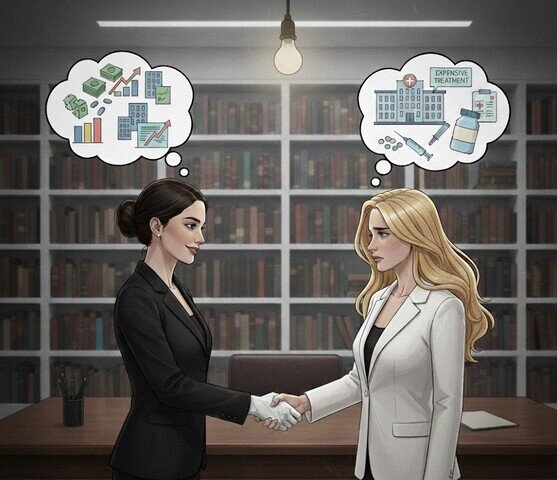
My coworker Rūta once saw an ad on Telegram for “The Golden Circle” agency, which, according to her, paid a ton of cash just for looking pretty. Normally, I would have laughed it off and called her naive. But then... it had been barely a week since my mother’s diagnosis and the conversation with the doctor about her very expensive treatment. At that moment, I had no other choice; I had to take care of my mother, and doing so on a waitress’s wage would have been impossible. I asked Rūta to forward the link to the ad, and a few days later, I walked through the agency’s doors.
The agency building stood away from the city’s busiest streets, as if intentionally hidden from prying eyes. At first glance, it might have seemed quite ordinary—a three-story brick building with a dark grey facade. No signs, no bright markings. Only heavy ebony doors with a golden handle, whose brilliance seemed to intentionally contrast with the building’s reserved, grey exterior. The windows were high but covered with thick, dark curtains, so not even a silhouette could be seen from the street.
Standing before those doors for the first time, the building left a dual impression on me. On one hand, it was alluring and exciting—as if whispering a promise of another, more beautiful life. On the other, it radiated a coldness that even the golden handle couldn’t mask.
After hesitating for a moment in front of the building, I realized there was no turning back, so I took a deep breath and resolved to step through the heavy, imitation-ebony doors, turning the cold, gold-colored handle. Deep in my heart, I knew that by opening those doors, I was stepping not just into an office, but into another world.
And so it was... Inside, I was met by a silence so clean that I could hear my own heart thumping. The floors were covered in a rich navy carpet. The walls were adorned with expensive, minimalist paintings—abstract blots that seemed to reflect both luxury and a chaotic, incomprehensible nature. The air smelled of vanilla, expensive perfume, and something metallic, as if a strict order had impregnated every object there.
In the center of the room, behind the reception desk, sat two girls. They were so flawless that I felt as if I had walked into a fashion show. Blonde hair, sharp suits, dark red lips. One raised an eyebrow; the other noted something in a leather binder. At that moment, I realized—here, every move you make is judged, weighed, and scrutinized.
“Hello... I’m here for the job interview,” I stammered, hearing my own voice tremble.
Before the girls could even respond, a woman appeared from a glass office. Her footsteps echoed across the carpet like a metronome. She was about forty, her hair pulled back into a severe bun, her black suit framing her every movement with a sense of order. She looked at me with eyes that didn’t just look at you, but pierced right through you.
“Follow me,” the woman said in a cold, emotionless tone.
Struggling to control my trembling legs, I hurried after her into the office. It resembled a museum hall. Soft white sofas lined the edges, a glass table sat in the middle, and behind it, a bookshelf filled with volumes on business, art, and philosophy. Everything glistened. That shining luxury was so sterile it took my breath away.
The woman gestured toward a leather armchair, walked around the table, sat down across from me, and opened a black notebook.
“Estela, is it?”
I nodded. My hands gripped my purse so hard that my fingers turned white. The woman began flipping through the pages of the notebook intensely, and once she found the right page, she started reading closely. From the corner of my eye, I saw my resume lying before her, marked with notes in red ink.
After a few minutes of tense silence, the woman raised her head and looked at me as if every detail—a strand of my hair, the movement of my hand, or even the pace of my breathing—could be the reason for her decision.
“I am Mirela. The head of this agency. Tell me, why are you here?” her voice sounded calm.
“I... I need the money,” I murmured, feeling my voice quiver.
“Money is only a means, not the end,” she said, her lips curling almost imperceptibly. “And what end do you see?”
I swallowed hard.
“I want to... provide my mother with the treatment she deserves.”
Mirela briefly lowered her eyes to the notebook, writing something down.
“That is noble. But nobility doesn’t help here. Let me ask you differently: what will a man get from you that he wouldn’t get from any other girl working at this agency?”
I didn’t know what to say. I repeated her question in my mind and finally whispered:
“I know how to listen. Not just to hear, but... to listen.”
The woman watched me for a long time. It felt as though she was trying to drill into my soul to find out if I was lying. Finally, she gave a slow nod.
“Interesting. Many come here with the idea that men only care about the body. But sometimes men just need ears and silence. A girl working for us must be beautiful, but she must also be a mystery and an intrigue that a man is willing to pay a substantial sum of money for.” Her voice was cold. “True, your appearance is suitable for the work.”
In fact, I was a beautiful girl—I had known that since childhood, when people on the street would secretly steal glances at me. My height always caught the eye—tall and straight as a string, as if designed to wear dresses that fall to the ground and flutter in the wind. My figure was slender yet feminine. Long legs, narrow hips, a subtly defined waist—as if someone had sketched me according to an old, classic model type. My hair was blonde, falling to the middle of my back. My eyes—large and blue. I often heard that my gaze wasn’t just beautiful, but transfixing. My features were symmetrical, but not perfect. Sharp cheekbones, a straight nose, and lips—a bit fuller than modesty required. They were usually what drew people’s eyes. When I wasn’t smiling, they looked stern. But when I did—it was almost dangerous.
“Have you read the contract?” Mirela asked suddenly.
“Yes. And I’ve set three boundaries,” I admitted, feeling sweat run down my back.
She narrowed her eyes.
“Bold. Such girls usually don’t earn the most. But sometimes they are the ones who last the longest.” Mirela leaned back in her chair, her long nails tapping quietly against the table surface. “Answer me one more question: what will you do if a man tries to cross those boundaries?”
“I will say no. And I will stand by my word,” I answered, a bit more confidently now.
Mirela’s eyes narrowed further, but a faint tone of something resembling respect finally appeared in her voice.
“Bold. Most girls just nod and agree to everything. At least you have a backbone. We’ll see if you can keep it later on.”
And then she reached out her hand. Her palms were cold, like marble. As I shook it, I realized—I had just closed a door behind me that had no handle on the other side.
- - - - -
Remembering that first meeting with Mirela, I felt a knot tighten inside me. Back then, I thought I knew what I was doing. That I was in control. That it was temporary. That I just had to endure it for a little while. Endure it until I earned the money needed for my mother’s treatment.
Now I know—once you cross the threshold of that agency, there is almost no way back.
Mirela had pointed out that such girls usually don’t earn the most, but I didn’t care. I didn’t go there for fame or greed. I only cared about one thing—my mother, her procedures, and the medications that could extend her life.
So, I remained merely an ornament. A beautiful accessory beside wealthy men, most of whom were over fifty. They wore expensive suits, drank whiskey that cost more than my monthly rent, and looked at me as if I were an object, not a human being. They didn’t needme; they needed what I could perform: a smile, a warm gaze, a patient nod. There were those who would talk for hours, wanting to pour out their souls: failed marriages, wives who could no longer satisfy their needs, children who spat on their authority. They would pour their resentment and bitterness into me, and I became a silent listener—a mirror reflecting their loneliness. And even though I felt a little dirty every time, I tried to remind myself: it’s just a job that adds a few thousand euros to my pocket in a single night.
The rushing water in the bathroom brought me back to reality. Steam rose and mingled with my breath—short, muffled, and heavy.
I am still here. Still in the same apartment. Still with the same man I don’t love. Still dependent on the agency whose doors I once walked through on my own two feet, and now, it seems, I am crawling through on all fours.
I sat huddled on the bathroom floor. Tears flowed down my cheeks—quietly, soundlessly. They fell one after another, as if they had decided I no longer belonged to myself.
And I thought about those twenty-one men—my clients. Every single one of them. Their hands stroked, their smiles enticed, but to me, they were just work... Yet I knew that somewhere between their gazes and the banknotes, somewhere between the glass tumblers and the silent nodding—I was slowly losing myself.
And more and more often, I began to think...
...what if one of my three boundaries is crossed one day? What will be left of me then? Will anything be left at all?