
Chapter 1


Near Lewes, Sussex, November 1066
Sending the garrison out had been a mistake.
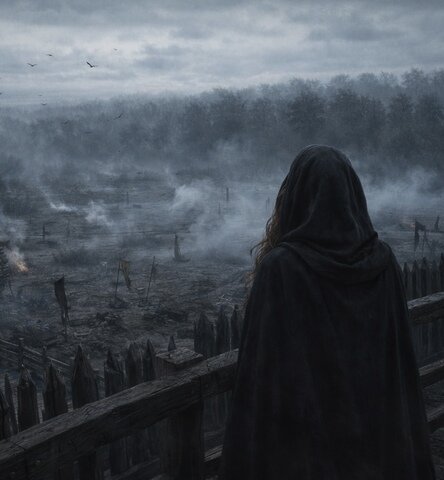
Ailith of Blackmere stood in the shadowed walkway above the gatehouse, looking down at the proof of it. The dying sun caught the ground below in eerie streaks of rust and old gold, clinging to torn banners and useless armour. Low fires still smouldered where fighting had burned itself out, smoke drifting aimlessly, thinning as it sank and spread, as though the ground itself were breathing it away. The smell of pitch reached her even at this height, and beneath it, the sweeter taint of blood and torn flesh.
Nothing before her moved as it should. The fields lay wrong, arrested mid-gesture, livestock roaming among men scattered where they had fallen, as if death had dropped them and forgotten them again. Broken shields and spears leaned at obscene angles. Limbs lay bent where they should not bend. One body lay half-turned toward the castle, mouth open, as though the man had meant to call out and never quite remembered why.Near the gates, just below her, anotherlay on his side, hair lifting and falling again in the faint breeze, soft as a caress, the only gentle thing left in a world gone savage.
She drew her hood forwardand steadied herself against the parapets, the chill of the old stone sinking into her palms, anchoring her to the moment. She did not turn away despite the nausea tightening her throat.This was the price of command. This was what her choice looked like when it had finished unfolding. She watched the crows gathering along the ditch and the broken ground beyond it, black shapes against the dimming earth, hopping once, stopping, their heads tilting as they measured the distance between cautionand hunger. Dogs loitered in the distance. Even the scavengers seemed subdued by the annihilation, as though dusk itself had laid a hand on them and told them to wait.
Something beyond the carnage caught her attention. At the forest line, something shifted. The movement was slight, no more than a darkeningbetween trunks, but it caught her eye at once, sharp as abladedrawn across her thoughts. She leaned forward, heart tightening, the world narrowing to that thin seam of shadow.A mounted figure had appeared just within the trees. He was not part of the loose, weary motion around him. He did not bend or dismount or call to anyone. The horse beneath him stood unnaturally still, head lowered, as though it too understood the value of waiting. There was no colour to mark him, no banner, no easy sign to read. She knew he was looking at the castle. At her. Or both. The knowledge did not arrive as a thought. It struck her lower and deeper with sudden, bodily certainty, like the sickening tilt before a fall. Her breath snagged painfully in her chest. Her heart lurched, then began to beat with a violence that startled her, as though it had recognised a danger her mind had not yet named. For an instant suspended beyond time, she did not know whether she had been seen. Then she felt it. Not sight. Attention.
It came with the unmistakable pressure of intimate heaviness, settling over her skin as if a hand had been laid there. The air thinned. She became aware of how exposed she was against the sky, of how foolish it was to remain where she could be measured so easily. She turned abruptly and pressed herself back against the nearest merlon, the uneven stones biting hard into her shoulder. Her hand flew to her mouth. Her breath dragged into her lungs in shallow, uneven pulls. The sound of it filled her ears, fast and feral, a betrayal she could not still. Fool, she thought, with a bitterness that burned. You know better. She stayed where she was for a while, rigid, counting without meaning to, the numbers sliding past without order or comfort. When she looked again, the forest was closing around him. The horse was moving, angled away, the rider turning with it, slipping between the trunks until there was only shadow and bark and the lie of emptiness, as though he had never been there at all. The field below seemed altered by his absence, the stillness sharper now, expectant. She swallowed, tasting smoke and bile and the cold understanding rising in her throat. Her limbs felt strangely unmoored, as though they no longer quite belonged to her.
This conqueror would not leave.
Luc De Morville. The name turned over in her mind with the weight of reputation. Beast. Slaughterer. Bastard. Merciless. Men like that did not look at something and turn away for nothing. He had assessed her. He would come closer, with terms or with steel, and when he did, everything she still held; walls, pride, children, the thin fiction of control, would be taken from her. The thoughts that followed did not arrive as anger or courage or hope. They came as necessity, stark and merciless, the last shape left to her.
If he came, she would not survive him. And because there were other lives bound to hers, the cost of that truth was unacceptable. The thought hardened, settling into her bones like iron. She would have to kill him before he entered her hall.
“My lady.”
“Aye.” Ailith did not turn as Sir Osbert, her castellan, took his place by her side.She had felt him before she heard him, the familiar weight of another presence, a man who had learned when speech only dulled what truth needed to cut.
“We lost most of the garrison.” He did not soften it. “Some of those who came back are severely wounded. Three won’t see morning.” She nodded once. “The gate took the worst of it,” he went on. “The old stones hold, but the timber is split. The crossbeam’s cracked. We’ve wedged it, strapped it where we can, but if they bring the ram again, it won’t stand. Two days, perhaps three, if they mean to finish it properly.”
“And the men?”
“Tired. Angry. They know they were drawn out.”
The words settled between them, heavy with blame he did not voice. He did not need to. She felt it already, sharp as grit under the tongue. “And the stores?”
“Grain for a sennight if we stretch it,” he replied. “Five if the horses eat. Four if the villagers do.”
Below them, scavengers began to descend in earnest, hopping closer to the bodies as the light failed, emboldened by the stillness. For a moment, neither of them spoke. Then Ailith asked, quietly, “What would Edgar do?”
Sir Osbert’s mouth tightened. “He would order another sortie. At dawn. He would tell the men they owed it to the dead to answer blood with blood.”
“And it would cost us what remains of the garrison.”
“Yes.”
“And then?”
Sir Osbert exhaled slowly, a sound close to contempt. “Then he would curse them for failing him.”
Ailith closed her eyes briefly. Edgar, her late husband and Lord of Blackmere, had never understood the difference between courage and waste. He had loved the sound of steel and the look of obedience, but not the people he ruled. He had spent them as though substitutes were endless, as though the walls would always rise behind him to catch what he threw away. “And now,” she asked, barely above a whisper.
Sir Osbert turned to her, his expression stripped of ceremony. “Now we cannot afford to spend what we cannot replace.”
“What would you advise, if I were any other lord?”
He considered the question with care. When he spoke, it was without comfort. “I would advise against another sortie. It will gain us nothing and cost us what little remains. I would tell you to shore the gate, double the watch, and hard ration the stores. I would tell you to keep the people busy mending, carrying, guarding, so they do not start counting the days.”
“And if they press the gate again?”
“Then we hold it as long as we can. And when it goes, we fall back to the hall and make them pay for every step.”
Ailith absorbed this without comment. “And if they offer terms?”
“Then you listen. But you do not answer quickly. Men who come with terms are rarely in a hurry to leave.”
“What if,” she said, as though the thought had only just come to her, “we are wrong about what we’re holding against?”
Her castellan looked at her sharply. “My lady?”
“We speak of the gate,” she went on. “Of grain. Of days. As though time were the thing that will undo us.”
“It is,” he said. “Time and pressure. Always.”
She shook her head once. “No. Not this time.” She turned to him then, fully, and he must have seen in her face that something had already settled there. Not fear. Not resolve, either. Calculation. “I saw him.”
Sir Osbert’s expression changed, not much, but enough. “Who?”
“De Morville. At the forest line. Mounted. Watching.” She did not dress it further. “It washim, I know it was, although he bore no insignia.”
Luc De Morville had been spoken of since the first fires were sighted on the ridge, quietly at first, then with the careful certainty men used when naming storms. Sir Osbert’s jaw tightened. “Then he will press closer.”
“He already has,” Ailith said. “But he will not waste men the way Edgar did. The way we already have. He will not batter the gate until it breaks and hope the rest follows. He will starve us. Measure us. Learn us.”
“And still we hold, my lady.”
She studied him for a long moment. “Not for long.”
“As long as wood and will allow.”
“If he takes this place, he will not leave a living heir behind him. You know that as well as I do.” Sir Osbert’s eyes flicked, briefly, toward the hall. Toward the rooms beyond it. “He will take my son,” Ailith continued, relentless now. “Or he will kill him. Either way, he will make a lesson of him. Men like that do not leave loose ends.”
“You cannot know that,” Sir Osbert said, though there was no conviction in it.
“I can. Because he waited. Because he watched. Because he turned away when he had finished measuring the cost of pursuit.” She drew a breath. “If he lives, we do not.” Silence pressed in around them, and she fisted her hands beneath the folds of her cloak. “I will go to his camp,” she finished with brittle determination.
Sir Osbert stared at her as though she had spoken a foreign language. “No,” he said at once. “No.”
“I will go, because they would not expect danger from a single woman. Tonight. I will not go as a petitioner or a hostage. I will go to end this. To end him.”
“My lady, you will be taken before you reach his tent. Or cut down. Or worse. This is not-”
“This is the only way,” she said, blinking away the sting of tears.
“You are the lady of this place.” Sir Osbert’s voice had turned sharp. “If you go out alone, you undo everything we have left. Your name. Your authority. What the men still believe in.”
“What they believe in will not stop De Morville,” she said. “And my name will not keep Wulf alive.” At that, Sir Osbert went very still. “If I do not return, you hold back. If I am taken, you do not bargain for me. If I am killed, you do not yield.”
“My lady. You are speaking of ruin.”
“I am speaking of the survival of our bloodline.”
“You would make yourself a murderer,” Sir Osbert said. “Or a whore, in their telling, a traitor, even. They will say you crept into his bed or his tent. They will say whatever strips you cleanest.”
“I know,” she whispered.
“You would be remembered for it,” he pressed. “Long after the walls are dust.”
She looked back out over the field, now swallowed entirely by dark. “Then let them remember what they like.”
“And the boy?”
“No matter what happens after tonight, Wulf is never to be spoken of as Edgar’s son. Not to anyone. He is to be called mine. But no more than that. A child born before marriage. A mistake. A mercy, if God wills it. He is to be forgotten, and he is too young to remember. And if I die, you take him and ride hard. North. Ireland. Anywhere far away from the Norman army.”
Sir Osbert’s breath left him slowly. “My lady, your reputation... his... You would strip him of his birthright?”
“I would strip him of a life as hostage. Or death.”
Sir Osbert turned away from her, pacing a few steps before stopping, hands clenched. “This will stain him. And you. There is no clean ending to this.”
“There is no clean ending for this at all,” she replied. “Only one where he lives.”
He searched her face, as though looking for the woman she had been. He did not find her, because she was gone. “This is madness,” he said.
“Yes,” Ailith agreed. “But it is my madness, not his.”
Ailith left the parapet and took the inner stair down, her hand brushing the wall as she went. The old Roman stones were warmer here, thick with the smell of bodies shut in too long and the faint sourness of fear. Below, the yard breathed restlessly and waited.
She crossed it quickly.
Her chamber lay deep within the hall, its door pulled nearly closed against the draughts. Light spilt through the narrow gap like a secret, bearing witness to the life she would die to protect. The bed was already turned down. Wulf lay against her pillow, small and boneless with exhaustion, one hand curled in the linen as though he feared it might slip away. He opened his eyes as she entered, sitting up at once.
“You came back.”
“I said I would.” She sat and drew him close. His thin shoulder pressed sharp beneath her palm, and she anchored herself there, breathing soap and stolen honey bread.
Near the hearth, Eda waited, hands folded in her lap. The old nurse read her face and stiffened. “My lady...?”
“I’m going out.” Ailith kept her voice low.“The Normans’ camp.”
Wulf’s fingers tightened in the fabric of her cloak. “Where is that?”
She bent her head until her forehead touched his. “Not far,” she said. It was not a lie. Not exactly.
Eda shook her head at once. “You can’t,” she whispered. “Not now. Not like this.”
“I must.”
“They’ll know you.”
Ailith lifted her head. “They won’t. I’ll be swift. A man like him will not expect a woman to undo him.”
Eda’s face folded in on itself, fear and protest warring there. “My lady, if you leave the safety of the walls...-”
“If I stay, they will come through the gate.”
“And the boy? You’ll leave him?”
Ailith’s arms tightened around the small body. “Only for a little while.”
“You won’t be gone when I wake,” Wulf asked thinly.
“If I am,” she said. “Eda will be here with you.”
Eda made a sound, half protest, half surrender. “God help us,” she murmured. “What if... What if you are detained?”
Ailith straightened. “Then you will go to Sir Osbert for instructions. If anyone asks, Wulf is mine. Only mine.”
“What do you mean?” Eda stared at her. “You can’t unmake a child’s father...!”
“I can unmake a claim. And that is what will keep him alive.” Wulf did not understand the words, but he understood the tone. He watched her with grave attention, his mouth set.
Eda’s hands trembled. “They’ll call him... And you-”
“Yes.”
For a long moment, Eda said nothing. Then she bowed her head. “Then you’ll not go out dressed as you are. If you mean to do this, you’ll do it properly.”
Ailith nodded once. She bent and kissed Wulf’s hair, breathing him in as though committing him to memory.
The dress Eda brought for her was coarse, made from homespun wool, undyed and uneven in colour. It was the sort worn until it thinned and then worn still. It hung straight from her shoulders, without shaping or seam to guide the eye, the fabric stiff where it had been mended and softened where countless hands had worried it thin. It made no attempt to flatter her. It did not acknowledge she had a body at all, reducing her to a moving mass of shadow. Over it, the cloak sat heavy and wrong, its weight dragging her narrower, pulling her down into herself.
As Eda tied the last knot, Ailith turned toward the pewter mirror. It was old and imperfect, its surface bending the light behind her into shallow waves. It did not offer a clear image so much as a suggestion; a figure caught and altered by the flaws in the surface. Torchlight from behind her muddied the reflection further, drawing shadow into the hollows of her face. She leaned closer. The girl in the reflection was pale, almost colourless, her skin stretched fine over bone. She looked smaller than memory allowed. Lithe, almost fragile, a girl built to pass unnoticed rather than command attention. Her eyes dominated what little of her remained visible, too large, too dark, giving her face a startled, almost feral intensity. Her hair had already rebelled, tight curls escaping along her brow and nape, the colour catching even in this poor light. Not bright, not fiery, but that old, unsettling red, like rust worked deep into earth. It framed her face too softly, making her look more innocent than she was.
It was the face men trusted. The one they underestimated. The authority she had worn for years was gone. It had never lived beneath her shield anyway.
She stepped back and crossed to the chest at the foot of the bed. The lid creaked softly as she lifted it. Inside lay the remnants of a life folded away when she was but a child: a length of linen, a broken comb, a ribbon long out of fashion. Beneath them, wrapped in oilcloth darkened with age, was the dagger. Her fingers closed around it without hesitation. The hilt was worn smooth by hands that were not hers, the leather darkened where her mother’s thumb had rested most often. It fit her palm with an old, unsettling familiarity. When she drew it free, the blade caught the light and held it, not bright, not cruel, but keen. She tested the edge with her thumb and felt the faint bite of it. Sharp enough. Her mother’s voice rose unbidden, low and practical, as it always had.
Don’t swing. Step in. Close. Use your weight.
She fastened the dagger at her thigh, angling it carefully, the way her mother had taught her, where a hand could find it without looking, and a man would not expect it.Behind her, Eda made a sharp sound. “No...” she whispered. “You’re not doing it... I....”
“I am.”
“God above.” Eda let out a short, broken laugh that held no humour. “Your mother would skin you for the recklessness.”
“She would skin me for hesitating,” Ailith said. “Then tell me where to stand.”
Eda’s mouth twisted. “You always did listen to the wrong lessons.”
Ailith allowed herself the smallest, bleak smile. “They’re the only ones that ever worked in my life.”
Eda shook her head once, hard. “You won’t come back clean.”
“I’m not going to him clean, either.” She went to the bed and laid her hand briefly on Wulf’s hair. The dagger rested warm and solid against her skin, no longer memory, no longer inheritance, but a decision with an edge. When she straightened, the last softness left her. “Keep him alive,” she said to Eda. “Whatever story you have to tell.”
Eda met her gaze. “Kill him,” she said hoarsely. “Don’t let him touch you.”
Ailith nodded once, then she went to the door.
The ground beyond the old palisade sloped downward toward the Norman camp, the earth churned and blackened where men and horses had passed too often. Ailith moved low, careful where she placed her feet, the fog thinning as she drew closer to the edge of the fires. The sounds changed here, voices and order, testifying to the quiet competence of men who did not fear the dark.
She paused at the rise of a shallow bank and lowered herself into the undergrowth. Below, tents lay spread in deliberate lines, set with a precision that made her chest tighten. Braziers burned low and steady. Horses stood tethered and calm. Nothing here had the frantic air of exhaustion she had seen among her own men. Near the far edge, where the ground dipped toward the river, she saw movement. At first, she thought it was a trick of the dark, a shadow bending, straightening again. Then the fog shifted, and the shape resolved.
A man was standing at the water’s edge, his back to her. He had stripped off his armour and tunic and laid them with care upon a stone, not flung aside, not abandoned. The firelight traced the line of his shoulders and the length of his spine as he bent to rinse blood and dirt from his hands. He moved without haste, as though nothing here required urgency. She watched, motionless. This was him. It had to be. She recognised the posture, the sharp cut of his jawline. There was no guard close by. No tension in him. He was unarmed and wholly unafraid. When he straightened, she noticed the scars cutting across his bronzed skin, not fresh, not dramatic, but old ones, mapped across him like history. He did not look like a man who had won his title by chance. Her fingers brushed the dagger at her thigh. The wind shifted, carrying the sound of the stream and the low crack of the braziers behind him. De Morville reached for his tunic and drew it on without looking around, as if the dark itself were something he trusted.
Ailith did not move. For the first time since leaving the walls, doubt brushed her, not fear of him, but fear of herself. She understood, suddenly and with chilling clarity, that killing a man like this would not be the hardest thing.
Getting close enough would be.


















I really enjoyed this so far. The historical setting feels vivid and immersive, and the enemies-to-lovers tension is set up in a way that feels earned, not rushed. I love how the aftermath of conquest shapes the characters’ emotions you can feel the weight of loss, pride, and survival in every scene. The writing is atmospheric and emotional, and it pulled me into the world quickly. I’m especially curious to see how the relationship develops across such deep conflict. Definitely a promising start
looking forward to reading more
Looking forward in hearing your thoughts about the feedback