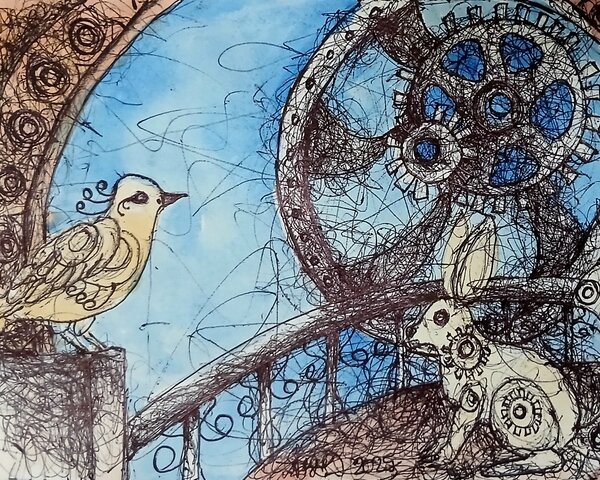
The Hour That Slipped
Dawn arrived over Aetherion like a careful hand pulling a curtain.
From the deck of the flying ship, the sky looked washed clean—pale gold at the horizon, feathering into soft blue where the upper air thinned and brightened. Below, the floating city drifted in its slow, steady rhythm, suspended on engines no one truly understood anymore, held aloft by breath and brass and something older than either.
Steam rose from towers in long, lazy ribbons. Pipes latticed the outer walls like veins, pulsing with warmth. Crystal spires caught the first light and returned it, fractured and gentle, as if the city had learned to glow without bragging about it.
Mechanical birds escorted the ship in loose formation.
They weren’t truly part of the vessel’s crew, not the way ropes and rivets were. They simply… arrived when ships crossed the city’s airspace, drawn by the currents of heat and sound. Their wings clicked as they flew—tiny gear-work joints flexing, feather-plates shifting with metallic whispers. One skimmed close enough that he could see a thin line of etched runes along its throat, the symbols worn soft from years of wind.
The city ahead was waking.
A bell should ring soon.
Far in the distance, rising above the clustered rooftops and arched bridges, the great clock tower stood like a promise everyone had agreed to believe in. It wasn’t shaped like the old world’s towers—not simple stone and hands on a face. This one was built in rings: brass circles stacked within brass circles, each turning at its own pace. A skeleton of iron and glass held it all together, and inside, a lattice of gears moved like an enormous, patient mind.
The tower did more than tell time. It kept it.
Every shift of labor, every opening of gates, every morning market and school bell and airship schedule ran by its chime. People might argue about weather, about politics, about whether mystics were real or just a story used to scare children into behaving.
But nobody argued with the clock.
The ship glided closer. Ropes creaked softly. The engine beneath the deck thumped in its steady heartbeat. Crew voices carried over the morning air in half-murmurs, the tone sleepy but busy. The scent of oil clung to everything—warm metal and grease and ozone from the coils.
He leaned a hand against the rail and watched the city grow larger.
He should have felt wonder.
He did—at first.
Then something in the air shifted.
Not like a gust of wind. Not like the ship losing altitude. More like… a pause. A thin hitch in the atmosphere itself, the way a song stutters when the needle skips.
The mechanical birds reacted first.
Two of them banked sharply and vanished upward, their bodies cutting through the light like blades. Another flared its wings and clicked its beak twice—a sound too deliberate to be meaningless—then darted away from the ship as if it had suddenly remembered something important it needed to do elsewhere.
His hand tightened on the rail.
A tremor moved through the ship—subtle, like a warning passed through the bones of metal.
In the distance, the clock tower prepared to speak.
Aetherion loved its rituals. Six o’clock was one of them. The city’s morning began with that chime. People timed their first breath of work to it like a prayer.
The tower’s rings turned. The great internal mechanism rotated.
And then—
It hesitated.
Not long. Just enough.
A pause that didn’t belong.
The chime came late, clipped and wrong, as if the bell had to force itself to remember how to make sound.
Six.
The note did not carry cleanly. It wavered, then snapped into silence too fast.
On the ship, nobody said anything. No one pointed. No one gasped. It wasn’t dramatic enough for that.
But he felt it in his teeth.
A second later, the engine beneath the deck gave a small cough—one uneven beat—and corrected itself with a shudder.
The city kept moving. Steam kept rising. Bridges held. Airships drifted.
Everything looked functional.
Just… slightly off.
The ship moved over the outer gardens—a network of suspended parks threaded between buildings, green platforms cradled in iron frames. Dew sparkled on leaves. A few early workers crossed a bridge with baskets slung over their shoulders, their breath visible for a moment in the cool morning before it vanished.
In one of the parks below, a small mechanical rabbit hopped along a pathway of pale stone.
It was the kind of harmless invention people bought for their children, or kept in gardens as decoration. A little thing made of polished brass and painted enamel, ears jointed with tiny hinges. It moved in brisk, cheerful hops, stopping occasionally to sniff at flowers it could not smell.
The rabbit paused at the edge of the path.
Its head tilted.
It held perfectly still, so still that the morning light caught on its metal body like it had become a statue.
Then, as if something unseen had brushed past it, the rabbit jerked once—an involuntary movement of gears—and bolted.
It didn’t hop anymore. It ran, metal feet striking stone too fast, cutting across the grass and disappearing beneath a low hedge as if it had suddenly remembered it was prey.
His eyes tracked it until it vanished.
A prickle moved up the back of his neck.
Behind him, something on the ship slammed.
Not a normal sound. Not a casual crew sound.
A heavy impact—metal meeting metal with the sharp finality of a door thrown open too hard.
A voice rose. Another answered. The words were lost in the engine’s thrum, but the tone was unmistakable.
Urgency. Anger.
A third voice—closer—called out, louder than the others, like someone giving an order.
He didn’t turn around.
He didn’t need to.
He already knew, the same way the rabbit knew.
Whatever was happening behind him wasn’t part of the morning ritual.
It was the kind of chaos that wanted a body.
Footsteps pounded across the deck.
The ship’s crew shouted, and suddenly the air felt crowded, charged.
His fingers slid under his coat, touching the hard shape pressed against his ribs. It wasn’t large, but it was heavy for its size—dense, like a secret that had been forged instead of written.
Another slam.
Closer.
A sharp scrape, like something being dragged across wood.
Then the words—clear this time.
“—There!”
He moved.
Not toward safety. Not toward help.
Toward the edge.
The ship was low enough now that the park beneath didn’t look like a distant painting—it looked like ground that would hurt to hit, and fences that could cut, and hedges that could hide.
He stepped onto the rail.
For a half second, the city filled his vision—the tower, the spires, the steam-lit morning—beautiful and fragile and wrong.
A breath.
Then he jumped.
The fall was short, but the impact was not gentle.
Boots struck stone, knees buckled, pain flashed bright and clean up his legs. The world jolted and snapped into sharp detail: the grit on the path, the damp smell of grass, the faint shimmer of steam curling from vents in the park’s metal framework.
Above, the ship groaned forward, and for a moment its shadow swallowed the park.
He didn’t look up.
He heard something else instead.
A sound that didn’t belong in a city waking up.
It rolled across the air like thunder, but it wasn’t thunder. It was layered—something mechanical grinding beneath something that sounded almost alive. A vibration that didn’t come from any engine he knew, threaded with a low note that made the skin on his arms tighten.
Distant, but too close.
His throat went dry.
Somewhere nearby, a gear clicked—one of the park mechanisms shifting position, adjusting for weight. The city was always moving, always recalibrating.
But this click felt like a nervous habit.
He pushed forward.
Run.
The first steps were ugly—painful, uneven—but his body remembered what it needed to do before his mind could argue.
The gears beneath the stone path hummed faintly, a vibration felt through the soles of his boots. Heat from the city’s vents brushed his face as he passed, warm breath against cool morning air.
Behind him, a shout from above.
Not words this time—just the sound of someone realizing what had happened and reacting too late.
He cut across the park, past dew-wet grass, under the shadow of a bridge where pipes ran thick along the underside like iron roots. A few early walkers turned, startled, eyes widening. Someone opened their mouth to ask a question.
He didn’t stop long enough to let it form.
He vaulted a low railing, dropped into a narrow service lane between buildings, and the city swallowed him in a maze of brass and shadow.
The wrong sound came again—closer this time.
And beneath it, faint but unmistakable, the city’s great clock tower clicked once.
Not the steady rhythm of time.
A misstep.
Like the whole world had shifted its weight.
He ran harder.