
The Great Zagreb Escape
The last thing Lora packed was her self-respect; she’d find it lying at the bottom of her Fiat Punto, somewhere between the emergency roadside kit and a box of stale tissues, but for now, she was just trying to fit her entire ruined life into three suitcases and a reusable bag from DM drogerie that kept threatening to split at the seams.
The suitcases themselves were a study in denial. The big one, a cavernous black thing with a broken zipper she had to wrestle shut like a rodeo cowboy, contained the debris of her former existence: work blazers that smelled faintly of the Zagreb PR firm where she’d spent five years teaching the public to care about things nobody should care about, a collection of self-help books she’d bought but never read (The Power of Now, she thought bitterly, what a load of shit), and approximately fourteen scented candles that Tomislav had claimed gave him a headache. The medium suitcase, a cheerful turquoise number that felt like an act of rebellion, was stuffed with summer dresses she’d ordered online in secret, a new bikini still with the tags on, and three different guides to the Dalmatian coast. The small one, which she was currently sitting on to force the zipper closed, contained her immediate future: underwear, a toothbrush, and her laptop.
The DM bag held a jar of Ajvar she’d found at the back of the fridge and a half-eaten bag of paprika chips. Survival essentials.
Tomislav’s face hovered in her memory, that particular expression he wore when he was being reasonable. It was the expression he’d used six days ago, when he’d sat her down on their matching IKEA sofa (his idea, very Scandinavian, very minimalist, very boring) and explained, with the calm authority of a man delivering a quarterly earnings report, that they had reached a “relationship plateau” and that perhaps it was time to “re-evaluate their synergies.”
Synergies. He’d used the word synergies. In a breakup.
She’d sat there, frozen, watching his mouth move, noticing for the first time the slight smugness at the corners, the way he smoothed his already perfect hair, the expensive watch on his wrist that she’d helped him pick out. He talked about “personal growth trajectories” and “compatible life-path mapping” while she mentally reviewed the last three years and realized, with a horror that bloomed slowly in her chest like a poisonous flower, that she couldn’t remember a single time he’d made her laugh. Not once. Not a real, snort-laugh. A few polite chuckles at work functions, sure. But a proper, tears-streaming-down-your-face, can’t-breathe laugh? Nothing.
He’d even had a PowerPoint slide. She wasn’t making that up. A PowerPoint slide titled “Lora & Tomislav: Future State Analysis.”
She hadn’t screamed. She hadn’t cried. She’d just nodded, stood up, walked to their pristine white bedroom, and started packing. The silence, she later realized, had been her superpower. It had unnerved him far more than any outburst. He’d followed her, hovering in the doorway, his reasonable mask slipping for just a moment. “Lora, be reasonable. We can still be friends. We have the same social circle. We can manage the narrative.”
Manage the narrative. His entire life was a narrative he managed. He was a brand manager for a major coffee company. He managed narratives for a living.
Now, six days later, she was sitting on a small suitcase in her now-empty apartment (his apartment, technically, his name on the lease, another thing she’d somehow missed), the mid-May sun streaming through the windows and illuminating the dust motes dancing where her life used to be. The apartment echoed. Her keychain, which still held his spare keys, felt heavy in her pocket.
She pulled out her phone and opened Instagram for the hundredth time that week. Her thumb, moving on autopilot, navigated to the saved folder. There it was. Photo after photo of a place that looked like a dream someone had photoshopped: a tiny island off the Dalmatian coast called Korčula. A medieval town perched on a rounded peninsula like a pearl on velvet water. Gleaming white stone streets. Cypress trees pointing at a sky so blue it hurt. Terraces dripping with bougainvillea in shades of hot pink and purple. Photos of clear, turquoise sea lapping at pebbly beaches. Photos of people smiling, really smiling, their faces tanned and relaxed, holding glasses of white wine outside ancient stone buildings.
She’d been saving these photos for two years. Two years of scrolling past them in grey Zagreb winters, in stuffy office meetings, in the quiet moments next to Tomislav while he scrolled through LinkedIn. They were her secret escape hatch, her mental “what if.” She’d never even told him about them. He would have asked to see the ROI on such a trip, the projected outcomes, the alignment with her five-year plan.
Well, fuck the five-year plan.
A small, electric thrill shot through her. It was immediately followed by a wave of terror so intense she had to sit down on the suitcase she’d just been trying to close. Was she really doing this? A thirty-year-old woman, quitting her job, leaving her city, driving eight hours south to an island where she knew absolutely no one, all because of some photos on the internet? It was insane. It was irresponsible. It was the kind of thing people in her old life would cluck their tongues at over overpriced cocktails.
Exactly, she thought. That’s the point.
The job had been the second coffin nail. After the Tomislav implosion, she’d gone into the office the next day, fueled by rage and three hours of sleep. She’d sat through a meeting where her boss, a woman named Renata who had the emotional range of a stapler, had asked her to “ideate synergistic paradigms for leveraging our core competencies in the current mediascape.” Lora had looked at Renata’s face, at the Botox-smooth forehead and the hungry eyes, and she had felt something inside her simply... snap. Not loudly. Not dramatically. Just a clean, quiet break, like a twig underfoot.
She’d handed in her notice that afternoon. Renata had been flummoxed. “But Lora, your trajectory... the quarterly targets... we were going to discuss a junior partnership...” Lora had just smiled, a real smile, the first one in weeks. “I’m going to go look at the sea,” she’d said. Renata had looked at her as if she’d announced she was joining a cult.
Now, the sea was waiting. Or at least, a seven-hour drive to the ferry port in Split was waiting.
She stood up, gave the empty apartment one last look. It was a nice apartment, objectively. Modern, clean, great location. But it had never felt like hers. It had felt like a showroom for Tomislav’s life. She hadn’t even hung a single picture without him “helping” her find the perfect geometric alignment with the sofa.
Her phone buzzed. A text from her mother.
Dobro jutro, kćeri. (Good morning, daughter.) Your father and I are worried. This is very impulsive. What will you do for money? Who will you talk to? There are good men in Zagreb. What about Tomislav’s friend, the one with the dental practice?
Lora typed back: I’ll figure it out, mama. Volim te.
She turned off her phone. She didn’t need to hear about dental practices or good men or any of it. She needed salt air and silence. She needed to be somewhere where no one knew her, where her past wasn’t a prelude to every conversation, where she could just... be.
She looked at the three suitcases and the bulging DM bag. This was it. Her entire life, condensed into luggage. It was both terrifying and liberating. She’d left behind the IKEA furniture, the matching towels, the Nespresso machine. Tomislav could keep it all. She was taking the things that mattered: her grandmother’s silver rings, a box of old photographs, her favorite chipped mug, and a small, leather-bound journal her best friend Nina had given her years ago with the words “For Your Adventures” embossed on the cover. It had remained stubbornly blank. Until now.
She grabbed a permanent marker from the kitchen drawer (which was empty, save for a single takeout menu) and uncapped it. On the first page of the adventure journal, in large, blocky letters, she wrote:
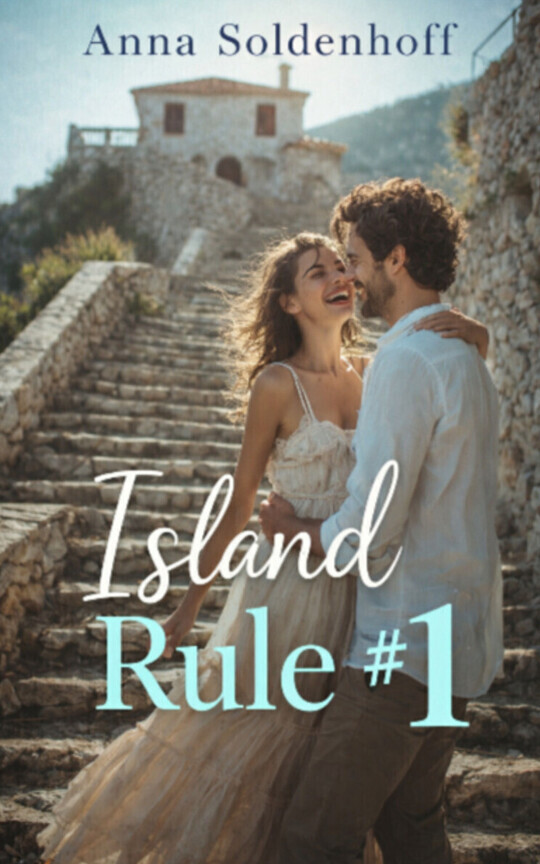
ISLAND RULE #1: DON’T DATE LOCALS.
Underneath, for emphasis, she added: This includes, but is not limited to: fishermen, bartenders, stone masons, handsome landlords, anyone who owns a boat, anyone whose grandfather owns a boat, and anyone who looks at you while fixing a shutter. YOU ARE HERE TO HEAL. NOT TO DATE. REPEAT: HEALING, NOT DATING. MEN ARE A DISTRACTION. THE ADRIATIC SEA IS YOUR THERAPIST.
She snapped the journal shut, feeling immensely better. A rule. A plan. This wasn’t impulsive chaos; this was a strategic retreat with clearly defined parameters. She was a PR professional, for god’s sake. She knew how to manage a narrative. This was just a new campaign: Rebranding Lora. Target audience: Herself. Key message: Happiness.
She wrestled the big suitcase down the narrow staircase, bumping it against each step and swearing creatively. By the time she’d loaded all three into the tiny Fiat, the DM bag wedged precariously on the passenger seat, she was sweating and her hair had escaped its ponytail in a frizzy halo. She looked, she imagined, like a woman fleeing a natural disaster. Which, she supposed, she was.
She slid into the driver’s seat, the Ajvar jar digging into her thigh. She inserted the key into the ignition, then paused. Her hand trembled slightly on the key. This was it. The point of no return. She could still go back upstairs, call Tomislav, apologize for the “misunderstanding,” beg for her job back. She could slide back into the comfortable, suffocating life she’d built.
She looked at the DM bag. At the Ajvar. At the incongruous bikini tag poking out of the turquoise suitcase in the rearview mirror.
She turned the key. The little engine coughed to life.
“Right,” she said to the empty car, to the Ajvar, to her former self standing forlornly on the Zagreb pavement. “Let’s go find some synergies with the sea.”
She pulled away from the curb, not looking back. The city unfurled around her—trams clanking, people hurrying, the grey weight of it all pressing in. She navigated through the familiar streets, past the coffee shop where she and Tomislav had their first date (he’d ordered a flat white and spent twenty minutes explaining the nuances of milk texturing), past her old office building with its glass facade reflecting the indifferent sky, past the park where she used to walk and dream about bougainvillea.
As she hit the highway heading south, the buildings thinned, the traffic eased, and the landscape began to change. The urban sprawl gave way to green hills, then to glimpses of the first mountains. The air coming through the open window lost its city grit and started to smell of pine and sun-baked earth.
She drove for hours, the radio tuned to a station playing old Croatian pop songs she half-remembered from her childhood. She sang along, badly and loudly, her voice competing with the wind. She stopped for a greasy ćevapi at a roadside rest stop, eating them standing up, the paprika-flavored grease dripping down her chin, and it was the most delicious thing she’d eaten in months. Tomislav only approved of restaurants with Michelin recommendations and napkins folded into swans.
The further south she drove, the lighter she felt. It was as if each kilometer peeled away a layer of something she hadn’t known she was wearing—a skin of expectation, of obligation, of being the person everyone else needed her to be. By the time she saw the first sign for Split, the sun was beginning its slow descent toward the horizon, painting the sky in shades of apricot and rose.
She found a cheap room near the ferry port, a boxy little space with a view of a parking lot and the distant masts of boats. It was perfect. She fell onto the bed, every muscle aching, and stared at the ceiling. Her phone, which she’d finally turned back on, buzzed with a cascade of messages. Nina, her best friend: YOU DID IT???? YOU MAD WOMAN I LOVE YOU CALL ME WHEN YOU GET THERE. Her mother, a string of worried emojis. A former colleague asking if she could “just quickly” look over a press release. Tomislav: Hope you’re okay. Let’s talk when you’re ready to be reasonable.
She deleted Tomislav’s message without reading it fully and texted Nina a photo of the parking lot view with the caption: The Ritz. Room service is slow. Nina replied instantly with a string of laughing-crying emojis and: Don’t hook up with any sexy sailors.
Lora looked at her journal on the nightstand. Don’t date locals, it commanded. She picked it up and added a postscript with the hotel pen: This includes sailors. Especially sailors. Sailors are just locals on water.
The next morning, she was on the first ferry to Korčula. She stood on the deck, the wind whipping her hair into a frenzy, watching the mainland shrink and the islands grow. The Adriatic was impossibly blue, a color that didn’t seem real, scattered with boats and dotted with tiny, rocky islets. Seagulls wheeled overhead, screaming their approval. She felt a grin spread across her face, so wide it made her cheeks ache.
After nearly three hours, the ferry rounded a peninsula and there it was. Korčula. The old town rose from the sea like a vision, its terracotta roofs and cream-colored stone walls gleaming in the midday sun. It looked exactly like the photos, only better. More solid. More real. More possible. The bell tower of the cathedral pointed at the sky, a stone finger saying, “You made it.”
As the ferry glided into the harbor, she could see people on the riva, the waterfront promenade, sitting at café tables under large umbrellas, strolling slowly, living their lives in a different tempo entirely. She saw a fisherman mending a net, an old woman in black carrying a bag of groceries, a cluster of teenage boys showing off on a moored speedboat.
And then her eyes snagged on something else. A man. He was standing on the dock, waiting for someone, his back half-turned to her. He was tall, with dark hair curling slightly at the collar, tanned arms folded across his chest. He wore a simple linen shirt and worn jeans. He wasn’t doing anything remarkable, just standing there, but there was an ease to him, a stillness, that was utterly foreign to the frantic energy of Zagreb. He was like a part of the landscape, as natural as the stone walls and the cypress trees.
The ferry bumped gently against the tires lining the dock. The gangplank went down with a clatter. Lora grabbed the handle of her big suitcase, the DM bag swinging precariously from her wrist.
Island Rule #1, she chanted in her head like a mantra. Don’t date locals. Don’t date locals. Don’t—
The man turned, and for a split second, his gaze swept across the disembarking passengers. It landed on her, just for an instant. A flicker of assessment, or maybe just curiosity, before it moved on, searching for someone else.
Lora’s stomach did a small, traitorous flip.
She tightened her grip on the suitcase and stepped onto the dock, the solid stone of Korčula beneath her feet for the first time. The sun was hot on her shoulders. The air smelled of salt, fish, and wild herbs. And somewhere in the back of her mind, a small, annoying voice whispered: Well, that’s just great. The island’s already testing the rules.
She hoisted her bag, ignored the voice, and walked straight into her new life, determined to leave her old one—and any thoughts of handsome, linen-shirted locals—firmly in her wake.